


Poor organization and lack of experience contributed to the failure of Greater Kaohsiung’s Appendectomy Project in two campaigns on election day, activists said yesterday.
Representatives of the group’s Greater Kaohsiung branch bowed in apology to supporters at a press conference. A representative from Greater Kaohsiung surnamed Hsieh (謝小姐) cried quietly throughout the proceedings.
Activists had hoped to take advantage of the nine-in-one elections to collect the signatures necessary to enter the recall campaign’s second phase, setting up tables outside voting sites. However, petitions to recall Chinese Nationalist Party (KMT) Legislators Lin Kuo-cheng (林國正) and Huang Chao-shun (黃昭順) failed to reach the threshold of 2 percent of the electorate, with just 3,355 (1.38 percent) signatures collected for Lin and 2,321 (0.8 percent) for Huang.
In contrast, the effort to recall Taipei KMT Legislator Alex Tsai (蔡正元) passed the first threshold in August, breezing past the second threshold on election day with more than 40,000 signatures.
“I was surprised by the result,” said the group’s spokesperson, who is known as “Mr Lin from Taipei” (台北林先生).
He said that people from the relatively “pan-green” Greater Kaohsiung tend to be more enthusiastic about the group’s cause than Taipei residents.
Hsieh attributed the poor results to insufficient experience and organization, with a lack of staff and funding preventing the group from setting up signature-collection booths at all voting sites.
She said volunteer turnover was a key problem, with more than two-thirds of the initial summer student volunteers leaving for other cities during the fall school semester, and most fall volunteers returning to their hometowns to vote, forcing the group to quickly patch together a new team from returning students on election day.
In addition, Greater Kaohsiung volunteers failed to foresee a number of election-day expenses and did not raise any money beforehand, she said.
In contrast, volunteers in Taipei have been raising funds since May, Mr Lin from Taipei said.
Activists promised to continue working to collect signatures until the Dec. 31 deadline, when forms will be destroyed if the threshold remains unattained.
The name Appendectomy Project is a pun on a Mandarin Chinese term for pan-blue camp legislators, lan wei (藍委), which is pronounced the same as the word for “appendix” (闌尾).

Yangmingshan National Park authorities yesterday urged visitors to respect public spaces and obey the law after a couple was caught on a camera livestream having sex at the park’s Qingtiangang (擎天崗) earlier in the day. The Shilin Police Precinct in Taipei said it has identified a suspect and his vehicle registration number, and would summon him for questioning. The case would be handled in accordance with public indecency charges, it added. The couple entered the park at about 11pm on Thursday and began fooling around by 1am yesterday, the police said, adding that the two were unaware of the park’s all-day live
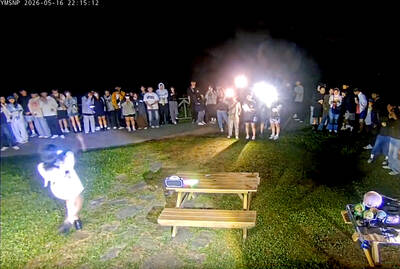
Yangmingshan National Park’s Qingtiangang (擎天崗) nature area has gone viral after a park livestream camera observed a couple in the throes of intimate congress, which was broadcast live on YouTube, drawing large late-night crowds and sparking a backlash over noise, bright lights and disruption to wildlife habitat. The area’s livestream footage appeared to show a couple engaging in sexual activity on a picnic table in the park on Friday last week, with the uncensored footage streamed publicly online. The footage quickly spread across social media, prompting a tide of visitors to travel to the site to “check in” and recreate the
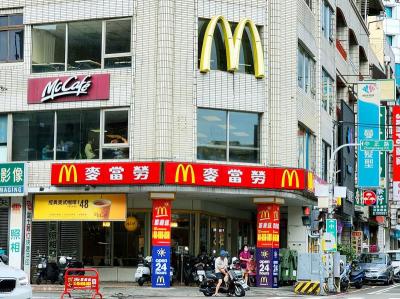
Fast food chain McDonald's is to raise prices by up to NT$5 on some products at its restaurants across Taiwan, starting on Wednesday next week, the company announced today. The prices of all extra value meals and sharing boxes are to increase by NT$5, while breakfast combos and creamy corn soup would go up by NT$3, the company said in a statement. The price of the main items of those meals, if ordered individually, would remain the same. Meanwhile, the price of a medium-sized lemon iced tea and hot cappuccino would rise by NT$3, extra dipping sauces for chicken nuggets would go up

Minister of Digital Affairs Lin Yi-ching (林宜敬) yesterday cited regulatory issues and national security concerns as an expert said that Taiwan is among the few Asian regions without Starlink. Lin made the remarks on Facebook after funP Innovation Group chief executive officer Nathan Chiu (邱繼弘) on Friday said Taiwan and four other countries in Asia — China, North Korea, Afghanistan and Syria — have no access to Starlink. Starlink has become available in 166 countries worldwide, including Ukraine, Malaysia, the Philippines and Vietnam, in the six years since it became commercial, he said. While China and North Korea block Starlink, Syria is not


 RSS
RSS