


National security authorities yesterday pledged to conduct a stringent investigation into a security breach at Chunghwa Telecom Co, the nation’s largest telecommunications company, after it was confirmed that a Chinese citizen gained access to an off-limits machine room.
News of the unauthorized visit was first reported by Chinese-language Next Magazine, which said a Chinese national posted dozens of photographs of machines and equipment from inside the Chunghwa Telecom facility to social media site WeChat.
The man was identified as Wu Xin (吳昕), a native of China’s Fujian Province, by Democratic Progressive Party Legislator Tsai Huang-liang (蔡煌瑯) at a press conference yesterday.
According to Next Magazine, Wu claimed the photographs were from a “top-secret agency” in Taiwan and he was the first Chinese visitor to see the “important” facility.
Chunghwa Telecom vice president Ho Hsu-hui confirmed the incident, which he said happened on Oct. 23, adding that it had not come to the company’s attention until Nov. 6, when the company called an emergency meeting.
An internal probe found that a senior staff member met Wu when traveling in China, and the employee invited Wu to come to Taiwan, said Ho, adding that since the staff member was still at work when Wu arrived, he invited his guest into the machine room.
According to Ho, the machine room Wu “toured” serves both commercial and residential areas, including several governmental units such as Taipei’s Traffic Adjudication Office, the Ministry of Economic Affair’s Small and Medium Enterprises Administration and the national power and water companies.
“No important national intelligence facilities are situated in those areas,” the company executive said, adding that Chunghwa Telecom, a formerly state-run enterprise in which the government still holds shares, has 900 machine rooms around Taiwan, “all under strict security control.”
Calling it an isolated incident, Ho said the company found no signs of intelligence leaks or sabotaged equipment, and the staff member responsible has been transferred and given a major demerit.
National Security Bureau division director Chao Chia-feng (趙家鋒) said measures have been taken to determine whether the purpose of Wu’s visit matched that stated on his application to come to Taiwan, adding that if he is found to have collected intelligence, he will face punishment under the Criminal Code and the Classified National Security Information Protection Act (國家機密保護法).

Actor Darren Wang (王大陸) was sentenced to six months in prison, commutable to a fine, by the New Taipei District Court today for contravening the Personal Data Protection Act (個人資料保護法) in a case linked to an alleged draft-dodging scheme. Wang allegedly paid NT$3.6 million (US$114,380) to an illegal group to help him evade mandatory military service through falsified medical documents, prosecutors said. He transferred the funds to Chen Chih-ming (陳志明), the alleged mastermind of a draft-evasion ring, although he lost contact with him as he was already in detention on fraud charges, they said. Chen is accused of helping a

SECURITY: Starlink owner Elon Musk has taken pro-Beijing positions, and allowing pro-China companies to control Taiwan’s critical infrastructure is risky, a legislator said Starlink was reluctant to offer services in Taiwan because of the nation’s extremely high penetration rates in 4G and 5G services, the Ministry of Digital Affairs said yesterday. The ministry made the comments at a meeting of the legislature’s Transportation Committee, which reviewed amendments to Article 36 of the Telecommunications Management Act (電信管理法). Article 36 bans foreigners from holding more than 49 percent of shares in public telecommunications networks, while shares foreigners directly and indirectly hold are also capped at 60 percent of the total, unless specified otherwise by law. The amendments, sponsored by Chinese Nationalist Party (KMT) Legislator Ko

‘SAME OLD TRICK’: Even if Beijing resumes individual travel to Taiwan, it would only benefit Chinese tourism companies, the Economic Democracy Union convener said China’s 10 new “incentives” are “sugar-coated poison,” an official said yesterday, adding that Taiwanese businesses see them clearly for what they are, but that Beijing would inevitably find some local collaborators to try to drums up support. The official, speaking on condition of anonymity, made the remark ahead of a news conference the General Chamber of Commerce is to hold today. The event, titled “Industry Perspectives on China’s Recent Pro-Taiwan Policies,” is expected to include representatives from industry associations — such as those in travel, hotels, food and agriculture — to request the government cooperate with China’s new measures, people familiar with
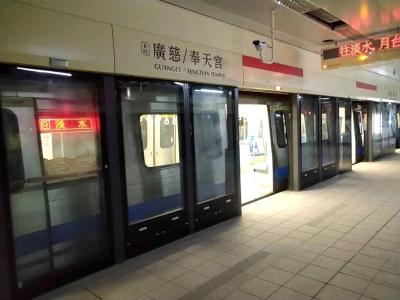
The eastern extension of the Taipei MRT Red Line could begin operations as early as late June, the Taipei Department of Rapid Transit Systems said yesterday. Taipei Rapid Transit Corp said it is considering offering one month of free rides on the new section to mark its opening. Construction progress on the 1.4km extension, which is to run from the current terminal Xiangshan Station to a new eastern terminal, Guangci/Fengtian Temple Station, was 90.6 percent complete by the end of last month, the department said in a report to the Taipei City Council's Transportation Committee. While construction began in October 2016 with an


 RSS
RSS