


Taiwan is moving ahead with plans to build its own submarines, with an initial design to be completed by the year-end, after lengthy delays in getting eight vessels under a 2001 US defense deal and as China’s navy expands rapidly.
While major obstacles remain, such as overcoming significant technical challenges and what would almost certainly be strenuous objections from Beijing, a political consensus has emerged in Taiwan in recent months that it can wait no longer, officials and legislators said.
Taiwan has four aging submarines, including two that date back to World War II, although its military is otherwise considered generally modern.
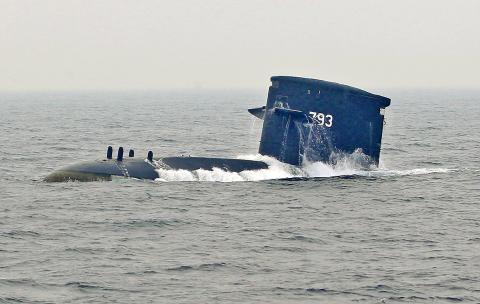
Photo: Pichi Chuang, Reuters
However China, has 70 submarines, along with dozens of surface ships and a refurbished aircraft carrier, although that vessel is not yet fully operational.
A recent government defense report said China would be capable of a successful invasion by 2020.
“Our determination to build indigenous submarines is very firm. The navy is very actively pushing this matter,” Ministry of National Defense (MND) spokesman Major General David Lo (羅紹和) said. “The Republic of China will not engage in an arms race with China. We hope to acquire submarines to strengthen our self-defense.”
Captain Lin Chau-luen, head of the ministry’s naval force build-up and planning section, said during a recent conference in Taipei that plans encompassing the capacity and tonnage of a diesel-electric submarine would be finished by the end of the year.
The design of weapons systems would come later, with construction possibly starting in two years, he said, without saying how many vessels Taiwan wanted to build.
When reached for comments, Lin declined to give further details, saying he was only permitted to speak with reporters at public engagements.
The Presidential Office and the Ministry of Foreign Affairs referred questions to the defense ministry.
Lo said it was too soon to make public comments on how far plans for homegrown submarines had advanced, but added that Taiwan would need assistance from the US or other parties with experience building submarines.
Taiwan was not currently in any formal talks with foreign defense contractors, officials said.
Experts said European governments would likely prevent their defense companies from getting involved to avoid China’s wrath.
“China is resolutely opposed to any form of military technological exchanges or cooperation or weapons sales from foreign countries to the Taiwan region,” the Chinese Ministry of Foreign Affairs said in a statement sent to reporters.
A Taiwanese defense ministry official who spoke on condition of anonymity said domestic industry could build basic surface ships, but did not have experience with underwater vessels.
Shipbuilder CSBC Corp Taiwan (CSBC) — the sole company in Taiwan able to construct submarines — has indicated it could build a pressurized hull, the official said, but added that developing a submarine was very complex.
A CSBC executive said the company had not received any orders and referred further questions to the government.
Taiwan began considering building its own submarines in the early 2000s, when a deal with Washington to acquire eight diesel-electric submarines in 2001 got bogged down amid technical and political constraints.
Since the US operates nuclear-powered submarines, Taiwan would have needed to buy vessels from foreign defense contractors or obtained enough technical details from Washington or other parties to refurbish older submarines acquired on the open market.
However, European countries, for example, balked in helping at the time for fear of damaging ties with China.
The US was also reportedly concerned about the security of any technology transfers. Another roadblock early on was in Taiwan, where political infighting over budget allocations held up funding.
“The US has received Taiwan’s requests for diesel submarines. These requests remain under interagency review,” said US Marine Corps Lieutenant Colonel Jeffrey Pool, a Pentagon spokesman, referring to the 2001 deal.
A US Department of State official, without mentioning the submarine agreement, said Washington would continue to help Taiwan maintain sufficient self-defense capabilities.
“We carefully evaluate Taiwan’s defensive needs on an ongoing basis and will consult with Congress as required before announcing any additional major arms sales to Taiwan,” the official said, speaking on condition of anonymity.
Taipei’s plans come as other regional navies expand their own submarine fleets in part to create a strategic deterrent against China’s growing naval assertiveness in regional waters.
Naval analysts say the stealth of a well-run submarine makes it a classic asymmetric weapon, complicating the strategic calculations of a potential foe with a larger navy.
Japan is gradually expanding its fleet of advanced diesel-electric submarines, while Vietnam recently put its first two full-sized submarines to sea, with four more diesel-electric vessels to be delivered within the next two years as part of a US$2.6 billion deal with Russia.
For Taiwan, the balance of power favors China, when many Taiwanese remain wary of autocratic China’s designs on the island.
China’s recent restrictions on how Hong Kong is to elect its next leader in 2017 have also stirred concern in Taiwan if it were to ever come under Beijing’s control.
“[China] is militarily stronger and stronger, while our submarines are older and older,” Chinese Nationalist Party (KMT) Legislator Lin Yu-fang (林郁方) said during a meeting of the Legislative Yuan’s Foreign Affairs and National Defense Committee. “We have to have something to build up the confidence in democracy in Taiwan.”
The Democratic Progressive Party has also advocated an indigenous submarine program.
A report by the Project 2049 Institute, a US-based think tank specializing in Asian security issues, said a viable fleet of at least eight submarines operating as one component of a broader operational system could deny China’s military uncontested control of the waters surrounding Taiwan.

NATIONAL SECURITY: Authorities are working to confirm the identities of the military personnel involved and investigating possible illegal conduct and regulatory violations Authorities are probing possible national security implications after Kinmen police and immigration officers on Sunday found a Chinese woman allegedly posing as a tourist while engaging in prostitution involving more than 10 military personnel. The woman, surnamed Chen (陳), has since been deported, authorities said, adding that investigators are still working to confirm the identities of those implicated, as the records only listed code names and aliases. The case stemmed from a report received by the Kinmen District Prosecutors’ Office on Friday last week from the Jinhu Precinct of the Kinmen County Police Bureau. On Sunday, police, along with the National Immigration

GLOBALGIVING: ‘ Caving to external pressure is not acceptable for an organization that has cultivated justice reform and human rights for 30 years,’ one NGO said A slew of non-government organizations (NGOs) have withdrawn from the GlobalGiving fundraising platform after it announced it would use “Chinese Taipei” instead of “Taiwan” from next month. The Taiwan Good Rice Association wrote on Facebook on Friday that it was informed on April 28 via a teleconference call of the change, which was made because the platform wanted to operate in China. Taiwan Good Rice is to terminate all cooperative relationships with GlobalGiving in response to the platform’s “unilateral and non-negotiable” decision to remove references to Taiwan, the NGO said. “Taiwan is in the official name of Taiwan Good Rice Association and the

HEAVY WEATHER: Typhoon Jangmi is due to crash straight into the Ryukyus as airlines look to shift flights to larger aircraft or cancel flights to Okinawa entirely Taiwan’s international air carriers announced flight adjustments over the weekend as Typhoon Jangmi is forecast to hit the Ryukyu Islands today and tomorrow. The Central Weather Administration (CWA) upgraded Jangmi from a tropical storm to a typhoon at 8am yesterday, with the eye located 580km south of Naha city. It was moving north at 19kph. Today, China Airlines’ CI-120, CI-121, CI-122 and CI-123 flights between Taoyuan and Naha, Okinawa, have been canceled as well as CI-132 and CI-133 between Kaohsiung and Naha. EVA Air’s BR-112, BR-113, BR-186 and BR-185 flights between Taoyuan and Naha are also canceled. Low-cost carrier Tigerair Taiwan canceled IT-230,
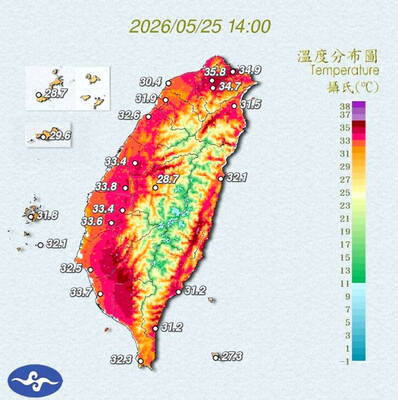
STAY COOL: The HPA recommended that people stay hydrated, use air-conditioning or fans while indoors, wear loose-fitting clothes and walk in the shade while outdoors Employers must implement measures such as installing cooling equipment, and providing drinking water and rest breaks for outdoor workers starting from Monday next week, the Taipei Department of Labor said on Sunday. Employers who fail to comply could face fines of NT$30,000 to NT$300,000 under the Occupational Safety and Health Act (職業安全衛生法), the department said. Businesses in Taipei employing fewer than 100 workers, as well as registered self-employed workers with labor insurance coverage, could receive on-site assessments and guidance from occupational safety consultants to help them apply for central government subsidies to implement or improve heat-protection measures, it said. Under the Ministry of


 RSS
RSS