


The US Department of State on Tuesday joined a controversy surrounding remarks made by former American Institute in Taiwan (AIT) chairman Richard Bush about Taiwan’s presidential elections.
“Mr Bush does not speak for the US government and his comments were made in a personal capacity,” a Department of State spokesperson said.
Bush, director of the Center for East Asian Policy Studies at the Brookings Institution, last week told a Washington conference that the US government “at some time and in some way will express itself on the implications of the 2016 election for US interests.”
“This is something we do. We feel there is a need for us to express our views on how our interests will be affected by Taiwan’s elections,” he said.
Bush’s remarks were widely interpreted as meaning that Washington would try to interfere in the next presidential election and put its thumb on the scales in favor of the party whose policies it favors most.
However, the Department of State said on Tuesday: “We strongly support Taiwan’s democratic system and the will of the people of Taiwan to make their own choice in their upcoming elections.”
“We support free, fair and open elections. The United States has a longstanding interest in peace and stability across the Taiwan Strait and urges both sides to avoid any provocative actions,” it said, adding: “We support continued improvement in cross-strait relations that will allow for increased contacts and a further reduction in tensions.”
Earlier the Taipei office of the AIT distanced itself from Bush’s remarks.
Bush was not the first former AIT official to suggest the US might try to play a role in Taiwan’s elections.
Before the previous presidential election, Carnegie Endowment vice president for studies Douglas Paal, a former director of the AIT, wrote that China had privately expressed hope for intervention by the administration of US President Barack Obama to “tilt the political playing field” in favor of President Ma Ying-jeou’s (馬英九) government and against the Democratic Progressive Party (DPP).
Paal said that China had counted on former US president George W. Bush’s administration to rein in former president Chen Shui-bian (陳水扁).
“But after Ma was elected, Beijing increasingly indicated it wanted the United States to back off. Once again the tide has turned and Beijing is looking to Washington for help to manage what it ordinarily insists are its internal affairs with Taiwan,” Paal said.
“This in turn will create a dilemma for Washington: How to appear impartial in Taiwan’s domestic elections and yet convey its preference for a continuation of Ma Ying-jeou’s management of cross-strait relations. Look for the Obama administration officials to state that they are impartial about the voting and will welcome whatever is the result of the democratic elections in Taiwan,” he said.
“But they are likely also to state that the United States hopes for a continuation of the reduction in tensions and would not welcome provocations from either side of the [Taiwan] Strait,” Paal said.
Addressing the convention last week, Richard Bush said that in September 2011, the Obama administration had “conveyed its views through the Financial Times.”
The American Enterprise Institute (AEI) said of this incident that the Obama administration had “apparently gotten into the business of interfering in other countries’ democratic elections.”
After DPP Chairperson Tsai Ing-wen (蔡英文) visited Washington in September 2011, the Financial Times reported that a senior US official told the newspaper that Tsai “had sparked concerns about stability in the Taiwan Strait, which is critically important to the US.”
“She left us with distinct doubts about whether she is both willing and able to continue the stability in cross-strait relations the region has enjoyed in recent years,” the senior official was reported as saying.
The institute said it was a “blatant effort” to undermine Tsai’s candidacy and influence the Taiwanese elections.
Following that incident, the Department of State said: “The official mentioned in the [Financial Times] article is totally unknown to us and certainly does not speak for the Obama administration. The administration does not take sides in Taiwan’s (or any country’s) election.”
Also, former US assistant secretary of state for East Asia Kurt Campbell told the US Congress: “We do not believe any one party or leader on Taiwan has a monopoly on effective management of the relationship, and we do not take sides in the elections.”
“We will work closely with whatever leadership emerges from Taiwan’s free and fair elections to build on our enduring commitment to Taiwan’s people, its prosperity and peace,” he said.
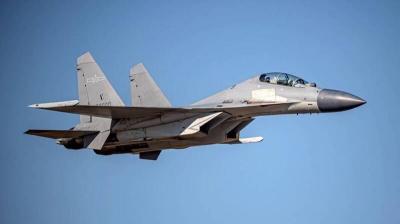
Eight Chinese naval vessels and 24 military aircraft were detected crossing the median line of the Taiwan Strait between 6am yesterday and 6am today, the Ministry of National Defense said this morning. The aircraft entered Taiwan’s northern, central, southwestern and eastern air defense identification zones, the ministry said. The armed forces responded with mission aircraft, naval vessels and shore-based missile systems to closely monitor the situation, it added. Eight naval vessels, one official ship and 36 aircraft sorties were spotted in total, the ministry said.
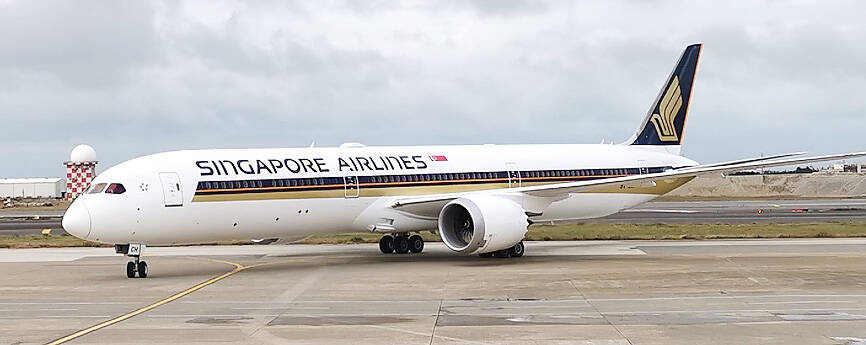
INCREASED CAPACITY: The flights on Mondays, Wednesdays, Fridays and Sundays would leave Singapore in the morning and Taipei in the afternoon Singapore Airlines is adding four supplementary flights to Taipei per week until May to meet increased tourist and business travel demand, the carrier said on Friday. The addition would raise the number of weekly flights it operates to Taipei to 18, Singapore Airlines Taiwan general manager Timothy Ouyang (歐陽漢源) said. The airline has recorded a steady rise in tourist and business travel to and from Taipei, and aims to provide more flexible travel arrangements for passengers, said Ouyang, who assumed the post in July last year. From now until Saturday next week, four additional flights would depart from Singapore on Monday, Wednesday, Friday
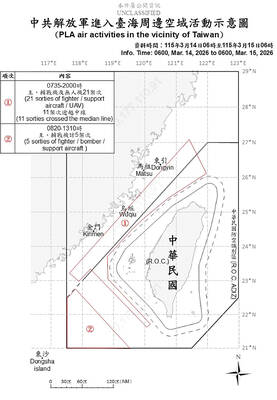
The Ministry of National Defense yesterday reported the return of large-scale Chinese air force activities after their unexplained absence for more than two weeks, which had prompted speculation regarding Beijing’s motives. China usually sends fighter jets, drones and other military aircraft around the nation on a daily basis. Interruptions to such routine are generally caused by bad weather. The Ministry of National Defense said it had detected 26 Chinese military aircraft in the Taiwan Strait over the previous 24 hours. It last reported that many aircraft on Feb. 25, when it spotted 30 aircraft, saying Beijing was carrying out another “joint combat
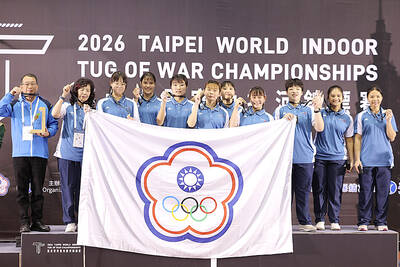
Taiwan successfully defended its women’s 540 kilogram title and won its first-ever men’s 640 kg title at the 2026 World Indoor Tug of War Championships in Taipei yesterday. In the women’s event, Taiwan’s eight-person squad reached the final following a round-robin preliminary round and semifinals featuring teams from Ukraine, Japan, Thailand, Vietnam, the Basque Country and South Korea. In the finals, they swept the Basque team 2-0, giving the team composed mainly of National Taiwan Normal University students and graduates its second championship in a row, and its fourth in five years. Team captain


 RSS
RSS