


The Global Education Association in Taiwan recently conducted a survey that found that over the past eight years, universities across the nation have closed eight English departments and changed the focus of nine others, showing a declining interest among students in English.
Among the nation’s 161 universities and junior colleges, 126 had English departments, with 50,000 students last year.
The total number of students graduating from English departments nationwide exceeded 10,000 in 2012, the poll said.
The association sent the survey to the 126 schools, for which it received 74 valid responses, and it found that 31.5 percent of respondents said they face problems finding sufficient students.
National Taiwan University (NTU) English department head Tseng Li-ling (曾麗玲) said that the department, which has long been the nation’s leading university English department, has also seen a rapid decrease in students in recent years.
Although the department does not face any problems finding students, it has seen a substantial decrease in applicants — from an average of 200 to less than 100 three years ago — for its graduate institute classes, due to students’ worries about finding a job with their major after graduation, Tseng said.
Tseng also said the institute had been forced to adjust curricula, lessen the amount of time to graduate from three-and-a-half years to two-and-a-half years, and decrease the requirements for graduate papers from 80 pages to 60 pages.
Although the university is establishing an Institute for Translation, competition from other departments has decreased enrollment in departments of foreign languages, Tseng said.
Tseng said that between 60 and 70 percent of foreign-language students minor in sociology or psychology, or pursue double majors in law and foreign languages, adding that many college students from the department of foreign languages went on to study law after graduating.
Many others branch out into baking, art or writing scripts and novels, Tseng said.
Tseng also said that since 2007, universities have closed eight departments of applied English, adding that more than nine other departments in schools, including Nan Jeon University of Science and Technology, have chosen to change the names of the departments and give them different focuses.
According to the association’s poll, 80 percent of all English departments continue to teach in English, but 40 percent of students lack opportunities for internships before graduating.
Many respondents to the poll said that English departments should stop trying to foster future English teachers and secretaries for companies and instead teach students how to apply the skills they learn in their departments in the international environment.
However, Vice Minister of Education Chen Der-hua (陳德華) said that applications to graduate institutes were at an all-time low for all subjects and it was not a problem facing only English departments.
Chen said graduate institutes need to introduce more professional courses with practical applications to give their students a competitive edge in the job market, adding that if departments of foreign languages trained students to become professional translators, it would help retain students.

A magnitude 6.1 earthquake struck off the coast of Yilan County at 8:39pm tonight, the Central Weather Administration (CWA) said, with no immediate reports of damage or injuries. The epicenter was 38.7km east-northeast of Yilan County Hall at a focal depth of 98.3km, the CWA’s Seismological Center said. The quake’s maximum intensity, which gauges the actual physical effect of a seismic event, was a level 4 on Taiwan’s 7-tier intensity scale, the center said. That intensity level was recorded in Yilan County’s Nanao Township (南澳), Hsinchu County’s Guansi Township (關西), Nantou County’s Hehuanshan (合歡山) and Hualien County’s Yanliao (鹽寮). An intensity of 3 was
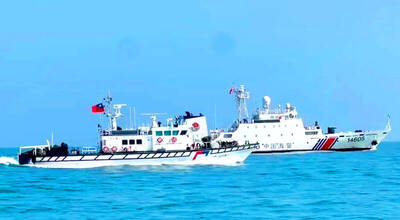
Instead of focusing solely on the threat of a full-scale military invasion, the US and its allies must prepare for a potential Chinese “quarantine” of Taiwan enforced through customs inspections, Stanford University Hoover fellow Eyck Freymann said in a Foreign Affairs article published on Wednesday. China could use various “gray zone” tactics in “reconfiguring the regional and ultimately the global economic order without a war,” said Freymann, who is also a nonresident research fellow at the US Naval War College. China might seize control of Taiwan’s links to the outside world by requiring all flights and ships entering or leaving Taiwan
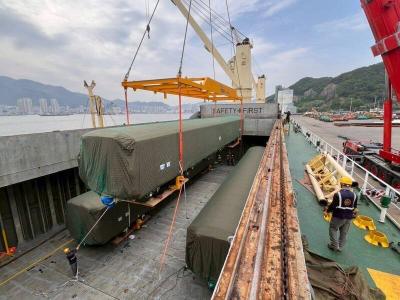
The first of 10 new high-capacity trains purchased from South Korea’s Hyundai Rotem arrived at the Port of Taipei yesterday to meet the demands of an expanding metro network, Taipei Rapid Transit Corp (TRTC) said yesterday. The train completed a three-day, 1,200km voyage from the Port of Masan in South Korea, the company said. Costing NT$590 million (US$18.79 million) each, the new six-carriage trains feature a redesigned interior based on "human-centric" transportation concepts, TRTC said. The design utilizes continuous longitudinal seating to widen the aisles and optimize passenger flow, while also upgrading passenger information displays and driving control systems for a more comfortable
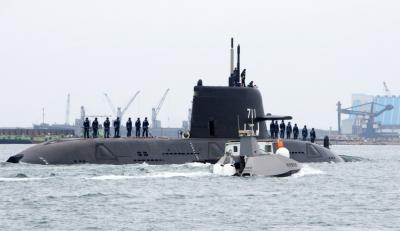
Taiwan's first indigenous defense submarine, the SS-711 Hai Kun (海鯤, or Narwhal), departed for its 13th sea trial at 7am today, marking its seventh submerged test, with delivery to the navy scheduled for July. The outing also marked its first sea deployment since President William Lai (賴清德) boarded the submarine for an inspection on March 19, drawing a crowd of military enthusiasts who gathered to show support. The submarine this morning departed port accompanied by CSBC Corp’s Endeavor Manta (奮進魔鬼魚號) uncrewed surface vessel and a navy M109 assault boat. Amid public interest in key milestones such as torpedo-launching operations and overnight submerged trials,


 RSS
RSS