


Social activists have in recent weeks been repeatedly harassed by false reports made by anonymous users to Facebook administrators, accusing them of posting inappropriate images that contain nudity. The identities of the complainers and their motives remain unclear, with some Facebook users commenting that they might be the work of supporters or even employees of the Chinese Nationalist Party (KMT).
“I’ve lost count of how many times I’ve received such a notice,” Lai Pin-yu (賴品妤), a member of the Black Island Youth Front who took part in the Sunflower movement, said on Facebook, after receiving yet another notice from the social media’s Web site administrator that someone reported that her profile picture was inappropriate, saying it involved “nudity.”
The photograph in question shows Lai in a business suit holding a cellphone. It does not contain any nudity — neither did her other pictures that were reported as being inappropriate.
“Seriously, I don’t block people from leaving messages on my Facebook wall. I only delete some harassing messages. If you don’t agree with me, I challenge you to a debate here — unless you are one of those harassers whose messages that I deleted,” Lai said.
Dozens of other people who have been involved in anti-government demonstrations recently — especially the Sunflower protests which occupied the legislature in March — have experienced the same harassment.
The profile picture of attorney Tseng Wei-kai (曾威凱), who has provided pro bono legal assistance to protesters arrested by the police, a picture of Sunflower movement leader Lin Fei-fan (林飛帆) with a jellyfish taken in an aquarium, and a picture of a human hand holding a candle to commemorate the victims of Typhoon Morakot in August 2009 posted by Huang Yen-ju (黃燕茹), who took part in several anti-government demonstrations in recent years, were also reported to contain nudity.
Savungaz Valicinan, an Aboriginal rights advocate of the Bunun tribe who also took part in the legislative occupation, said her profile photo was not only reported to contain nudity by an anonymous Facebook user, but she was also accused of using a “fake name.”
Savungaz said it was her Bunun name, but her Facebook account was temporarily suspended.
Savungaz then used the Mandarin phonetic translation of her Bunun name, but she was again reported to be using a fake name and her Facebook account was again suspended.
She was forced to use her Chinese name, Lee Pin-han (李品涵).
“Both Savungaz Valicinan and Lee Pin-han are my legal names,” she said, showing a picture of her national identity card that displays both names. “I think I was picked at for some reason.”
“It must be someone from the KMT who did it,” Facebook user Lin Ming-yao (林明嶢) said in a comment about the harassments.
Many other Facebook users agreed with Lin, saying that KMT supporters or even employees probably reported the pictures and the use of Aboriginal name as inappropriate.
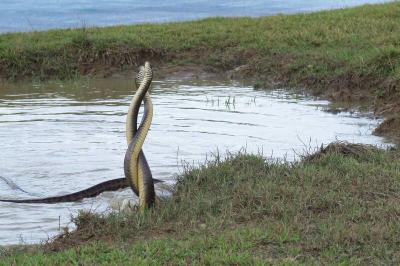
Kenting National Park service technician Yang Jien-fon (楊政峰) won a silver award in World Grand Prix Photography Awards Spring Season for his photograph of two male rat snakes intertwined in combat. Yang’s colleagues at Kenting National Park said he is a master of nature photography who has been held back by his job in civil service. The awards accept entries in all four seasons across six categories: architectural and urban photography, black-and-white and fine art photography, commercial and fashion photography, documentary and people photography, nature and experimental photography, and mobile photography. Awards are ranked according to scores and divided into platinum, gold and
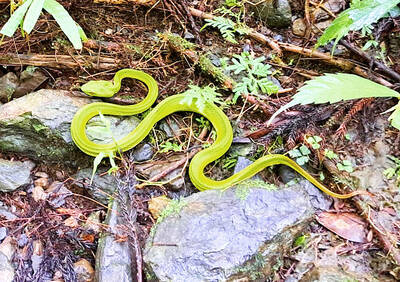
More than half of the bamboo vipers captured in Tainan in the past few years were found in the city’s Sinhua District (新化), while other districts had smaller catches or none at all. Every year, Tainan captures about 6,000 snakes which have made their way into people’s homes. Of the six major venomous snakes in Taiwan, the cobra, the many-banded krait, the brown-spotted pit viper and the bamboo viper are the most frequently captured. The high concentration of bamboo vipers captured in Sinhua District is puzzling. Tainan Agriculture Bureau Forestry and Nature Conservation Division head Chu Chien-ming (朱健明) earlier this week said that the

The Chinese Nationalist Party (KMT) caucus yesterday said it opposes the introduction of migrant workers from India until a mechanism is in place to prevent workers from absconding. Minister of Labor Hung Sun-han (洪申翰) on Thursday told the Legislative Yuan that the first group of migrant workers from India could be introduced as early as this year, as part of a government program. The caucus’ opposition to the policy is based on the assessment that “the risk is too high,” KMT caucus secretary-general Lin Pei-hsiang (林沛祥) said. Taiwan has a serious and long-standing problem of migrant workers absconding from their contracts, indicating that

SPACE VETERAN: Kjell N. Lindgren, who helps lead NASA’s human spaceflight missions, has been on two expeditions on the ISS and has spent 311 days in space Taiwan-born US astronaut Kjell N. Lindgren is to visit Taiwan to promote technological partnerships through one of the programs organized by the US for its 250th national anniversary. Lindgren would be in Taiwan from Tuesday to Saturday next week as part of the US Bureau of Educational and Cultural Affairs’ US Speaker Program, organized to celebrate the 250th anniversary of the signing of the Declaration of Independence, the American Institute in Taiwan (AIT) said in a statement yesterday. Lindgren plans to engage with key leaders across the nation “to advance cutting-edge technological partnerships and inspire the next generation of scientists and engineers,”


 RSS
RSS