


A follower of a Chinese religious leader who has reportedly been persecuted for more than a decade and recently incriminated by the Chinese government for undertaking “illegal acts of goodwill” has come to Taiwan seeking assistance and to raise awareness.
The repression of religious practitioners in China seems to be worsening since Chinese President Xi Jinping (習近平) took office, according to Democratic Progressive Party (DPP) Legislator Tien Chiu-chin (田秋堇), who held a press conference yesterday with a member of the Hua Zang Dharma Buddhist religious group who was detained and interrogated, but managed to escape Chinese officials.
The religious traditions of Muslims in Xinjiang have been restricted, Christian crosses and churches in Zhejiang Province were demolished and last month, Chinese Buddhist master Shi Guoshi (釋果實) came to Taiwan accusing Beijing of repressing religious freedom and protesting against her master’s detention on a charge of “inciting the subversion of state power.”
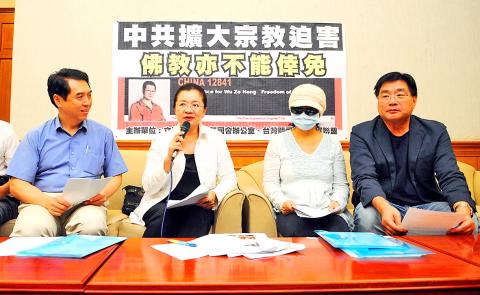
Photo: Wang Min-wei, Taipei Times
Hua Zang Dharma founder Wu Zeheng (吳澤恆) has proposed “institutional reform” to the Beijing government as early as 1998, said the member, surnamed Lin (林).
Wu again in 1999 advocated “universal philosophy” when the country “was facing a crisis of faith,” a move that resulted in his arrest and an 11-year prison term.
The religious leader was under surveillance after he got out of prison in 2010, but continued to call on his followers to perform good deeds everyday. His calls had been repressed and alleged to be “illegal acts of goodwill,” Lin said.
Taiwan Association for China Human Rights chairman Yang Hsien-hung (楊憲宏) said that it was very “creative” for the Chinese government to come up with this charge in a remark seen as sarcastic.
Wu was arrested at the end of last month, along with 80 followers who were questioned, Lin said.
“Two weeks after the arrest, the state-controlled media, including overseas outlets, started labeling the group as ‘an evil cult’ that swindles money and lures women,” Lin said.
Chinese Nationalist Party (KMT) Legislator Apollo Chen (陳學聖) was also present at the press conference to show his support.
“I’m also a Buddhist, but I’m not here only because of that,” he said. “Human rights is universal and the key issue for future possible advancement in cross-strait relations.”
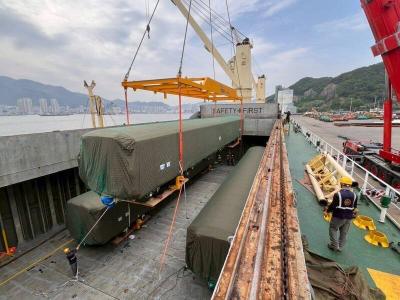
The first of 10 new high-capacity trains purchased from South Korea’s Hyundai Rotem arrived at the Port of Taipei yesterday to meet the demands of an expanding metro network, Taipei Rapid Transit Corp (TRTC) said yesterday. The train completed a three-day, 1,200km voyage from the Port of Masan in South Korea, the company said. Costing NT$590 million (US$18.79 million) each, the new six-carriage trains feature a redesigned interior based on "human-centric" transportation concepts, TRTC said. The design utilizes continuous longitudinal seating to widen the aisles and optimize passenger flow, while also upgrading passenger information displays and driving control systems for a more comfortable
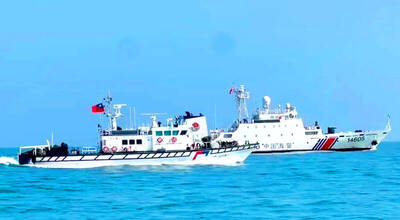
Instead of focusing solely on the threat of a full-scale military invasion, the US and its allies must prepare for a potential Chinese “quarantine” of Taiwan enforced through customs inspections, Stanford University Hoover fellow Eyck Freymann said in a Foreign Affairs article published on Wednesday. China could use various “gray zone” tactics in “reconfiguring the regional and ultimately the global economic order without a war,” said Freymann, who is also a nonresident research fellow at the US Naval War College. China might seize control of Taiwan’s links to the outside world by requiring all flights and ships entering or leaving Taiwan
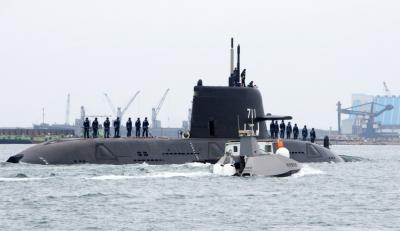
Taiwan's first indigenous defense submarine, the SS-711 Hai Kun (海鯤, or Narwhal), departed for its 13th sea trial at 7am today, marking its seventh submerged test, with delivery to the navy scheduled for July. The outing also marked its first sea deployment since President William Lai (賴清德) boarded the submarine for an inspection on March 19, drawing a crowd of military enthusiasts who gathered to show support. The submarine this morning departed port accompanied by CSBC Corp’s Endeavor Manta (奮進魔鬼魚號) uncrewed surface vessel and a navy M109 assault boat. Amid public interest in key milestones such as torpedo-launching operations and overnight submerged trials,
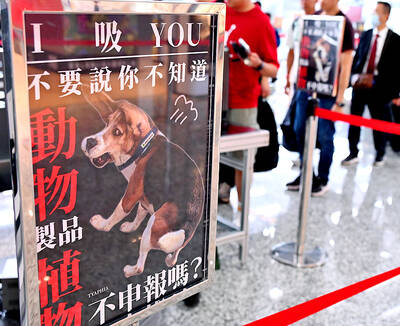
Quarantine awareness posters at Taiwan Taoyuan International Airport have gone viral for their use of wordplay. Issued by the airport branch of the Animal and Plant Health Inspection Agency, the posters feature sniffer dogs making a range of facial expressions, paired with advisory messages built around homophones. “We update the messages for holidays and campaign needs, periodically refreshing materials to attract people’s attention,” quarantine officials said. “The aim is to use the dogs’ appeal to draw focus to quarantine regulations.” A Japanese traveler visiting Taiwan has posted a photo on X of a poster showing a quarantine dog with a


 RSS
RSS