


Chinese are skirting rules aimed at limiting their purchases of property in Taiwan, stirring anger among local home buyers and fuelling worries over Beijing’s creeping influence over the nation.
While Chinese money has boosted property markets across the world — from Sydney and London to Vancouver — Chinese capital flows into Taiwan are an especially emotive issue for many Taiwanese. Taiwan’s government has been criticized by some for not being more restrictive on Chinese ownership of Taiwanese real estate.
Fueling fears of further encroachment by Beijing is a review of a cross-strait trade deal next month. In March and April, hundreds of students occupied the Legislative Yuan for more than three weeks to protest against the service trade pact.
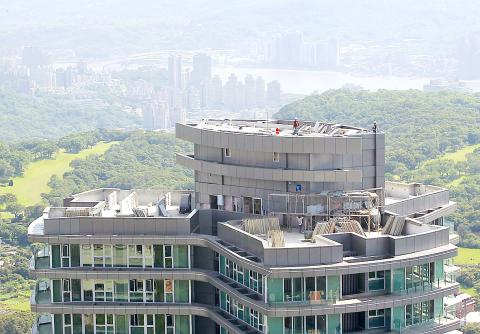
Photo: Reuters
Shih Ming-shih, a senior Ministry of the Interior official, said that the government had imposed measures to limit Chinese from buying too many homes as such a move “would jeopardize our national security or economic development.”
“If people do not apply legally, there is no way we can stop that, but they have to bear the risk of losing the properties they bought,” Shih said in a warning to would-be violators.
Some Taiwanese feel priced out of the property market at a time when President Ma Ying-jeou’s (馬英九) government is trying to convince them of the advantages of closer economic integration with China through the service trade pact.
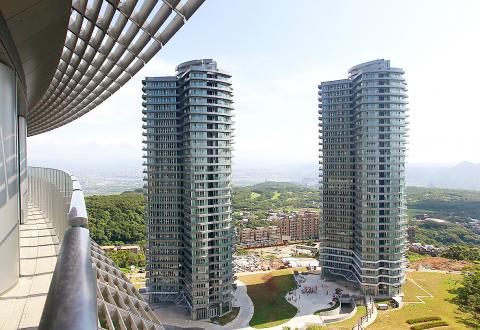
Photo: Reuters
“If mainlanders are in the market, we don’t even have a chance. What if, in the end, those who live in Taiwan aren’t Taiwanese but Chinese?” said Melissa Hu, a 40-year-old public servant in Taipei.
Some property agents said loopholes that allow Chinese buyers to get around restrictions make it difficult for Taiwan to take meaningful action.
“It’s impossible for the Taiwan government to fix it. The best it can do is to set up a limit on how many houses Chinese can buy each year,” said Stanley Su, research and development manager at Sinyi Realty Co in Taipei. “That way, it can at least avoid a situation where massive inflows of Chinese investment go to Taiwan’s property market.”
Money from China has helped drive home prices in Taipei up almost 200 percent in the past decade, according to property agents.
Taiwan imposes strict rules on Chinese home buyers, including restrictions on quick re-sales and background checks to exclude people with links to the Chinese Communist Party and People’s Liberation Army.
However, many Chinese investors have found ways around those barriers, usually by buying homes through Taiwanese business partners or using overseas investment schemes to mask their activity, agents and industry watchers said.
While the number of individual Chinese buyers is small — Taiwan allows only 400 apartments to be sold to Chinese each year — it is clear that more Chinese capital is flowing in.
Government figures show Chinese have bought 160 properties valued at NT$2.3 billion (US$76.6 million) since Taiwan allowed Chinese capital to invest in real estate in 2002. However, many industry watchers and agents say that those numbers are under-reported.
In just one transaction two years ago, a Taipei-based real-estate attorney said he helped a Chinese state-owned steel company buy land worth NT$580 million under the name of a Taiwanese shareholder.
The deal, concluded in Hong Kong, was recorded as a domestic transaction and surpassed the NT$530 million in Chinese property investment reported by the government from 2002 to 2011.
“Transactions under the table would be at least 10 times more than what we see on the table,” said the attorney, who declined to be identified due to the sensitivity of the matter.
“Most mainland investments detour through somewhere else in order to enter Taiwan, which is quite mysterious and makes it hard to trace where those overseas companies are really from,” said Erin Ting, senior research manager at property consultancy Savills.
Some places where Chinese investors set up overseas subsidiaries before entering Taiwan include Hong Kong, Singapore and the British Virgin Islands (BVI), some agents said.
“The government only looks at the very last door of the money flows,” Ting said. “It’s likely that many are from mainland China, but it’s all under the table so no one would say it out loud.”
Wu Zhongxian, commercial property assistant manager at property agency H&B Business Group, said Chinese investors were eyeing hotels and retail shops in popular tourist areas as Taiwan allowed more individual Chinese tourists to visit.
“It takes them 1.5 to two years if they follow government rules,” Wu said. “So they buy via BVI firms or through a particular person in the company.”
Beijing-based developer Vantone Real Estate, the first Chinese developer to enter Taiwan’s market in 2011 by setting up an associate company in Singapore, said 40 percent of its 294 high-end apartments in Taipei had been sold to Chinese buyers by last month.
“Many Chinese clients are longing for Taiwan,” said Kidd Lin, sales manager at Vantone International Development Ltd. “Taiwan offers a lifestyle that the Chinese middle class are most looking forward to.”
Many Chinese are attracted to Taiwan thanks to a similar language and culture.
Vantone’s large, high-end apartments just 30 minutes from the center of Taipei sell for between NT$30 million and NT$100 million.
Other Chinese developers, including Fujian-based Yuzhou Properties, are planning to follow Vantone into the Taiwanese market.
However, Vantone’s Taipei project — the first large-scale home sales to Chinese — may be subject to strict government scrutiny and it remains to be seen how many apartment sales will be approved to Chinese as local elections approach, several industry watchers said.
“It’s sensitive timing. We want to stay low-key,” said Lana Xie, founder of a real-estate agency in Beijing that targets individual Chinese buyers for Taiwanese residential property.
Xie said transactions had doubled in the first half of this year, with most Chinese buyers chasing “holiday homes” in southern Taiwanese cities.
“It’s really not easy for Chinese to buy a property in Taiwan,” Xie said.
“That’s why owning a Taiwan house is really something Chinese can show off to everyone,” she said.
Additional reporting by James Zhang and Clare Jim

Taiwanese can file complaints with the Tourism Administration to report travel agencies if their activities caused termination of a person’s citizenship, Mainland Affairs Council Minister Chiu Chui-cheng (邱垂正) said yesterday, after a podcaster highlighted a case in which a person’s citizenship was canceled for receiving a single-use Chinese passport to enter Russia. The council is aware of incidents in which people who signed up through Chinese travel agencies for tours of Russia were told they could obtain Russian visas and fast-track border clearance, Chiu told reporters on the sidelines of an event in Taipei. However, the travel agencies actually applied

New measures aimed at making Taiwan more attractive to foreign professionals came into effect this month, the National Development Council said yesterday. Among the changes, international students at Taiwanese universities would be able to work in Taiwan without a work permit in the two years after they graduate, explainer materials provided by the council said. In addition, foreign nationals who graduated from one of the world’s top 200 universities within the past five years can also apply for a two-year open work permit. Previously, those graduates would have needed to apply for a work permit using point-based criteria or have a Taiwanese company
The Shilin District Prosecutors’ Office yesterday indicted two Taiwanese and issued a wanted notice for Pete Liu (劉作虎), founder of Shenzhen-based smartphone manufacturer OnePlus Technology Co (萬普拉斯科技), for allegedly contravening the Act Governing Relations Between the People of the Taiwan Area and the Mainland Area (臺灣地區與大陸地區人民關係條例) by poaching 70 engineers in Taiwan. Liu allegedly traveled to Taiwan at the end of 2014 and met with a Taiwanese man surnamed Lin (林) to discuss establishing a mobile software research and development (R&D) team in Taiwan, prosecutors said. Without approval from the government, Lin, following Liu’s instructions, recruited more than 70 software

Chinese spouse and influencer Guan Guan’s (關關) residency permit has been revoked for repeatedly posting pro-China videos that threaten national security, the National Immigration Agency confirmed today. Guan Guan has said many controversial statements in her videos posted to Douyin (抖音), including “the red flag will soon be painted all over Taiwan” and “Taiwan is an inseparable part of China,” and expressing hope for expedited reunification. The agency last year received multiple reports alleging that Guan Guan had advocated for armed reunification. After verifying the reports, the agency last month issued a notice requiring her to appear and explain her actions. Guan


 RSS
RSS