


Efforts by Taiwan and others to persuade China to jointly develop oil and gas deposits under the East and South China seas are likely to fail, a new analysis by a former US government official says.
The conventional wisdom that energy is the motivating force behind Beijing’s claims to maritime territory is wrong, Harvard University fellow Holly Morrow says.
Rather, she argues in Foreign Policy this week, the disputes are a “fundamental conflict” over sovereignty in the region.
Morrow, a former US National Security Council director for Southeast Asia, argues that if energy resources were the primary issue in China’s territorial disputes, it would be easier to find solutions.
Taiwan pushed for the joint development of potential energy resources in August 2012, when President Ma Ying-jeou (馬英九) proposed the East China Sea Peace Initiative.
As part of a much-praised initiative, Ma called for Taiwan, China and Japan to pursue joint development of natural resources to pave the way for a peaceful resolution of their disputes.
“But China’s energy exploration efforts are about demonstrating sovereignty and control, not vice versa,” Morrow writes. “Energy resources are dividable and shareable; sovereignty is not.”
“Viewing the South and East China seas through the lens of sovereignty rather than energy makes these issues zero-sum and much more intractable,” she adds. “It also makes clear why efforts at joint development are likely to fail.”
Morrow writes that there have been an increasing number of conflicts in recent years over who has the right to exploit potential energy resources in the seabed under disputed waters.
And that China’s introduction of a deepwater drilling rig into contested waters around the Paracel Islands (Xisha Islands, 西沙群島) has reinforced the idea that energy is “at the core of these disputes.”
She says that the words “vast” and “huge” are regularly applied to the hydrocarbon deposits of the South China Sea, but the truth is that nobody knows.
The contested areas around the Paracel and Spratly Islands (Nansha Islands, 南沙群島), which Taiwan also claims, are little-explored, and a US Energy and Information Agency (EIA) report contends that there is probably not much oil and gas.
Morrow says that there is likely no oil and less than 100 billion cubic feet (2.83 trillion liters) of gas — “a miniscule amount roughly equivalent to one week of China’s gas consumption.”
Morrow says that the East China Sea — where Taiwan, China and Japan spar over the Diaoyutai Islands (釣魚台), known as the Senkakus in Japan — “is even more negligible in terms of hydrocarbons.”
The EIA estimates that it contains 60 million to 100 million barrels of oil — about two weeks of oil for China — and between 1 trillion and 2 trillion cubic feet of natural gas, about six months’ worth of gas consumption in China.
“If energy were truly Beijing’s concern, its obstruction of other states’ development of their oil and gas resources — which prevents new supplies from coming online — is self-defeating,” she says.
Morrow writes that there are far easier ways to procure energy in the 21st century than occupying territory or starting conflicts with international neighbors.
Morrow’s analysis comes as Beijing’s China News Service reports that China plans to build lighthouses on five disputed islands in the South China Sea.
Two of the sites, in the Paracels, are also claimed by Taiwan and Vietnam.
US Secretary of State John Kerry is expected to call for a voluntary freeze on island development when he attends a Southeast Asian foreign ministers conference in Myanmar this weekend.

SHIPS, TRAINS AND AUTOMOBILES: The ministry has announced changes to varied transportation industries taking effect soon, with a number of effects for passengers Beginning next month, the post office is canceling signature upon delivery and written inquiry services for international registered small packets in accordance with the new policy of the Universal Postal Union, the Ministry of Transportation and Communications said yesterday. The new policy does not apply to packets that are to be delivered to China, the ministry said. Senders of international registered small packets would receive a NT$10 rebate on postage if the packets are sent from Jan. 1 to March 31, it added. The ministry said that three other policies are also scheduled to take effect next month. International cruise ship operators

HORROR STORIES: One victim recounted not realizing they had been stabbed and seeing people bleeding, while another recalled breaking down in tears after fleeing A man on Friday died after he tried to fight the knife-wielding suspect who went on a stabbing spree near two of Taipei’s busiest metro stations, Taipei Mayor Chiang Wan-an (蔣萬安) said. The 57-year-old man, identified by his family name, Yu (余), encountered the suspect at Exit M7 of Taipei Main Station and immediately tried to stop him, but was fatally wounded and later died, Chiang said, calling the incident “heartbreaking.” Yu’s family would receive at least NT$5 million (US$158,584) in compensation through the Taipei Rapid Transit Corp’s (TRTC) insurance coverage, he said after convening an emergency security response meeting yesterday morning. National

PLANNED: The suspect visited the crime scene before the killings, seeking information on how to access the roof, and had extensively researched a 2014 stabbing incident The suspect in a stabbing attack that killed three people and injured 11 in Taipei on Friday had planned the assault and set fires at other locations earlier in the day, law enforcement officials said yesterday. National Police Agency (NPA) Director-General Chang Jung-hsin (張榮興) said the suspect, a 27-year-old man named Chang Wen (張文), began the attacks at 3:40pm, first setting off smoke bombs on a road, damaging cars and motorbikes. Earlier, Chang Wen set fire to a rental room where he was staying on Gongyuan Road in Zhongzheng District (中正), Chang Jung-hsin said. The suspect later threw smoke grenades near two exits
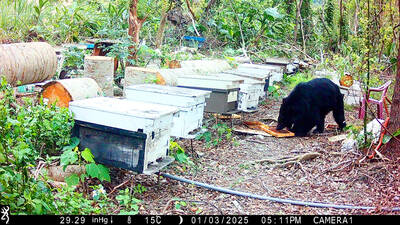
The Forestry and Nature Conservation Agency yesterday launched a gift box to market honey “certified by a Formosan black bear” in appreciation of a beekeeper’s amicable interaction with a honey-thieving bear. Beekeeper Chih Ming-chen (池明鎮) in January inspected his bee farm in Hualien County’s Jhuosi Township (卓溪) and found that more than 20 beehives had been destroyed and many hives were eaten, with bear droppings and paw prints near the destroyed hives, the agency said. Chih returned to the farm to move the remaining beehives away that evening when he encountered a Formosan black bear only 20m away, the agency said. The bear


 RSS
RSS