


In light of the explosions caused by gas leaking from underground pipelines in Greater Kaohsiung last week, which killed at least 28 people and injured more than 300, lawmakers are denouncing what they say is the longstanding unfairness of the city’s residents bearing the risks of living near petrochemical plants, while the companies’ Taipei headquarters enjoy the tax revenue generated by those facilities.
One of these critics is Democratic Progressive Party (DPP) Legislator Lee Kun-tse (李昆澤), who yesterday called on LCY Chemical Corp and the state-owned CPC Corp, Taiwan (CPC) to move their head offices to Greater Kaohsiung.
Lee said this would bridge the gap between the amount of central government-funded tax revenue allocated to the companies’ Taipei headquarters and that received by their Greater Kaohsiung units, which receive only about half the funds that their Taipei affiliates do.
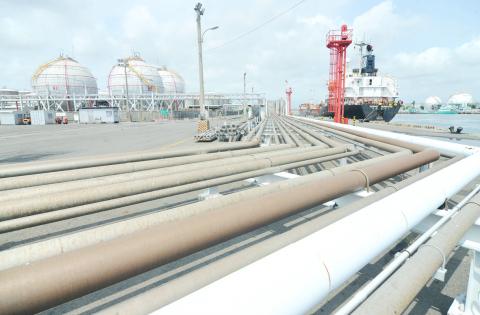
Photo: Huang Chih-yuan, Taipei Times
Citing the Regulations for Allocation of Centrally Funded Tax Revenues (中央統籌分配稅款分配辦法), Lee said that since the system assigns a 50 percent value to the revenue generated by each municipality and allocates central government-funded tax revenue accordingly, the petrochemical companies’ Taipei headquarters acquire the lion’s share of state-funded revenues, leaving their under-funded Kaohsiung units to deal with the pollution and public safety issues that come with operating a petrochemical facility.
Citing LCY as an example, he said the company’s head office is in Taipei, but five of its six plants are based in the southern municipality, including its Kaohsiung, Siaogang (小港), Dashe (大社) and Linyuan plants (林園), as well as a fuel storage and transfer station it operates in the seaport of Cianjhen District (前鎮), the site of the explosions.
Similarly, CPC has two smelters in the municipality, its Kaohsiung and Dalin (大林) smelters, as well as a refinery in Linyuan and a Cianjhen storage and transfer station, Lee said.
Both LCY and CPC, whose revenues totaled NT$49.7 billion (US$1.67 billion) and NT$1.15 trillion respectively last year, put their Taipei headquarters in charge when filing business taxes, Lee said, adding that as a result, all their business taxes are filed with the National Taxation Bureau of Taipei.
The companies’ practice of establishing plants in Greater Kaohsiung while letting their Taipei offices handle tax filing duties is against the principle of fair taxation, because Greater Kaohsiung residents have to live with the pollution and safety concerns caused by the plants, while those in Taipei receive most of the profits, he said.
“[Greater] Kaohsiung has carried too heavy a burden for the sake of Taiwan’s economic development,” he said.
Lee said he would submit a request to CPC asking it to move its head office to Kaohsiung, a move he said would raise the tax revenue allocated to the municipality by NT$3 billion a year.
An official at the Greater Kaohsiung Government’s Finance Bureau, who declined to be named, said the taxes shouldered by CPC’s facilities in the south are about NT$500 million to NT$600 million, adding that the bureau is not privy to the amount the facilities pay in business tax since the National Taxation Bureau says that information is “confidential.”
When reached for comment, independent Greater Kaohsiung City Councilor Huang Shih-lung (黃石龍) said: “Since CPC’s president lives in Taipei, why not ask him to move the plants there to make his managing them more efficient? Would Taipei residents approve of that?”
He said the bottom line should be people’s quality of life, not tax revenues, adding that petrochemical companies should establish their facilities away from densely populated areas.
DPP Legislator Chen Chi-mai (陳其邁) said on Facebook that setting up petrochemical facilities in a busy city is no different than planting a time bomb there, since both put residents’ lives at risk.
He urged the central government to perform its duties and move underground pipelines out of densely populated areas, while calling on CPC to move its headquarters south to enable Greater Kaohsiung residents to benefit from the municipality receiving a higher amount of centrally funded tax revenues.
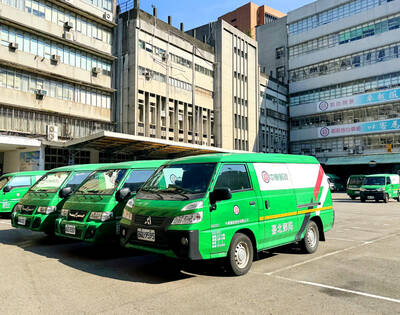
SHIPS, TRAINS AND AUTOMOBILES: The ministry has announced changes to varied transportation industries taking effect soon, with a number of effects for passengers Beginning next month, the post office is canceling signature upon delivery and written inquiry services for international registered small packets in accordance with the new policy of the Universal Postal Union, the Ministry of Transportation and Communications said yesterday. The new policy does not apply to packets that are to be delivered to China, the ministry said. Senders of international registered small packets would receive a NT$10 rebate on postage if the packets are sent from Jan. 1 to March 31, it added. The ministry said that three other policies are also scheduled to take effect next month. International cruise ship operators
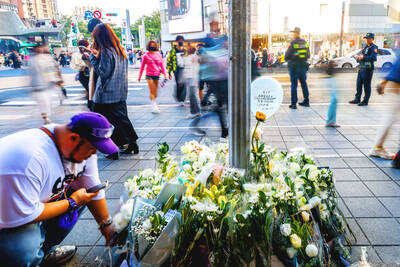
HORROR STORIES: One victim recounted not realizing they had been stabbed and seeing people bleeding, while another recalled breaking down in tears after fleeing A man on Friday died after he tried to fight the knife-wielding suspect who went on a stabbing spree near two of Taipei’s busiest metro stations, Taipei Mayor Chiang Wan-an (蔣萬安) said. The 57-year-old man, identified by his family name, Yu (余), encountered the suspect at Exit M7 of Taipei Main Station and immediately tried to stop him, but was fatally wounded and later died, Chiang said, calling the incident “heartbreaking.” Yu’s family would receive at least NT$5 million (US$158,584) in compensation through the Taipei Rapid Transit Corp’s (TRTC) insurance coverage, he said after convening an emergency security response meeting yesterday morning. National

PLANNED: The suspect visited the crime scene before the killings, seeking information on how to access the roof, and had extensively researched a 2014 stabbing incident The suspect in a stabbing attack that killed three people and injured 11 in Taipei on Friday had planned the assault and set fires at other locations earlier in the day, law enforcement officials said yesterday. National Police Agency (NPA) Director-General Chang Jung-hsin (張榮興) said the suspect, a 27-year-old man named Chang Wen (張文), began the attacks at 3:40pm, first setting off smoke bombs on a road, damaging cars and motorbikes. Earlier, Chang Wen set fire to a rental room where he was staying on Gongyuan Road in Zhongzheng District (中正), Chang Jung-hsin said. The suspect later threw smoke grenades near two exits
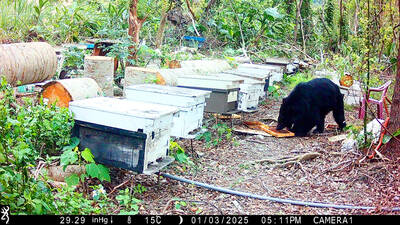
The Forestry and Nature Conservation Agency yesterday launched a gift box to market honey “certified by a Formosan black bear” in appreciation of a beekeeper’s amicable interaction with a honey-thieving bear. Beekeeper Chih Ming-chen (池明鎮) in January inspected his bee farm in Hualien County’s Jhuosi Township (卓溪) and found that more than 20 beehives had been destroyed and many hives were eaten, with bear droppings and paw prints near the destroyed hives, the agency said. Chih returned to the farm to move the remaining beehives away that evening when he encountered a Formosan black bear only 20m away, the agency said. The bear


 RSS
RSS