


An 85-year-old Taoyuan resident was honored on Friday with a Filial Piety Award for looking after his elder brother’s centenarian wife to repay the kindness she showed in raising her brother-in-law when he was young.
Chou Ting-li (周鼎立), the oldest of the 30 winners of this year’s Filial Piety Award, was brought to Jiangxi Province by his elder brother and his wife when he was 11 years old because the family’s hometown in China was plagued by drought and pestilence.
He later came to Taiwan with the army unit in which he was serving.
Chou said all of the clothes he wore during his childhood were sewn by his sister-in-law, who is now 100 years old and has been suffering from dementia for eight years.
Chou said his sister-in-law’s physical condition has worsened as she has gotten older, and he moved to Taoyuan from Greater Tainan to live with her and also hired a full-time caregiver to attend to her.
Despite his age, Chou said he was still healthy and felt like he was in his 30s or 40s.
The youngest recipient of the award this year was 14-year-old Wang Chi-lung (王志龍) from Changhua County. Wang’s father survived a heart attack in 2009, but his recovery did not go well and he had to have his right foot amputated.
Since then, Wang has become his father’s “right foot,” helping push his father’s wheelchair when they visit doctor, emptying and cleaning his father’s chamber pot and bathing him.
This year was also the first time one of the award recipients was a foreign spouse of a Taiwanese national.
Pan Yu-lien (潘玉蓮), an Indonesian native, has been the primary income earner for her family since her husband became paralyzed after a severe illness. Despite the challenge, she has not brushed aside her responsibility, instead assimilating herself into Taiwanese society and looking after her parents-in-law and raising her children.
The 30 awards went to 19 male and 11 female recipients, with 11 winners aged 20 or younger and five aged 60 or older, according to Ministry of the Interior data.
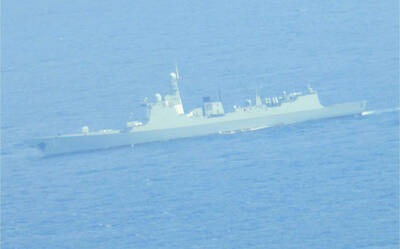
The military has spotted two Chinese warships operating in waters near Penghu County in the Taiwan Strait and sent its own naval and air forces to monitor the vessels, the Ministry of National Defense (MND) said. Beijing sends warships and warplanes into the waters and skies around Taiwan on an almost daily basis, drawing condemnation from Taipei. While the ministry offers daily updates on the locations of Chinese military aircraft, it only rarely gives details of where Chinese warships are operating, generally only when it detects aircraft carriers, as happened last week. A Chinese destroyer and a frigate entered waters to the southwest
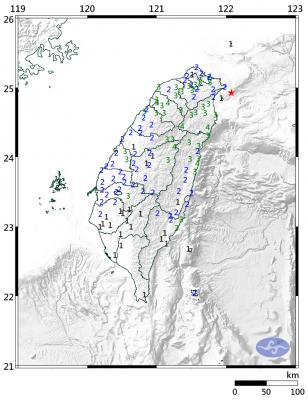
A magnitude 6.1 earthquake struck off the coast of Yilan County at 8:39pm tonight, the Central Weather Administration (CWA) said, with no immediate reports of damage or injuries. The epicenter was 38.7km east-northeast of Yilan County Hall at a focal depth of 98.3km, the CWA’s Seismological Center said. The quake’s maximum intensity, which gauges the actual physical effect of a seismic event, was a level 4 on Taiwan’s 7-tier intensity scale, the center said. That intensity level was recorded in Yilan County’s Nanao Township (南澳), Hsinchu County’s Guansi Township (關西), Nantou County’s Hehuanshan (合歡山) and Hualien County’s Yanliao (鹽寮). An intensity of 3 was

Japanese Prime Minister Sanae Takaichi’s comment last year on Tokyo’s potential reaction to a Taiwan-China conflict has forced Beijing to rewrite its invasion plans, a retired Japanese general said. Takaichi told the Diet on Nov. 7 last year that a Chinese naval blockade or military attack on Taiwan could constitute a “survival-threatening situation” for Japan, potentially allowing Tokyo to exercise its right to collective self-defense. Former Japan Ground Self-Defense Force general Kiyofumi Ogawa said in a recent speech that the remark has been interpreted as meaning Japan could intervene in the early stages of a Taiwan Strait conflict, undermining China’s previous assumptions
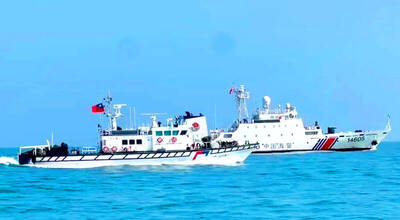
Instead of focusing solely on the threat of a full-scale military invasion, the US and its allies must prepare for a potential Chinese “quarantine” of Taiwan enforced through customs inspections, Stanford University Hoover fellow Eyck Freymann said in a Foreign Affairs article published on Wednesday. China could use various “gray zone” tactics in “reconfiguring the regional and ultimately the global economic order without a war,” said Freymann, who is also a nonresident research fellow at the US Naval War College. China might seize control of Taiwan’s links to the outside world by requiring all flights and ships entering or leaving Taiwan


 RSS
RSS