

The Ministry of Health and Welfare’s Administrative Appeal Committee has canceled a NT$1.85 billion (US$62 million) fine imposed on cooking-oil producer Chang Chi Foodstuff Factory Co (大統) last year by the Changhua County Public Health Bureau in an adulterated oil scandal, citing the principle of double jeopardy.
Administrative Appeal Committee executive-secretary Kao Tsung-hsien (高宗賢) said the committee had held three special meetings between April and last month to deliberate the case after Chang Chi filed a petition at the end of last year asking that the fine be annulled.
“Given that the Changhua District Court has handed down a punishment against the company’s chairman, Kao Cheng-li (高振利), [in December last year], the committee members decided to cancel the NT$1.85 billion fine in accordance with Article 26 of the Administrative Penalty Act (行政罰法),” Kao Tsung-hsien said.
Kao Tsung-hsien added that the bureau would only be allowed to reimpose the fine should Kao Cheng-li be acquitted by the court.
The article stipulates that if one single act constitutes simultaneously a criminal offense or offenses, as well as a breach of duty under administrative law, it shall be punishable under criminal law.
The district court sentenced Kao Cheng-li to 16 years in prison and fined him NT$50 million on charges of fraud and violations of the Act Governing Food Sanitation (食品衛生管理法) for blending edible oil products for the previous seven years with copper chlorophyllin and cottonseed oil, which are cheaper than other edible oils and toxic if they are left unrefined.
Two senior staff members, Wen Jui-pin (溫瑞彬) and Chou Kun-ming (周昆明), were given terms of two years and 10 months respectively.
Commenting on the committee’s decision, Consumers’ Foundation chairman Mark Chang (張智剛) said the annulment of the fine would send a message to other companies that “it is okay to engage in illegal activities.”
“Unless the government is willing to increase the criminal penalties for corporations using illegal means to gain profits, there will be no one left to safeguard public health and food safety,” Chang said.
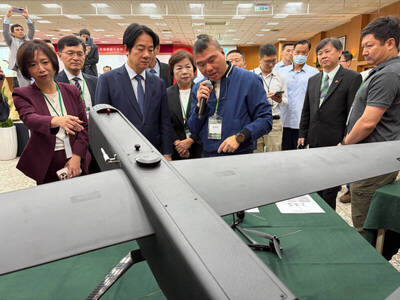
Two executives of drone supplier Jiin Ming Industry Co (錦明實業) have been detained and held incommunicado over the company's alleged use of prohibited China-made chips and camera lenses in drones supplied under recent military contracts, the Taoyuan District Prosecutors' Office said today. In a statement, prosecutors said they raided the offices of Jiin Ming — headquartered in Taoyuan — as well as those of its subsidiaries and its suppliers on Thursday last week. The raids followed a report that the company had breached its procurement contracts by putting the prohibited components into drones delivered to the military. During the raids, prosecutors summoned
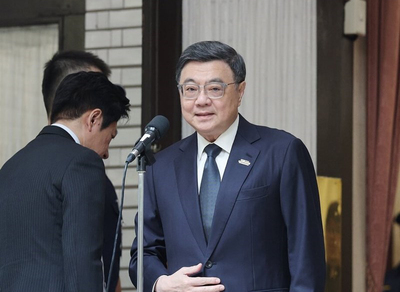
The government would continue monitoring online rumors that a pneumonic plague outbreak has spread from Russia into China and could enhance existing quarantine measures, Premier Cho Jung-tai (卓榮泰) said today. During a legislative meeting, Democratic Progressive Party Legislator Wang Ting-yu (王定宇) said rumors were circulating that the disease had spread across several Chinese provinces. He asked Cho whether the government was prepared to prevent the disease from spreading to Taiwan, given the frequent exchanges between Taiwan and China, and how concerned the government was about the alleged outbreak. The Ministry of Health and Welfare implemented border quarantine measures after briefing the Executive Yuan

South Korean boy band BigBang drew 120,000 fans to three concerts at Taipei Dome from Friday through yesterday, as the band thanked them for their support over their 20-year career. The Taipei Dome concerts were part of BigBang's "2026-2027 World Tour XX: Cosmos." Friday's concert was BigBang's first performance in Taiwan in 11 years. During the encore, group leader G-Dragon (GD) shouted "I love you" in Chinese and said he was especially happy to perform in Taiwan with bandmates Taeyang and Daesung. "Taipei, I'm very grateful to you all," GD said in Chinese, asking fans to wait for the band's return. Daesung thanked

MAYORAL RACE: Su Chiao-hui made gains by persuading undecided voters and winning over voters in KMT-leaning districts, a pollster said Legislator Su Chiao-hui (蘇巧慧), the Democratic Progressive Party’s (DPP) candidate for New Taipei City mayor, has a 13.1 percentage point lead over her Chinese Nationalist Party (KMT) rival Lee Shu-chuan (李四川), a poll released yesterday showed. The poll, commissioned by the Taipei Trust in Democracy Association, showed that 43.1 percent of respondents said they would vote for Su, up 7.9 percentage points from a poll conducted in late August, while support for Lee was at 30 percent, down 4.7 percentage points. It showed that 48.6 percent of respondents thought Su would make a suitable mayor, compared with 35.9 percent for Lee. Independent candidate


 RSS
RSS