


Suspicions have surfaced about the new qualification rules that the Ministry of Culture has set for this year’s Taipei TV Festival, with critics alleging that the regulatory overhaul is aimed at excluding the New Tang Dynasty Television (NTDTV, 新唐人電視台) channel, which is known for its critical stance on China, from the event.
The new rules listed in the brochures advertising the festival, which is scheduled for September, stipulate that a channel must have a viewership penetration rate of at least 60 percent of all cable TV subscribers to qualify for the event.
The regulations also prohibit the participation of self-funded channels and state that all applicants will be require to submit to an appraisal, but do not elaborate on what the procedure will entail and who will be carrying it out.
Citing an incident during last year’s festival in which dozens of Chinese channels withdrew from the event to protest the participation of NTDTV, Flora Chang (張錦華), a professor at National Taiwan University, said she suspected that the rule changes were directed at the channel.
NTDTV’s outspoken stance against Chinese bureaucracy and programs about Beijing’s persecution of Falun Gong practitioners have irked Chinese authorities in the past.
Chang pointed to the eligibility of self-funded and non-funded channels to apply for the event in the past, adding that only a handful of non-funded channels were made to undergo a review before being admitted to the festival, whereas this year, all self-funded channels are completely shut out and all participants are subject to appraisal.
Calling the revised vetting rules “odd,” Chang said they not only undermine the visibility of Taiwanese TV channels on the global stage, but are also overkill for high-quality independent cable TV operators.
In response to the misgivings, the ministry issued a statement yesterday saying that appraisals are conducted every year and that the 60 percent viewership cap was imposed in an effort to boost the sales volumes of high-quality domestic television shows.
However, some TV operators said they found the ministry’s response unconvincing, saying that there are as many as 250 licensed TV channels nationwide and that of these, only 100 are commonly viewed by the general public.
It is inherently unfair to evaluate a channel solely based on its penetration rate, they added.

The military has spotted two Chinese warships operating in waters near Penghu County in the Taiwan Strait and sent its own naval and air forces to monitor the vessels, the Ministry of National Defense (MND) said. Beijing sends warships and warplanes into the waters and skies around Taiwan on an almost daily basis, drawing condemnation from Taipei. While the ministry offers daily updates on the locations of Chinese military aircraft, it only rarely gives details of where Chinese warships are operating, generally only when it detects aircraft carriers, as happened last week. A Chinese destroyer and a frigate entered waters to the southwest
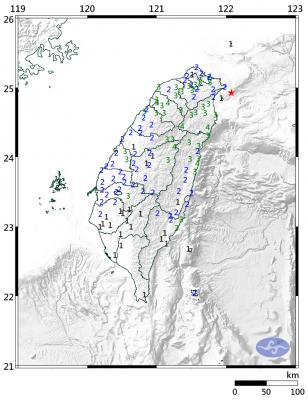
A magnitude 6.1 earthquake struck off the coast of Yilan County at 8:39pm tonight, the Central Weather Administration (CWA) said, with no immediate reports of damage or injuries. The epicenter was 38.7km east-northeast of Yilan County Hall at a focal depth of 98.3km, the CWA’s Seismological Center said. The quake’s maximum intensity, which gauges the actual physical effect of a seismic event, was a level 4 on Taiwan’s 7-tier intensity scale, the center said. That intensity level was recorded in Yilan County’s Nanao Township (南澳), Hsinchu County’s Guansi Township (關西), Nantou County’s Hehuanshan (合歡山) and Hualien County’s Yanliao (鹽寮). An intensity of 3 was
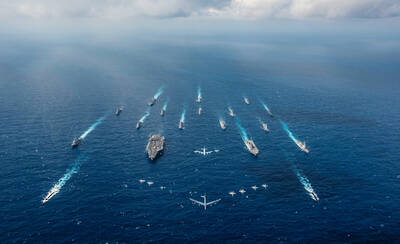
Japanese Prime Minister Sanae Takaichi’s comment last year on Tokyo’s potential reaction to a Taiwan-China conflict has forced Beijing to rewrite its invasion plans, a retired Japanese general said. Takaichi told the Diet on Nov. 7 last year that a Chinese naval blockade or military attack on Taiwan could constitute a “survival-threatening situation” for Japan, potentially allowing Tokyo to exercise its right to collective self-defense. Former Japan Ground Self-Defense Force general Kiyofumi Ogawa said in a recent speech that the remark has been interpreted as meaning Japan could intervene in the early stages of a Taiwan Strait conflict, undermining China’s previous assumptions
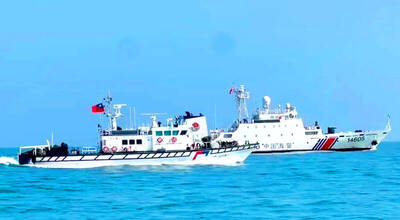
Instead of focusing solely on the threat of a full-scale military invasion, the US and its allies must prepare for a potential Chinese “quarantine” of Taiwan enforced through customs inspections, Stanford University Hoover fellow Eyck Freymann said in a Foreign Affairs article published on Wednesday. China could use various “gray zone” tactics in “reconfiguring the regional and ultimately the global economic order without a war,” said Freymann, who is also a nonresident research fellow at the US Naval War College. China might seize control of Taiwan’s links to the outside world by requiring all flights and ships entering or leaving Taiwan


 RSS
RSS