


Albie Sachs, a former justice of the Constitutional Court of South Africa, has become the first winner of the Tang Prize in Rule of Law yesterday for his contributions to human rights and justice around the world.
Sachs, a lawyer and human rights activist who spent his lifetime fighting apartheid, helped write the new constitution of South Africa and was appointed by late South African president Nelson Mandela in 1994 to serve as a justice of the Constitutional Court — a position he held until 2009.
The 79-year-old is to receive a cash prize of NT$40 million (US$1.33 million) and a research grant of up to NT$10 million to be used within five years, as well as a medal and a certificate.
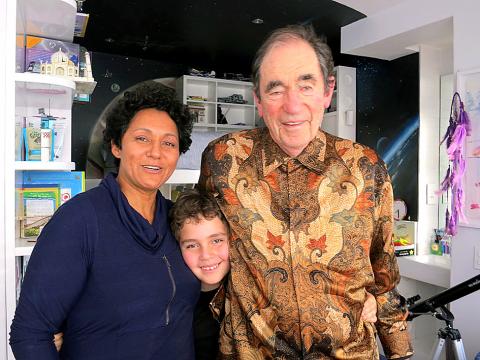
Photo courtesy of the Tang Prize Foundation
The Tang Prize was awarded to Sachs “for his many contributions to human rights and justice globally through an understanding of the rule of law in which the dignity of all persons is respected and the strengths and values of all communities are embraced, in particular through his efforts in the realization of the rule of law in a free and democratic South Africa, working as activist, lawyer, scholar, and framer of a new constitution to heal the divisions of the past and to [establish] a society that respects diversity and is based on democratic values, social justice and fundamental human rights,” Nobel laureate Lee Yuan-tseh (李遠哲) read from the citation.
Lee, who chairs the Tang Prize Selection Committee, announced the award winner at a ceremony in Taipei.
Born to politically active parents of a Jewish family, Sachs joined the anti-apartheid movement at the age of 17.
After gaining his law degree at 21, he defended people charged under repressive apartheid laws and, as a result, was several times imprisoned and tortured.
He went into exile in 1966 and spent the next 24 years studying, teaching and writing in the UK and Mozambique.
During the 1980s, Sachs helped draft the Code of Conduct and Statutes for the African National Congress (ANC), which prohibits torture of detainees under any circumstances.
In 1988, South African security agents planted a bomb in his car that blew off his right arm and blinded him in one eye, a story recounted in his autobiographical book The Soft Vengeance of a Freedom Fighter.
“To get freedom was a much more powerful vengeance than to subject the people who had done these things to us to the same harm,” Sachs wrote in the book. “If the person accused in a Mozambique Court of being responsible for placing the bomb in my car is put on trial and the evidence is insufficient and he is acquitted, that will be my soft vengeance, because we will be living under the rule of law.”
Sachs returned to his homeland in 1990 after Mandela and other ANC leaders were released from prison, where he played a key role in drafting South Africa’s new constitution and Bill of Rights, a human rights charter contained in the constitution that lays down the fundamental rights of all South Africans.
South Africa’s Bill of Rights is regarded as one of the most progressive constitutional documents in the world.
It stipulates not only traditional civil rights such as the freedom of expression and the right to assemble, but also the rights to housing, education, healthcare, food, water and social security.
During Sachs’ tenure as a judge, the South African Constitutional Court abolished the death penalty, overturned anti-homosexuality laws and legalized same-sex marriage.
In the landmark Minister of Home Affairs versus Fourie case in 2005, Sachs authored the court’s decision that legalized same-sex marriage in South Africa, making South Africa the fifth country to recognize such unions.
Sachs has honorary doctorates from over a dozen universities, including Princeton, Cambridge and the University of Edinburgh.
Winners of the award are selected by panels of judges convened by Academia Sinica.
An award ceremony for the winners in all four categories is to take place on Sept. 18 in Taipei.
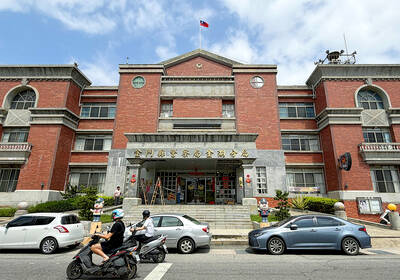
NATIONAL SECURITY: Authorities are working to confirm the identities of the military personnel involved and investigating possible illegal conduct and regulatory violations Authorities are probing possible national security implications after Kinmen police and immigration officers on Sunday found a Chinese woman allegedly posing as a tourist while engaging in prostitution involving more than 10 military personnel. The woman, surnamed Chen (陳), has since been deported, authorities said, adding that investigators are still working to confirm the identities of those implicated, as the records only listed code names and aliases. The case stemmed from a report received by the Kinmen District Prosecutors’ Office on Friday last week from the Jinhu Precinct of the Kinmen County Police Bureau. On Sunday, police, along with the National Immigration

GLOBALGIVING: ‘ Caving to external pressure is not acceptable for an organization that has cultivated justice reform and human rights for 30 years,’ one NGO said A slew of non-government organizations (NGOs) have withdrawn from the GlobalGiving fundraising platform after it announced it would use “Chinese Taipei” instead of “Taiwan” from next month. The Taiwan Good Rice Association wrote on Facebook on Friday that it was informed on April 28 via a teleconference call of the change, which was made because the platform wanted to operate in China. Taiwan Good Rice is to terminate all cooperative relationships with GlobalGiving in response to the platform’s “unilateral and non-negotiable” decision to remove references to Taiwan, the NGO said. “Taiwan is in the official name of Taiwan Good Rice Association and the

HEAVY WEATHER: Typhoon Jangmi is due to crash straight into the Ryukyus as airlines look to shift flights to larger aircraft or cancel flights to Okinawa entirely Taiwan’s international air carriers announced flight adjustments over the weekend as Typhoon Jangmi is forecast to hit the Ryukyu Islands today and tomorrow. The Central Weather Administration (CWA) upgraded Jangmi from a tropical storm to a typhoon at 8am yesterday, with the eye located 580km south of Naha city. It was moving north at 19kph. Today, China Airlines’ CI-120, CI-121, CI-122 and CI-123 flights between Taoyuan and Naha, Okinawa, have been canceled as well as CI-132 and CI-133 between Kaohsiung and Naha. EVA Air’s BR-112, BR-113, BR-186 and BR-185 flights between Taoyuan and Naha are also canceled. Low-cost carrier Tigerair Taiwan canceled IT-230,
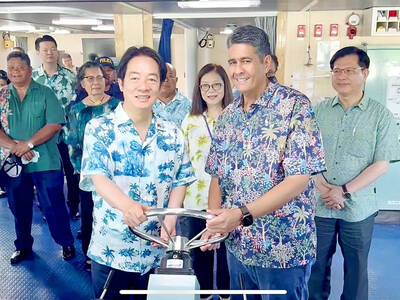
MULTIPRONGED APPROACH: China has sought to pressure Palau across a number of fronts, but the island nation has staunchly resisted overtures to ditch Taiwan Palau has been firm in backing Taiwan despite Chinese pressure that uses tourism economics, cyberattacks and criminal infiltration as tools to threaten the Pacific ally into renouncing its recognition of Taiwan as a sovereign state. The Presidential Office yesterday announced that Vice President Hsiao Bi-khim (蕭美琴) would visit Palau from Saturday to Wednesday next week at the invitation of Palauan President Surangel Whipps Jr. Whipps in April said in an interview that China had outspokenly asked Palau to “denounce Taiwan.” “And we have said: ‘We have no enemies, but nobody tells us who our friends are,’” he said. Whipps has told reporters multiple times


 RSS
RSS