


Taiwanese netizens criticized President Ma Ying-jeou’s (馬英九) administration for what they called its “false accusation” of the Japanese government for removing the word “national” from posters that promote a National Palace Museum exhibition in Tokyo and Kyushu.
Ma undermined the mutual trust between the two countries and misplaced the blame, the netizens said.
The Ma administration has strongly protested to Tokyo over the missing word on posters printed by certain media outlets, including threatening to cancel the show scheduled to begin on Tuesday.
Netizens said that the Japanese authorities have not tried to avoid using the word “national.”
A netizen using the name “goplayer” on the Professional Technology Temple (PTT) posted an article saying that both the Tokyo National Museum and the Kyushu National Museum used the museum’s full name on their posters and official Web sites.
Representative to Japan Shen Ssu-tsun’s (沈斯淳) criticism, citing the media outlets’ posters rather than the museums’, shows that Shen had no idea what was going on, goplayer said.
The netizen said that the amendment made in 1968 to the Sino-Japanese Journalist Exchange Agreement (signed in 1964) had established three political principles: the Japanese media are not to be hostile to the Chinese government, they are to unwaveringly deny that there are two Chinas and they are not to impede the normalization of Sino-Japanese relations.
Although the agreement was abolished when Tokyo and Beijing established diplomatic relations in 1972, the Japanese media has kept hewing to the former principles for fear that their reporters who are stationed in China will be forced to leave the country, or of coming under pressure from the Japanese government for hurting “national interests,” the netizen added.
Taiwanese can question the Japanese media’s conservative stance, asking why they are afraid of using “national,” while the Japanese authorities have blatantly done so, goplayer said, “but the root of the problem lies with the Chinese government, which has unabashedly insisted on its ‘one China’ policy.”
He accused Ma of being spineless toward China.
“This kind of dirty political intrigue will only destroy the mutual trust between Japan and Taiwan,” the netizen added.
Another netizen “suntree” said he has seen exhibition posters at the Tokyo Station with the word “national” many times.
He also referred to the museums’ official Web sites.
Suntree called on the Ma administration to display the contract for public examination.
“Let us see whether the Japanese government is shameless, or stupid enough to have signed a contract that requires domestic media to ‘toe the authority’s line,’ a requirement that is highly unlikely in any democratic country,” suntree added.
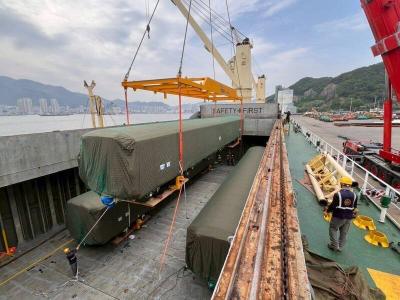
The first of 10 new high-capacity trains purchased from South Korea’s Hyundai Rotem arrived at the Port of Taipei yesterday to meet the demands of an expanding metro network, Taipei Rapid Transit Corp (TRTC) said yesterday. The train completed a three-day, 1,200km voyage from the Port of Masan in South Korea, the company said. Costing NT$590 million (US$18.79 million) each, the new six-carriage trains feature a redesigned interior based on "human-centric" transportation concepts, TRTC said. The design utilizes continuous longitudinal seating to widen the aisles and optimize passenger flow, while also upgrading passenger information displays and driving control systems for a more comfortable
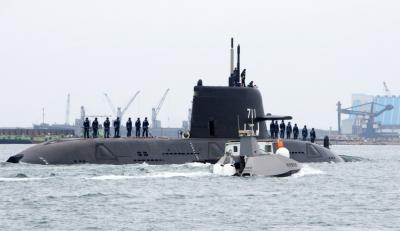
Taiwan's first indigenous defense submarine, the SS-711 Hai Kun (海鯤, or Narwhal), departed for its 13th sea trial at 7am today, marking its seventh submerged test, with delivery to the navy scheduled for July. The outing also marked its first sea deployment since President William Lai (賴清德) boarded the submarine for an inspection on March 19, drawing a crowd of military enthusiasts who gathered to show support. The submarine this morning departed port accompanied by CSBC Corp’s Endeavor Manta (奮進魔鬼魚號) uncrewed surface vessel and a navy M109 assault boat. Amid public interest in key milestones such as torpedo-launching operations and overnight submerged trials,
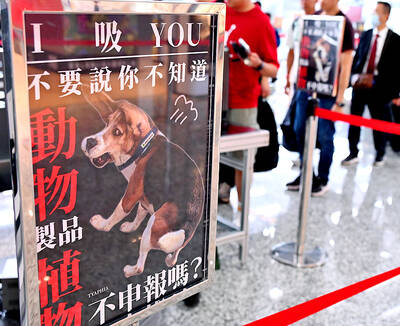
Quarantine awareness posters at Taiwan Taoyuan International Airport have gone viral for their use of wordplay. Issued by the airport branch of the Animal and Plant Health Inspection Agency, the posters feature sniffer dogs making a range of facial expressions, paired with advisory messages built around homophones. “We update the messages for holidays and campaign needs, periodically refreshing materials to attract people’s attention,” quarantine officials said. “The aim is to use the dogs’ appeal to draw focus to quarantine regulations.” A Japanese traveler visiting Taiwan has posted a photo on X of a poster showing a quarantine dog with a

Taiwan’s coffee community has launched a “one-person-one-e-mail” campaign, calling for people to send a protest-e-mail to the World Coffee Championships (WCC) urging it to redesignate Taiwanese competitors as from “Taiwan,” rather than “Chinese Taipei.” The call followed sudden action last week after the WCC changed all references to Taiwanese competitors from “Taiwan” to “Chinese Taipei,” including recent World Latte Art champion Bala (林紹興), who won the World Latte Art Championship in San Diego earlier this month. When Bala received the trophy, he was referred to as representing Taiwan, as well as in the announcement on the WCC’s Web site, until it


 RSS
RSS