


Legislators across party lines have accused National Security Council (NSC) Secretary-General King Pu-tsung (金溥聰) of overreaching his authority and acting like an “underground president” when he visited the National Police Agency (NPA) to sit in on a report on Friday following a visit to the Ministry of Justice’s Investigation Bureau on Wednesday.
Chinese Nationalist Party (KMT) Legislator Lo Shu-lei (羅淑蕾) said the legality of King’s visit depended on whether there were precedents and if his rights as secretary-general sanctioned such visits, adding that King was overreaching if such visits were outside of his purview.
KMT Legislator Wang Hui-mei (王惠美) said no harm was done if King wished to get to understand the duties of the bureau, but added that the systemic difference — the NSC is an organ of the Presidential Office, while the Investigation Bureau falls under the Executive Yuan — is not conducive to such visits.
Democratic Progressive Party (DPP) Legislator Chen Chi-mai (陳其邁) said King’s actions have confirmed that he is in fact the “underground president.”
The NSC has no administrative powers, and is not directly in charge of the NPA or the Investigation Bureau, he said.
“The NSC secretary-general is simply an advisory unit and no one, not even the Presidential Office secretary-general or former NSC secretaries-general, has such powers,” Chen said, adding that King’s actions may be unconstitutional.
DPP Legislator Tsai Chi-chang (蔡其昌) said King’s actions would only muddle the system.
Meanwhile, senior bureau officials, who declined to be named, said they could not recollect any precedent of the NSC secretary-general and the National Security Bureau (NSB) director inspecting the Investigation Bureau, adding that the visit was not appropriate.
The NSC is not a direct supervising unit of the Investigation Bureau and should not intervene in its handling of intelligence, sources said.
Citing similar incidents where former NSC secretary-general Hu Wei-chen (胡為真) had been criticized for “disrespecting the system” when he attended a news meeting at the Investigation Bureau, sources said King had overreached his authority and broken the chain of command in the nation’s intelligence units.
Presidential Office spokesperson Ma Wei-kuo (馬瑋國) referred reporters to the NSB for response, by quoting the bureau as saying that the visit was in accordance with King’s legal responsibility to “visit units with the same responsibility as intelligence gathering agencies” and receive reports from them.
The visit was an effort to better understand the general status of national security intelligence-gathering and not to intervene in the everyday operations of the agencies, she quoted the bureau as saying.
However, detractors said the National Security Council Organization Act (國家安全會議組織法) stated that the NSC secretary-general was a close adviser to the president in matters of national defense, diplomacy, cross-strait relations and other national affairs, but had no legal justification for intervening in the organizations’ operations.
NSC officials may need to have certain channels through which they receive information pertinent to their jobs, but they should not reach over the line, sources said, citing former secretaries-general Su Chi’s (蘇起) and Jason Yuan’s (袁健生) conduct as examples of passive interaction between the NSC and the Investigation Bureau.
Su visited the Investigation Bureau with President Ma Ying-jeou (馬英九) in 2008, and Yuan has never set foot in the Investigation Bureau, sources said.
Sources said “visit units with the same responsibility as intelligence gathering agencies” referred to government agencies whose jobs touched on affairs of national security, such as the National Immigration Agency.
Sources said King’s actions, from rearranging the personnel assignments in the NSB and the Investigation Bureau to sitting in on their meetings, pointed toward tightened security ahead of the seven-in-one elections at the end of the year.
Additional reporting by Yang Kuo-wen, Lo Tien-pin, Shih Hsiao-kuang, Wang Wen-hsuan and Tseng Wei-chen
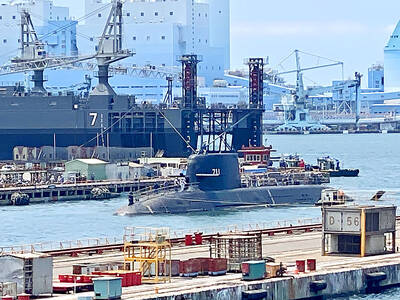
AGING: While Japan has 22 submarines, Taiwan only operates four, two of which were commissioned by the US in 1945 and 1946, and transferred to Taiwan in 1973 Taiwan would need at least 12 submarines to reach modern fleet capabilities, CSBC Corp, Taiwan chairman Chen Cheng-hung (陳政宏) said in an interview broadcast on Friday, citing a US assessment. CSBC is testing the nation’s first indigenous defense submarine, the Hai Kun (海鯤, Narwhal), which is scheduled to be delivered to the navy next month or in July. The Hai Kun has completed torpedo-firing tests and is scheduled to undergo overnight sea trials, Chen said on an SET TV military affairs program. Taiwan would require at least 12 submarines to establish a modern submarine force after assessing the nation’s operational environment and defense
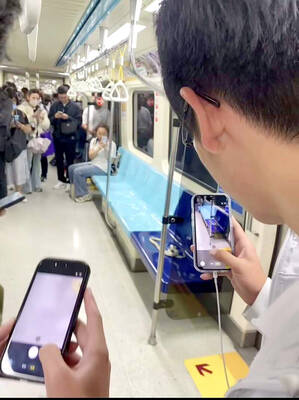
A white king snake that frightened passengers and caused a stir on a Taipei MRT train on Friday evening has been claimed by its owner, who would be fined, Taipei Rapid Transit Corp (TRTC) said yesterday. A person on Threads posted that he thought he was lucky to find an empty row of seats on Friday after boarding a train on the Bannan (Blue) Line, only to spot a white snake with black stripes after sitting down. Startled, he jumped up, he wrote, describing the encounter as “terrifying.” “Taipei’s rat control plan: Release snakes on the metro,” one person wrote in reply, referring
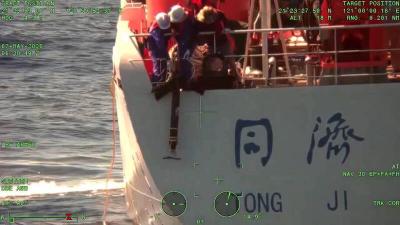
The coast guard today said that it had disrupted "illegal" operations by a Chinese research ship in waters close to the nation and driven it away, part of what Taipei sees a provocative pattern of China's stepped up maritime activities. The coast guard said that it on Thursday last week detected the Chinese ship Tongji (同濟號), which was commissioned only last year, 29 nautical miles (54km) southeast of the southern tip of Taiwan, although just outside restricted waters. The ship was observed lowering ropes into the water, suspected to be the deployment of scientific instruments for "illegal" survey operations, and the coast
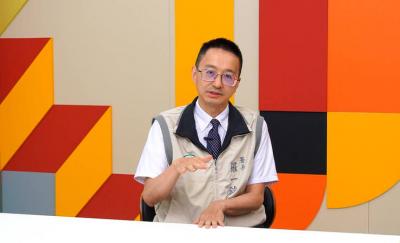
Taiwan’s two cases of hantavirus so far this year are on par with previous years’ case numbers, and the government is coordinating rat extermination work, so there should not be any outbreaks, Centers for Disease Control (CDC) Director-General Philip Lo (羅一鈞) said today in an interview with the Liberty Times (the Taipei Times’ sister newspaper). An increase in rat sightings in Taipei and New Taipei City has raised concerns about the spread of hantavirus, as rats can carry the disease. In January, a man in his 70s who lived in Taipei’s Daan District (大安) tested positive posthumously for hantavirus, Taiwan’s


 RSS
RSS