


Young Taiwanese voters have a “sense of hopelessness about the direction their country is taking,” a US congressional commission was told on Thursday.
There were also concerns that Taiwanese politics could become radicalized, US-Taiwan Business Council president Rupert Hammond-Chambers said.
Young voters were worried, he said, about the long-term viability of democratic institutions in which they have great pride.
These institutions, Hammond-Chambers said, are being threatened by “increasing and very heavy Chinese coercion.”
Addressing a hearing on recent developments in China’s relations with Taiwan — held on Capitol Hill by the US-China Economic and Security Review Commission, Hammond-Chambers said that Taiwan is an integral part of the US’ role in the Asia-Pacific region.
In his 20 years in Taiwan affairs this was the first time friends in Taiwan said they were “genuinely concerned about political violence” in the elections, he said.
Hammond-Chambers said that while the administration of President Ma Ying-jeou (馬英九) has achieved relative economic success in its dealings with China, it has failed to open substantial trade doors with other countries.
Taiwan needs to negotiate a Bilateral Investment Agreement (BIA) with the US as a bridge to gaining membership to the negotiations of the Trans-Pacific Partnership (TPP), Hammond-Chambers said.
He said he hopes the administration of US President Barack Obama will announce this summer that it had reached a consensus with Taiwan on launching a BIA and that over the next 12 to 18 months, negotiations can position Taiwan as a credible second-round TPP member.
However, Hammond-Chambers stressed that the US and Taiwan were experiencing the longest period since 1979 without brokering an arms deal.
“This is an unprecedented moment in the arms sales relationship,” he said.
The Obama administration has accepted one letter of request for significant military equipment since 2009, when it agreed to upgrade Taiwan’s existing fleet of F-16 jets.
Hammond-Chambers said China would “bank” this “time out” in the modernization of Taiwan’s military force and try to make it a new “status quo” and make it much more difficult to restart the arms sales process. At the same time, budgets would make it difficult for Taiwan to play “catch-up.”
He said the US-Taiwan relationship appeared to be running smoothly, but this was predicated on the notion that Taiwan asked for very little, which “we are happy to give them.”
“We are pocketing peace and security in the Taiwan Strait and putting the relationship on autopilot before peace and security in the Taiwan Strait has broken out,” Hammond-Chambers said.
He said there was a feeling in Taiwan that people had less and less control of their own fortunes.
University of Richmond professor Vincent Wei-cheng Wang (王維正) and Brookings Institution visiting fellow JoAnn Fan also participated on the cross-strait economic and political panel.
Wang said some analysts were asking whether the US should now be more concerned about Taiwan willingly joining China or being economically absorbed by China.
“Cross-strait relations have indeed entered uncharted waters,” Wang said.
He said Washington should closely monitor developments in cross-strait relations, and assess the risks and opportunities to US interests.
Fan said that US Congress should advise the White House to conduct a comprehensive policy review on Taiwan on a periodic basis.
“This year marks the 20th anniversary of the Taiwan Policy Review done under the [former US president Bill] Clinton administration in 1994,” she said. “The dynamics in the Taiwan Strait, as well as within Taiwan and its people, have evolved greatly over the past two decades. It is important to update and incorporate current trends in policy planning to ensure effectiveness going forward.”
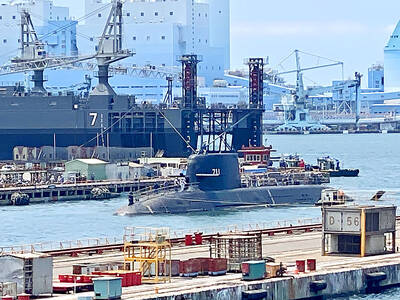
AGING: While Japan has 22 submarines, Taiwan only operates four, two of which were commissioned by the US in 1945 and 1946, and transferred to Taiwan in 1973 Taiwan would need at least 12 submarines to reach modern fleet capabilities, CSBC Corp, Taiwan chairman Chen Cheng-hung (陳政宏) said in an interview broadcast on Friday, citing a US assessment. CSBC is testing the nation’s first indigenous defense submarine, the Hai Kun (海鯤, Narwhal), which is scheduled to be delivered to the navy next month or in July. The Hai Kun has completed torpedo-firing tests and is scheduled to undergo overnight sea trials, Chen said on an SET TV military affairs program. Taiwan would require at least 12 submarines to establish a modern submarine force after assessing the nation’s operational environment and defense
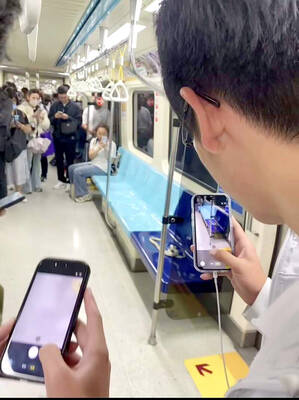
A white king snake that frightened passengers and caused a stir on a Taipei MRT train on Friday evening has been claimed by its owner, who would be fined, Taipei Rapid Transit Corp (TRTC) said yesterday. A person on Threads posted that he thought he was lucky to find an empty row of seats on Friday after boarding a train on the Bannan (Blue) Line, only to spot a white snake with black stripes after sitting down. Startled, he jumped up, he wrote, describing the encounter as “terrifying.” “Taipei’s rat control plan: Release snakes on the metro,” one person wrote in reply, referring
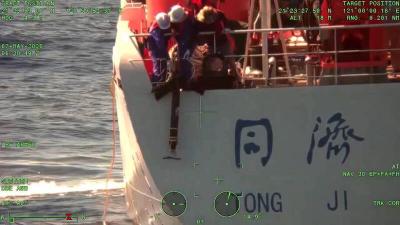
The coast guard today said that it had disrupted "illegal" operations by a Chinese research ship in waters close to the nation and driven it away, part of what Taipei sees a provocative pattern of China's stepped up maritime activities. The coast guard said that it on Thursday last week detected the Chinese ship Tongji (同濟號), which was commissioned only last year, 29 nautical miles (54km) southeast of the southern tip of Taiwan, although just outside restricted waters. The ship was observed lowering ropes into the water, suspected to be the deployment of scientific instruments for "illegal" survey operations, and the coast
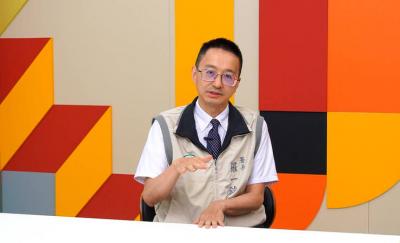
Taiwan’s two cases of hantavirus so far this year are on par with previous years’ case numbers, and the government is coordinating rat extermination work, so there should not be any outbreaks, Centers for Disease Control (CDC) Director-General Philip Lo (羅一鈞) said today in an interview with the Liberty Times (the Taipei Times’ sister newspaper). An increase in rat sightings in Taipei and New Taipei City has raised concerns about the spread of hantavirus, as rats can carry the disease. In January, a man in his 70s who lived in Taipei’s Daan District (大安) tested positive posthumously for hantavirus, Taiwan’s


 RSS
RSS