


Beijing displaying a tolerant attitude toward political dissidents is a better way to bridge the psychological divide between the nations on either side of the Taiwan Strait than China’s “yielding benefits” on the economic front, President Ma Ying-jeou (馬英九) said yesterday.
Ma made the remark in a written statement issued to reflect on the 25th anniversary of the Tiananmen Square Massacre yesterday. He has issued a statement on each of the massacre’s anniversaries since he came into office.
In the statement yesterday he lamented the long and rugged road for “the Chinese nation’s” democracy and rule of law, but said “as time passes and with various changes, I have started to become carefully optimistic about now being the best moment for democracy and the rule of law to take root in [China].”
Ma said that since Republic of China (ROC) founding father Sun Yat-sen (孫逸仙) ignited a revolution against the Qing Dynasty in the early 20th century, “establishing a republic” has been the “Chinese dream” of all Chinese around the globe, while the May Fourth movement had also compellingly called for democracy in China.
“After decades of hesitation and struggles, democracy and constitutionalism have finally taken root and bloomed in Taiwan, showing that Huaxia (華夏) soil is not hostile to these ideas,” Ma said.
“However, the June Fourth incident in 1989 dumbfounded us by exposing that Chinese still had to pay such a hefty price for democracy and freedom, exactly 70 years after the May Fourth movement,” Ma said. “Facing such historical trauma, I truly hope that the mainland authorities can redress the wrongs and make sure that [such a] tragedy never happens again.”
Taiwanese society has grown more mature in tolerating dissenting views and the conversations and reflections brought by them, 27 years after martial law was lifted, although disputes and protests are still rife, Ma said.
“In the process of interacting, communicating or even conflicting, more extreme confrontations and divides have been avoided and harmonized,” he said.
“The ideals of democracy — tolerance of opposing views, conforming to the majority and respecting the minority — have been part of Taiwanese life. Democracy is not simply a political system; it is also a civilized way of life,” Ma said.
“I wholeheartedly believe that today’s China is at the most felicitous moment for the implementation of political reform, democracy and the rule of law,” he added.
The reason he gave was that as Taiwan had achieved impressive economic growth before political democratization in the late 1980s, China’s economy and its people’s education and modernization have reached a point that could yield an environment with freedom of speech, an impartial judicial system and a law-abiding government that protects human rights.
“I have stressed on several occasions commemorating the June Fourth incident that the most effective way to close the gap between the two sides of the Strait is for the Chinese government to treat its dissidents well. Not only could the legitimacy of the authorities be raised, the deed would also show Taiwanese that it [Beijing] is serious about its political reform,” Ma said.
“It would better to win Taiwanese and international society’s respect than surrendering economic benefits to Taiwan. And the stereotypical view Taiwanese have of the Chinese government could also be greatly altered,” he said.
It was the first time that Ma, who has been criticized for softening the stance of his statements about the incident compared with his previous remarks, has called for reparations for the Tiananmen Square Massacre since he took office in 2008.
In response, Democratic Progressive Party (DPP) spokesperson Hsu Chia-ching (徐佳青) said the remark was Ma’s strongest criticism of China in six years.
“It is long overdue. While it is late, it is better late than never and the DPP respects what he said. However, Ma should have done more as president, as we have seen democracy advocates and artists being arrested and detained by Beijing over the past 25 years,” Hsu said.
However, Ma has committed a grave mistake in his comments about freedom of speech, Hsu said.
Ma urged Beijing to respect freedom of speech, saying that the ROC has never oppressed people’s freedom of speech during the “phase of political tutelage” it underwent between 1928 and 1947.
The Chinese Nationalist Party’s (KMT) oppression of freedom of speech and democracy advocates during its authoritarian rule in Taiwan was undeniable and “it is unfortunate that Ma has deliberately ignored history,” Hsu said.
Additional reporting by Shih Hsiu-chuan
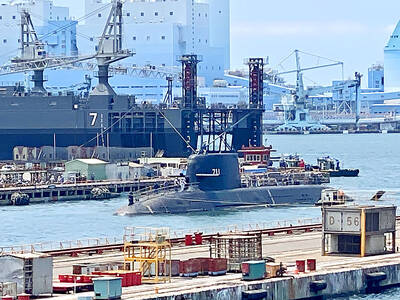
AGING: While Japan has 22 submarines, Taiwan only operates four, two of which were commissioned by the US in 1945 and 1946, and transferred to Taiwan in 1973 Taiwan would need at least 12 submarines to reach modern fleet capabilities, CSBC Corp, Taiwan chairman Chen Cheng-hung (陳政宏) said in an interview broadcast on Friday, citing a US assessment. CSBC is testing the nation’s first indigenous defense submarine, the Hai Kun (海鯤, Narwhal), which is scheduled to be delivered to the navy next month or in July. The Hai Kun has completed torpedo-firing tests and is scheduled to undergo overnight sea trials, Chen said on an SET TV military affairs program. Taiwan would require at least 12 submarines to establish a modern submarine force after assessing the nation’s operational environment and defense
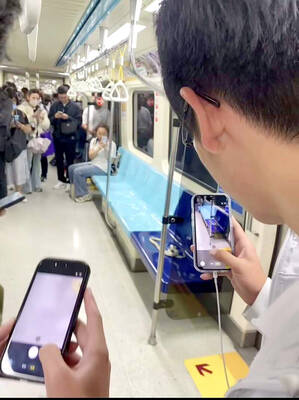
A white king snake that frightened passengers and caused a stir on a Taipei MRT train on Friday evening has been claimed by its owner, who would be fined, Taipei Rapid Transit Corp (TRTC) said yesterday. A person on Threads posted that he thought he was lucky to find an empty row of seats on Friday after boarding a train on the Bannan (Blue) Line, only to spot a white snake with black stripes after sitting down. Startled, he jumped up, he wrote, describing the encounter as “terrifying.” “Taipei’s rat control plan: Release snakes on the metro,” one person wrote in reply, referring
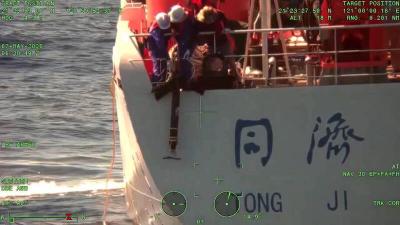
The coast guard today said that it had disrupted "illegal" operations by a Chinese research ship in waters close to the nation and driven it away, part of what Taipei sees a provocative pattern of China's stepped up maritime activities. The coast guard said that it on Thursday last week detected the Chinese ship Tongji (同濟號), which was commissioned only last year, 29 nautical miles (54km) southeast of the southern tip of Taiwan, although just outside restricted waters. The ship was observed lowering ropes into the water, suspected to be the deployment of scientific instruments for "illegal" survey operations, and the coast
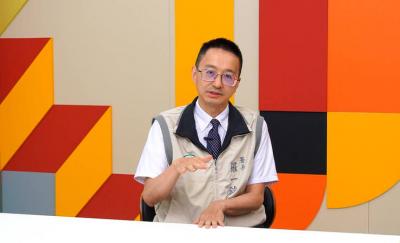
Taiwan’s two cases of hantavirus so far this year are on par with previous years’ case numbers, and the government is coordinating rat extermination work, so there should not be any outbreaks, Centers for Disease Control (CDC) Director-General Philip Lo (羅一鈞) said today in an interview with the Liberty Times (the Taipei Times’ sister newspaper). An increase in rat sightings in Taipei and New Taipei City has raised concerns about the spread of hantavirus, as rats can carry the disease. In January, a man in his 70s who lived in Taipei’s Daan District (大安) tested positive posthumously for hantavirus, Taiwan’s


 RSS
RSS