


The Discovery Channel yesterday said it would present a new series of documentaries that showcase Taiwan’s achievements in medicine, agriculture and industrial innovation.
The three-episode program, which was made in cooperation with the Ministry of Foreign Affairs, is to premiere tomorrow, Arjan Hokstra, president and managing director of Discovery Networks Asia-Pacific, told a press conference in Taipei.
The first episode, titled Taiwan Revealed: Body Reconstructed, focuses on Taiwanese microsurgeon Wei Fu-chan (魏福全) and his team at Chang Gung Memorial Hospital’s plastic reconstructive surgery department.
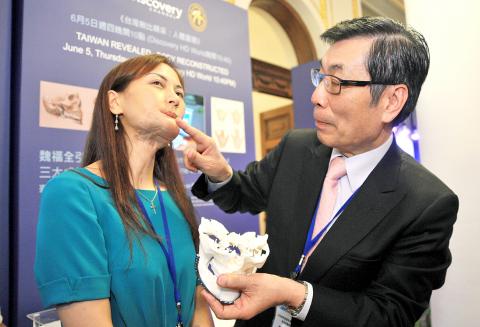
Photo: Liu Hsin-de, Taipei Times
Wei, among the world’s top plastic and reconstructive surgeons, has provided surgical treatment to peopled injured at work or those needing craniofacial reconstruction, among others.
The episode features how Wei and his team treated three people and helped restore their dignity. The patients include a Taiwanese man who lost 10 fingers in an accident and a Hong Kong woman who lost her lower jaw from a gunshot.
Another episode, Taiwan Revealed: Convenient Truths, scheduled to air on Thursday next week, showcases cutting-edge agricultural innovations in Taiwan, the channel said.
Among the featured stories are a high-tech LED lighting system that helps produce beautiful water bamboo in Nantou County, a prewarning system for fruit flies that protects guava farms in Changhua and the invention of a membrane that can recycle and reuse industrial water.
The final documentary in the series, Taiwan Revealed: Innovation Island, is to air on June 19. Featured stories include the world’s first transparent smartphone, which was introduced by a Taiwanese company, and the use of coffee grounds to produce odor-resistant fabric.
At the press conference, Hokstra said that “this year marks Discovery Channel’s 20th anniversary in the Asia-Pacific.”
As part of the channel’s efforts to tell local stories from a global perspective, the channel has worked with the ministry to produce several documentary series on Taiwan over the past 10 years, he added.
President Ma Ying-jeou (馬英九) and many Taiwan-based foreign officials attended the press conference, during which video clips from the programs were shown.
Ma praised Discovery Channel’s role in helping promote Taiwan on the international stage and recommended that the channel also produce documentaries featuring outstanding Taiwanese such as Lien Jih-ching (連日清), a specialist in mosquito-borne diseases who has played an important role in combating malaria.
The Taiwan Revealed series will be aired in 36 countries and territories across the Asia-Pacific region this month and next, the channel said.

NATIONAL SECURITY: Authorities are working to confirm the identities of the military personnel involved and investigating possible illegal conduct and regulatory violations Authorities are probing possible national security implications after Kinmen police and immigration officers on Sunday found a Chinese woman allegedly posing as a tourist while engaging in prostitution involving more than 10 military personnel. The woman, surnamed Chen (陳), has since been deported, authorities said, adding that investigators are still working to confirm the identities of those implicated, as the records only listed code names and aliases. The case stemmed from a report received by the Kinmen District Prosecutors’ Office on Friday last week from the Jinhu Precinct of the Kinmen County Police Bureau. On Sunday, police, along with the National Immigration

GLOBALGIVING: ‘ Caving to external pressure is not acceptable for an organization that has cultivated justice reform and human rights for 30 years,’ one NGO said A slew of non-government organizations (NGOs) have withdrawn from the GlobalGiving fundraising platform after it announced it would use “Chinese Taipei” instead of “Taiwan” from next month. The Taiwan Good Rice Association wrote on Facebook on Friday that it was informed on April 28 via a teleconference call of the change, which was made because the platform wanted to operate in China. Taiwan Good Rice is to terminate all cooperative relationships with GlobalGiving in response to the platform’s “unilateral and non-negotiable” decision to remove references to Taiwan, the NGO said. “Taiwan is in the official name of Taiwan Good Rice Association and the

HEAVY WEATHER: Typhoon Jangmi is due to crash straight into the Ryukyus as airlines look to shift flights to larger aircraft or cancel flights to Okinawa entirely Taiwan’s international air carriers announced flight adjustments over the weekend as Typhoon Jangmi is forecast to hit the Ryukyu Islands today and tomorrow. The Central Weather Administration (CWA) upgraded Jangmi from a tropical storm to a typhoon at 8am yesterday, with the eye located 580km south of Naha city. It was moving north at 19kph. Today, China Airlines’ CI-120, CI-121, CI-122 and CI-123 flights between Taoyuan and Naha, Okinawa, have been canceled as well as CI-132 and CI-133 between Kaohsiung and Naha. EVA Air’s BR-112, BR-113, BR-186 and BR-185 flights between Taoyuan and Naha are also canceled. Low-cost carrier Tigerair Taiwan canceled IT-230,

Chinese Nationalist Party (KMT) Chairwoman Cheng Li-wun (鄭麗文) yesterday briefed her party’s Central Standing Committee regarding her scheduled visit to the US between Monday next week and June 16, saying that her purpose would be to persuade the US that the Republic of China (ROC) Constitution was a “one China” constitution that would foster stable and peaceful cross-strait relations. The ROC Constitution is the most important defense for all Taiwanese citizens, as it upholds our democracy and has contributed to our robust economy, which aligns with international and US interests, she said. “We would not be troublemakers and drag the US under,”


 RSS
RSS