


Liberty Times (LT): How do you feel about the Tiananmen Square Massacre with the 25th anniversary just over the horizon? Do you have any goals you would like to set for China’s democratization efforts?
Wang Dan (王丹): My heart is heavy when looking back [at what happened] 25 years ago. There was never a political rehabilitation of the event and historically, it has not yet received the redress it deserved. It has always been a great sadness that many sacrificed themselves in that event, yet it seems China’s democratization is still far off.
Despite my heavy feelings over the subject, I do not regret my actions. Although I have not accomplished much, I have struck to my course and have done my best to be consistent.
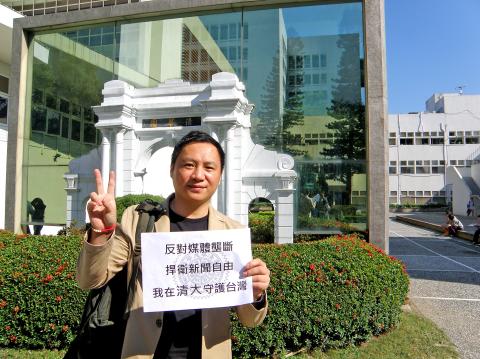
Photo: Hung Mei-hsiu, Taipei Times
The ideals and passion of youth are the valuable assets of any society, and the most important thing I can do is to ensure that such vitality is passed down from generation to generation and influences more young men for the betterment of the country and the nation.
As a participant in the June 4 Incident, I feel it is my duty as a witness to pass on the truth of this particular event in history. I hope for the day when China will be ruled by democracy, but this is not just a problem stemming from the Chinese Communist Party. I also hope to see more Chinese come to the realization [that China needs democracy] and seek to reorder their lives and politics under a new system.
LT: After Chinese President Xi Jinping (習近平) came to power, he started to crack down on corrupt officials. What do you think his actual goal is?
Wang: Of course Xi’s crackdown on corruption is fake; it is simply a ruse he has been using since he came to power. Xi is calling for anti-corruption, [but] he is looking the other way when it comes to his own family. It is evident the anti-corruption crackdown is selective, and targets the action of corruption, not the corrupted system.
The system is important, especially if one wishes to provide a solution to corruption. Targeting specific actions for correction — ie, limiting spending on extravagant meals — will not solve corruption. The only way to solve corruption is [to allow the] democratization [of China], but Xi is unwilling to do so.
Xi’s anti-corruption crackdown, in this sense, is phony and is only a ploy to strike at his enemies and consolidate power. Ultimately, the target is not corruption, but power.
LT: Xi has adopted a more aggressive strategy on diplomacy than his predecessor, Hu Jintao (胡錦濤), and is actively challenging the US strategy of pivoting toward Asia. What are your thoughts on this?
Wang: The tougher stance the Xi regime has adopted on foreign policy [may stem from] Xi wishing to emulate Mao [Zedong (毛澤東).] Both in terms of language and policy, there are hints that Xi is strongly influenced by Mao. Xi’s wish to put himself in the role of the leader of nationalism, or his tendency to use blunt, straightforward methods to handle otherwise sensitive diplomatic situations [are examples].
However, the international diplomatic situation is quite complex, and Xi’s simplistic approach in handling it cannot allow him to arrive at his goals; quite the opposite, it will only bring him more trouble. I feel that he has taken on an erroneous attitude in this regard.
LT: Both the leaders of the Sunflower movement, Lin Fei-fan (林飛帆) and Chen Wei-ting (陳為廷), were once your students. What do you think of their performance during the movement’s protests? And what kind of advice would you give to young students if they were considering joining a civic movement?
Wang: I myself have created a piece of history by taking action. There is nothing more comforting than seeing my own students writing another chapter of history by doing something right. They are remarkable people who are full of passion.
To resolve the challenges and difficulties Taiwan has encountered during its [democratization] process, more young people must start caring about and getting involved in major social issues. Whether or not others are 100 percent satisfied with the pair’s conduct and performance, I, as an educator, am very proud of them.
The Sunflower movement has had two profound effects on the nation.
The first one is on its democracy. Triggered by people’s discontent with the system of representative politics in this country, the movement demonstrated the force of “people power” so magnificently that it has helped blaze a new path for the nation’s democratic development.
From now on, Taiwanese may begin to exercise people power more often to make up for the deficiency of the nation’s current democratic system.
The second effect is on its ties with China. To the communist regime, the appeals, stances and attitudes of participants in the movement were something completely unexpected. This surprise could force the regime to rethink or even change its policies toward Taiwan.
In addition to China, Hong Kong was also deeply influenced by the movement.
After the Sunflower movement was launched, many members of the Hong Kong Federation of Students and the Legislative Council flew to Taiwan to show their support for the student-led movement.
It is apparent that the “China factor” has underlined the importance of mutual support and understanding between Taiwanese and Hong Kongers and has brought them closer than ever.
One of the leaders of a recent 20,000-strong rally in Macau against a controversial bill is Su Jiahao (蘇嘉豪), a Macanese student in National Taiwan University’s political science department, whom I have known since he was a freshman.
Since I started teaching in Taiwan [in 2009], I have held a memorial event for [the massacre] on June 4 of each year. Chen and Su were both among the organizers for the first such event, which I believe signaled the beginning of a mutually supportive relationship between the younger generation of Taiwanese and their counterparts across the Taiwan Strait.
Only by standing together and joining forces can these young people channel enough power to have a fighting chance against their mutual enemy — the Chinese government.
LT: President Ma Ying-jeou (馬英九) has endeavored to make breakthroughs in cross-strait ties in a desperate attempt to prop up his dismal approval ratings at home. How do you think China would evaluate Ma’s remaining term and what kind of adjustments do you think it would make on its policies toward Taiwan?
Wang: China’s Taiwan Affairs Office (TAO) has made its stance quite clear and has hinted that it is determined to make some adjustments. It has repeatedly pledged to reach out to people from southern Taiwan, to the proprietors of small and medium-sized enterprises, and to the nation’s younger generation.
In the past, it never occurred to China that there would be another political power in Taiwan apart from the Chinese Nationalist Party (KMT) and the Democratic Progressive Party — the power of civil society.
I believe the TAO has learned its lessons and will start paying more heed to this particular power. Efforts will also be made to get in touch with Taiwan’s civic society.
With regard to President Ma’s performance, his recent approval ratings suggest that there is still ample room for improvement. While the president has repeatedly reassured the public that he has always listened to the voices of the people, I doubt he is truly willing to open his mind to different opinions.
For instance, Ma held a forum with a number of young people after the conclusion of the Sunflower movement to solicit their opinions, but none of the prominent participants of the Sunflower movement were invited.
LT: You have been teaching in Taiwan for nearly five years. What is your impression of Taiwan and what advice would you give?
Wang: Taiwan has experienced plenty of changes over the past years, but far too many them were in the political spectrum. The country has been unable to find a clear path forward and many of the changes were made in the absence of a national consensus.
The country’s next tasks will be more profound than democratization, including making changes to existing ideas and creating a new set of social values.
China has been luring Taiwanese with high salaries, but that trick does not seem to work on Europeans and Americans.
This phenomenon poses a tough question to Taiwanese society: Is being able to live freely and with dignity more important than being wealthy?
If you choose money, it is only a matter of time before you are drawn to China’s bait, particularly at a time when its rapid economic growth has turned it into a powerful magnet for global talent. However, if you attach more importance to your values, then there is no need for you to move to China.
Following the student movement, Taiwan has seen a new generation of youth who are concerned about public affairs and are no longer indifferent to reality and politics.
From this point of view, I believe there is still hope for Taiwan.
Translated by Jake Chung and Stacy Hsu

NATIONAL SECURITY: Authorities are working to confirm the identities of the military personnel involved and investigating possible illegal conduct and regulatory violations Authorities are probing possible national security implications after Kinmen police and immigration officers on Sunday found a Chinese woman allegedly posing as a tourist while engaging in prostitution involving more than 10 military personnel. The woman, surnamed Chen (陳), has since been deported, authorities said, adding that investigators are still working to confirm the identities of those implicated, as the records only listed code names and aliases. The case stemmed from a report received by the Kinmen District Prosecutors’ Office on Friday last week from the Jinhu Precinct of the Kinmen County Police Bureau. On Sunday, police, along with the National Immigration

GLOBALGIVING: ‘ Caving to external pressure is not acceptable for an organization that has cultivated justice reform and human rights for 30 years,’ one NGO said A slew of non-government organizations (NGOs) have withdrawn from the GlobalGiving fundraising platform after it announced it would use “Chinese Taipei” instead of “Taiwan” from next month. The Taiwan Good Rice Association wrote on Facebook on Friday that it was informed on April 28 via a teleconference call of the change, which was made because the platform wanted to operate in China. Taiwan Good Rice is to terminate all cooperative relationships with GlobalGiving in response to the platform’s “unilateral and non-negotiable” decision to remove references to Taiwan, the NGO said. “Taiwan is in the official name of Taiwan Good Rice Association and the

HEAVY WEATHER: Typhoon Jangmi is due to crash straight into the Ryukyus as airlines look to shift flights to larger aircraft or cancel flights to Okinawa entirely Taiwan’s international air carriers announced flight adjustments over the weekend as Typhoon Jangmi is forecast to hit the Ryukyu Islands today and tomorrow. The Central Weather Administration (CWA) upgraded Jangmi from a tropical storm to a typhoon at 8am yesterday, with the eye located 580km south of Naha city. It was moving north at 19kph. Today, China Airlines’ CI-120, CI-121, CI-122 and CI-123 flights between Taoyuan and Naha, Okinawa, have been canceled as well as CI-132 and CI-133 between Kaohsiung and Naha. EVA Air’s BR-112, BR-113, BR-186 and BR-185 flights between Taoyuan and Naha are also canceled. Low-cost carrier Tigerair Taiwan canceled IT-230,
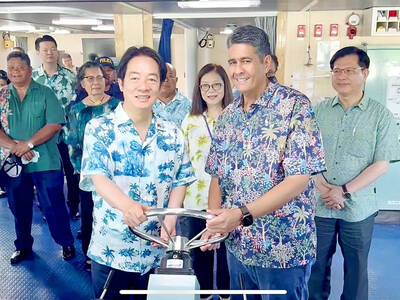
MULTIPRONGED APPROACH: China has sought to pressure Palau across a number of fronts, but the island nation has staunchly resisted overtures to ditch Taiwan Palau has been firm in backing Taiwan despite Chinese pressure that uses tourism economics, cyberattacks and criminal infiltration as tools to threaten the Pacific ally into renouncing its recognition of Taiwan as a sovereign state. The Presidential Office yesterday announced that Vice President Hsiao Bi-khim (蕭美琴) would visit Palau from Saturday to Wednesday next week at the invitation of Palauan President Surangel Whipps Jr. Whipps in April said in an interview that China had outspokenly asked Palau to “denounce Taiwan.” “And we have said: ‘We have no enemies, but nobody tells us who our friends are,’” he said. Whipps has told reporters multiple times


 RSS
RSS