


In an interview published yesterday, President Ma Ying-jeou (馬英九) said that he has been highly active in developing cross-relations since Chinese President Xi Jinping (習近平) assumed his post last year, adding that he believes that the upcoming APEC Economic Leaders’ Meeting would be a suitable occasion for a meeting between him and Xi.
However, since Beijing remains reserved about the prospect of such a summit, the government has no concrete plan for it, Ma said in response to media queries in an interview in Japanese newspaper the Yomiuri Shimbun.
In the interview, Ma discussed a range of issues, such as the cross-strait service trade agreement and the nation’s economic and trade development.
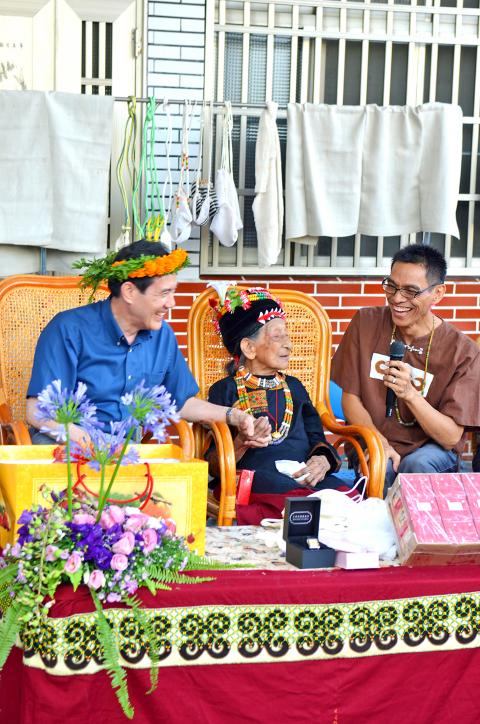
Photo: Chiu Chih-jou, Taipei Times
The president said that when Xi met former vice president Vincent Siew (蕭萬長) at last year’s APEC Economic Leaders’ Meeting, the Chinese leader went beyond reiterating Beijing’s standard position on the importance of promoting the peaceful development of cross-strait relations.
According to Ma, Xi said then that in the “long term,” the political differences between the two sides must be resolved so they are not passed on from generation to generation.
The government’s stance toward interactions with China has been and remains: “First the urgent, then the gradual; first the easy, then the difficult; first economics, then politics,” Ma said.
Ma made headlines on a separate occasion yesterday, when, while on a visit to an Aboriginal Rukai village in Pingtung County’s Sandimen Township (三地門) he was rejected by an elderly woman after asking her for a kiss.
The episode took place at an event in the township’s Chingye Village (青葉) held to commemorate Rukai elder Peng Yu-mei’s (彭玉梅) 112th birthday.
When the president took her by the hands and asked if he could kiss her on the cheek, Peng turned him down, saying that “no other man aside from my husband has ever touched my body,” drawing a bit of embarrassed laughter from Ma and the other guests.
After being spurned, Ma presented Peng with gifts that included a red envelope, ornamental items, a presidential watch and red tea.
Peng was born in 1903 and has witnessed multiple changes of government through her lifetime, she said.
She has a big family, with more than 100 members spanning across six generations, she added.
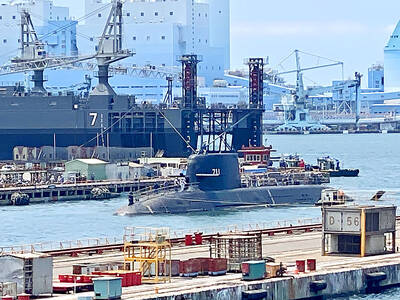
AGING: While Japan has 22 submarines, Taiwan only operates four, two of which were commissioned by the US in 1945 and 1946, and transferred to Taiwan in 1973 Taiwan would need at least 12 submarines to reach modern fleet capabilities, CSBC Corp, Taiwan chairman Chen Cheng-hung (陳政宏) said in an interview broadcast on Friday, citing a US assessment. CSBC is testing the nation’s first indigenous defense submarine, the Hai Kun (海鯤, Narwhal), which is scheduled to be delivered to the navy next month or in July. The Hai Kun has completed torpedo-firing tests and is scheduled to undergo overnight sea trials, Chen said on an SET TV military affairs program. Taiwan would require at least 12 submarines to establish a modern submarine force after assessing the nation’s operational environment and defense
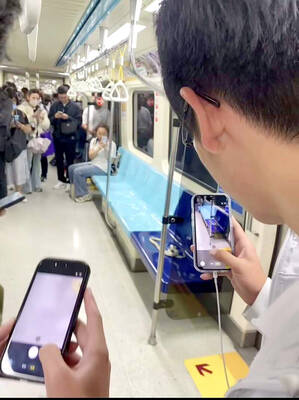
A white king snake that frightened passengers and caused a stir on a Taipei MRT train on Friday evening has been claimed by its owner, who would be fined, Taipei Rapid Transit Corp (TRTC) said yesterday. A person on Threads posted that he thought he was lucky to find an empty row of seats on Friday after boarding a train on the Bannan (Blue) Line, only to spot a white snake with black stripes after sitting down. Startled, he jumped up, he wrote, describing the encounter as “terrifying.” “Taipei’s rat control plan: Release snakes on the metro,” one person wrote in reply, referring
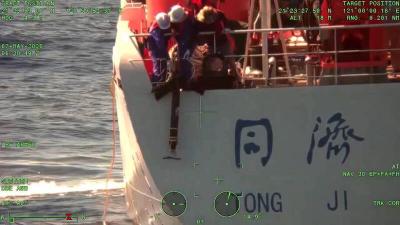
The coast guard today said that it had disrupted "illegal" operations by a Chinese research ship in waters close to the nation and driven it away, part of what Taipei sees a provocative pattern of China's stepped up maritime activities. The coast guard said that it on Thursday last week detected the Chinese ship Tongji (同濟號), which was commissioned only last year, 29 nautical miles (54km) southeast of the southern tip of Taiwan, although just outside restricted waters. The ship was observed lowering ropes into the water, suspected to be the deployment of scientific instruments for "illegal" survey operations, and the coast
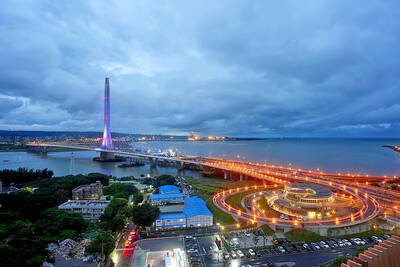
An inauguration ceremony was held yesterday for the Danjiang Bridge, the world’s longest single-mast asymmetric cable-stayed bridge, ahead of its official opening to traffic on Tuesday, marking a major milestone after nearly three decades of planning and construction. At the ceremony in New Taipei City attended by President William Lai (賴清德), Premier Cho Jung-tai (卓榮泰), Minister of Transportation and Communications Chen Shih-kai (陳世凱) and New Taipei City Mayor Hou Yu-ih (侯友宜), the bridge was hailed as both an engineering landmark and a long-awaited regional transport link connecting Tamsui (淡水) and Bali (八里)


 RSS
RSS