


The US’ relationship with Taiwan has “suffered from benign neglect for far too long,” Project 2049 Institute academic Julia Famularo told a Washington conference on Thursday.
She said US President Barack Obama’s administration should “reinvigorate” relations by working directly with Taipei to promote peace and stability in Asia, preserve human rights and media freedom, and facilitate Taiwan’s meaningful participation in international organizations.
Famularo said the US should maintain regular and appropriate arms sales to bolster Taiwan’s capacity to defend itself against military threats.
“The Obama administration should authorize the sale of increasingly advanced weapons platforms to assist Taiwan in maintaining its defense capability,” she told the conference on US-Taiwan relations organized by the American Enterprise Institute (AEI).
Famularo said Washington could not expect to successfully implement its Asia rebalancing policy unless Taiwan maintained the capacity to defend its sovereignty.
She called for a more “robust and transparent” dialogue on how Taipei could best counter threats from Beijing.
Washington should strengthen the US-Taiwan economic and trade relationship and actively support Taiwan’s membership in the Trans-Pacific Partnership (TPP) as a second round candidate, Famularo said.
In addition, she said the White House should speak out “far more frequently” on the importance of preserving democracy, human rights and media freedom in Taiwan.
There were “indications” that Taiwan was being pressured into backtracking on civil rights and liberties “for the purpose of improving cross-strait relations,” Famularo said.
Washington needed to “appropriately react” to pressures faced by civil society in Taiwan.
US officials visiting Taiwan should meet with opposition political parties, non-governmental organizations and civic groups throughout the country, she said.
And the Obama administration should send high level State Department officials to study the recent large scale protests in Taiwan and such groups as the Sunflower movement.
“If Taiwan’s voice is extinguished in the international community, the US will lose an essential democratic, economic and security partner,” Famularo said.
“It is in US interests to expand Taiwan’s international space by facilitating Taiwan’s participation as a member or observer in existing international organizations such as the United Nations, TPP, the International Monetary Fund and the World Bank,” she said.
“The US-Taiwan relationship is not merely one that we should manage effectively in order to strengthen bilateral ties with China,” Famularo said.
Center for Strategic and Budgetary Assessments vice president Jim Thomas said Taiwan had been “strangely absent” from discussion about Obama’s Asia rebalance.
This lack of discussion only served to highlight that “fundamental underlying tensions” between Taiwan and China remain, he said.
AEI resident academic Derek Scissors said that while US-Taiwan relations still mattered, their importance was “increasingly fragile.”
On the economic side, he said, Taiwan had almost nothing to offer.
Scissors said the rise of Japan boosted Taiwan’s economy for about three decades and the rise of China boosted it for three more decades.
However, those boosts were over and Taiwan now needed new partners to maintain its prosperity.
“It has to be extremely aggressive to find these partners in trade and investment,” he said.
If the TPP is successful and if Taiwan joins it early “the problem is largely solved,” Scissors said.
However, if the partnership fails or Taiwan is late in joining, the nation is headed for long-term economic stagnation.
“There is no way around it,” Scissors said.
If South Korea, Vietnam, Malaysia, Singapore and Mexico join the TPP before Taiwan, “no one will need Taiwan.”
“Joining late is no good,” Scissors said.
It would be a mistake, he said, to get in line behind South Korea and the Philippines.
Vice president for political and security affairs at the National Bureau of Asian Research Abe Denmark reminded the conference that this year marked the 20th anniversary of the Taiwan Policy Review.
“It was a very important step in the evolution of American strategy and policy towards Taiwan,” he said.
Denmark said the military and economic situation had changed greatly since the review and that it may now be time to repeat the process.
“It may be time for another review,” he said.
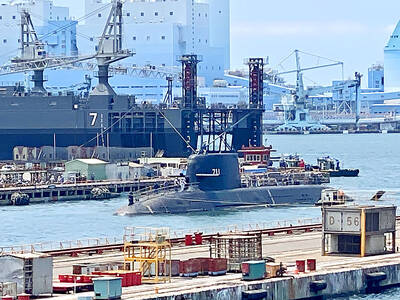
AGING: While Japan has 22 submarines, Taiwan only operates four, two of which were commissioned by the US in 1945 and 1946, and transferred to Taiwan in 1973 Taiwan would need at least 12 submarines to reach modern fleet capabilities, CSBC Corp, Taiwan chairman Chen Cheng-hung (陳政宏) said in an interview broadcast on Friday, citing a US assessment. CSBC is testing the nation’s first indigenous defense submarine, the Hai Kun (海鯤, Narwhal), which is scheduled to be delivered to the navy next month or in July. The Hai Kun has completed torpedo-firing tests and is scheduled to undergo overnight sea trials, Chen said on an SET TV military affairs program. Taiwan would require at least 12 submarines to establish a modern submarine force after assessing the nation’s operational environment and defense

A white king snake that frightened passengers and caused a stir on a Taipei MRT train on Friday evening has been claimed by its owner, who would be fined, Taipei Rapid Transit Corp (TRTC) said yesterday. A person on Threads posted that he thought he was lucky to find an empty row of seats on Friday after boarding a train on the Bannan (Blue) Line, only to spot a white snake with black stripes after sitting down. Startled, he jumped up, he wrote, describing the encounter as “terrifying.” “Taipei’s rat control plan: Release snakes on the metro,” one person wrote in reply, referring
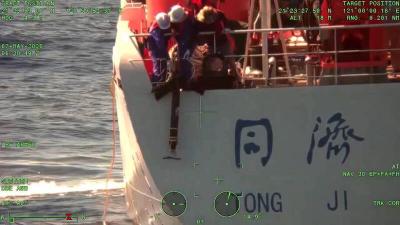
The coast guard today said that it had disrupted "illegal" operations by a Chinese research ship in waters close to the nation and driven it away, part of what Taipei sees a provocative pattern of China's stepped up maritime activities. The coast guard said that it on Thursday last week detected the Chinese ship Tongji (同濟號), which was commissioned only last year, 29 nautical miles (54km) southeast of the southern tip of Taiwan, although just outside restricted waters. The ship was observed lowering ropes into the water, suspected to be the deployment of scientific instruments for "illegal" survey operations, and the coast
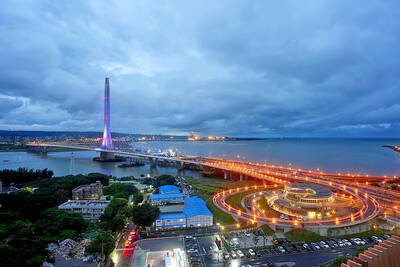
An inauguration ceremony was held yesterday for the Danjiang Bridge, the world’s longest single-mast asymmetric cable-stayed bridge, ahead of its official opening to traffic on Tuesday, marking a major milestone after nearly three decades of planning and construction. At the ceremony in New Taipei City attended by President William Lai (賴清德), Premier Cho Jung-tai (卓榮泰), Minister of Transportation and Communications Chen Shih-kai (陳世凱) and New Taipei City Mayor Hou Yu-ih (侯友宜), the bridge was hailed as both an engineering landmark and a long-awaited regional transport link connecting Tamsui (淡水) and Bali (八里)


 RSS
RSS