


The Chinese Nationalist Party (KMT) said on Monday and reiterated yesterday that it would invite city and county mayors to the Legislative Yuan to make public their stands on the controversial issue of establishing free economic pilot zones (FEPZs). Democratic Progressive Party (DPP) local government leaders panned the motion as tantamount to “blackmail.”
The KMT party caucus yesterday called on the local governors to “reveal their stance on the nation’s major economic policy,” after DPP city and county mayors issued a joint statement late on Monday and turned down the KMT’s invitation to attend a joint committee session for reviewing a bill on the development of the pilot zones.
KMT Legislator Huang Chao-shun (黃昭順), convener of the legislature’s joint committee, said last week she would invite the mayors of the cities and counties that would be home to the planned FEPZs to the committee session today to announce their endorsement or rejection of the policy concerning the pilot zones.
“If you don’t need [the pilot zones], they could be taken away. There’s no pressure,” Huang said.
KMT Deputy Chairman Tseng Yung-chuan (曾永權) praised Huang’s “decisive” action on Monday and said if DPP mayors do not want the pilot zones, the plans for their cities and counties could be “scrapped” and given to other places whose mayors “assertively asked for the [projects].”
The DPP mayors — Yilan County Commissioner Lin Tsung-hsien (林聰賢), Chiayi County Commissioner Helen Chang (張花冠), Greater Kaohsiung Mayor Chen Chu (陳菊), Greater Tainan Mayor William Lai (賴清德) and Pingtung County Commissioner Tsao Chi-hung (曹啟鴻) — released a joint statement later on Monday, denouncing the KMT’s proposal as oversimplifying a complex policy project that requires thorough deliberation.
“Policies such as FEPZs deserve better deliberation than a simple question of ‘yes’ or ‘no.’ That the local governments welcome the setting up of the FEPZs does not mean that they endorse the bill package, which contains inappropriate designs,” they said in the statement.
The statement added that rigorous review of a policy is the legislature’s duty and that the Executive Yuan’s proposal must be able to “stand [up to] the legislature and civil society’s close examination, rather than force local governments into submission with intimidation measures.”
“The KMT’s tactic of ‘endorse it or be excluded from it’ is tantamount to blackmail. It arises from an authoritarian mentality which is extremely anti-democratic,” the five mayors said.
“We agree that as an economy that strongly depends on economic commerce, Taiwan cannot be insulated from the international trade network. However, the plan of FEPZs is no small business and must undergo comprehensive review to avoid another ‘black-box’ controversy sparked by the cross-strait service trade agreement,” they said.
Responding to the statement, Huang said yesterday that the KMT did not insist on passing the Executive Yuan’s version of the bill, but the bill has been blocked by the DPP since early March.
“Different opinions, if explicitly voiced, would be considered in the review process,” she said.
Greater Kaohsiung Mayor Chen Chu said separately yesterday that the KMT’s strong-arm tactics to win endorsement of the policy is no different from threatening Kaohsiung’s 2.27 million citizens and questioned in what capacity Tseng could have a say in the matter.
She said that she supported the clauses in the bill that would bring benefits to Greater Kaohsiung and Taiwan, but room for rational discussion must be allowed for the clauses that the local governments are having doubts about.
Chen said she would not be able to attend the session, but would ask DPP legislators to voice her concerns.
The KMT caucus announced later yesterday that six KMT and non-partisan local government heads agreed to attend today’s session.
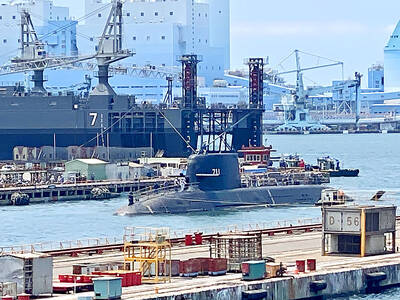
AGING: While Japan has 22 submarines, Taiwan only operates four, two of which were commissioned by the US in 1945 and 1946, and transferred to Taiwan in 1973 Taiwan would need at least 12 submarines to reach modern fleet capabilities, CSBC Corp, Taiwan chairman Chen Cheng-hung (陳政宏) said in an interview broadcast on Friday, citing a US assessment. CSBC is testing the nation’s first indigenous defense submarine, the Hai Kun (海鯤, Narwhal), which is scheduled to be delivered to the navy next month or in July. The Hai Kun has completed torpedo-firing tests and is scheduled to undergo overnight sea trials, Chen said on an SET TV military affairs program. Taiwan would require at least 12 submarines to establish a modern submarine force after assessing the nation’s operational environment and defense

A white king snake that frightened passengers and caused a stir on a Taipei MRT train on Friday evening has been claimed by its owner, who would be fined, Taipei Rapid Transit Corp (TRTC) said yesterday. A person on Threads posted that he thought he was lucky to find an empty row of seats on Friday after boarding a train on the Bannan (Blue) Line, only to spot a white snake with black stripes after sitting down. Startled, he jumped up, he wrote, describing the encounter as “terrifying.” “Taipei’s rat control plan: Release snakes on the metro,” one person wrote in reply, referring
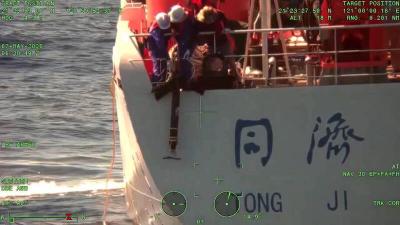
The coast guard today said that it had disrupted "illegal" operations by a Chinese research ship in waters close to the nation and driven it away, part of what Taipei sees a provocative pattern of China's stepped up maritime activities. The coast guard said that it on Thursday last week detected the Chinese ship Tongji (同濟號), which was commissioned only last year, 29 nautical miles (54km) southeast of the southern tip of Taiwan, although just outside restricted waters. The ship was observed lowering ropes into the water, suspected to be the deployment of scientific instruments for "illegal" survey operations, and the coast
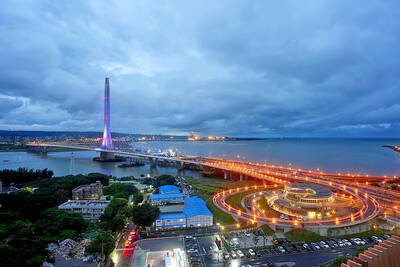
An inauguration ceremony was held yesterday for the Danjiang Bridge, the world’s longest single-mast asymmetric cable-stayed bridge, ahead of its official opening to traffic on Tuesday, marking a major milestone after nearly three decades of planning and construction. At the ceremony in New Taipei City attended by President William Lai (賴清德), Premier Cho Jung-tai (卓榮泰), Minister of Transportation and Communications Chen Shih-kai (陳世凱) and New Taipei City Mayor Hou Yu-ih (侯友宜), the bridge was hailed as both an engineering landmark and a long-awaited regional transport link connecting Tamsui (淡水) and Bali (八里)


 RSS
RSS