


The US will continue to expand ties with “longtime friends” such as Taiwan, US Assistant Secretary of State for East Asia Daniel Russel told US lawmakers on Tuesday.
“The Asia-Pacific [region] is integral to United States growth and stability and for that reason our continued engagement must not and will not waver,” he said.
Testifying on next year’s US$1.2 billion budget request for East Asia, Russel told the US House of Representatives Foreign Affairs Subcommittee on Asia that the future security and prosperity of the US would be significantly defined by developments in the region.
The testimony took on new importance, following Russian President Vladimir Putin’s visit to Beijing this week, China’s reaction to charges by Washington that senior Chinese military officers were stealing US commercial secrets and the standoff between China and Vietnam over an oil rig in the South China Sea.
“At a time when the region is building a more mature security and economic architecture to promote stability and prosperity, sustained US commitment is essential,” Russel said.
“US leadership will strengthen that architecture and pay dividends for our security and prosperity well into this century,” he said.
Russel said that in its second term US President Barack Obama’s administration was continuing to build commitments, to modernize alliances, expand trade and investment, strengthen regional institutions and respect for rule of law, promote respect for human rights and deepen engagement with emerging powers.
“We also continue to develop our longstanding partnership with Singapore, deepen our comprehensive partnerships with Vietnam, Malaysia and Indonesia, and expand ties with longtime friends such as Taiwan and New Zealand,” he said.
Russel said the US was seeking greater cooperation with China on a range of bilateral, regional and global issues and “constructive management of our differences.”
The budget request includes diplomatic engagement funds and foreign assistance, and reflects a 5 percent increase from last year.
“It sends a clear signal of the importance of the rebalance and the US’ commitment to advancing our interests in the region,” Russel said.
He stressed that US$12.5 million would go for International Military Education and Training (IMET), a 46 percent increase from last year.
“As we seek to build ties and influence in the Asia-Pacific, there is arguably no better program than IMET to ensure the US is positioned for strong relationships with the next generation of military leaders,” Russel said.
“Providing valuable training and education on US military doctrine and practices promotes domestic values, builds capacity in key areas, increases the professionalization of the forces, and creates lasting military-to-military relationships,” he said.
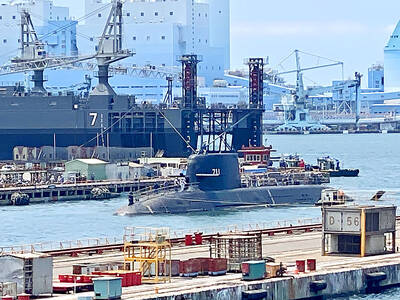
AGING: While Japan has 22 submarines, Taiwan only operates four, two of which were commissioned by the US in 1945 and 1946, and transferred to Taiwan in 1973 Taiwan would need at least 12 submarines to reach modern fleet capabilities, CSBC Corp, Taiwan chairman Chen Cheng-hung (陳政宏) said in an interview broadcast on Friday, citing a US assessment. CSBC is testing the nation’s first indigenous defense submarine, the Hai Kun (海鯤, Narwhal), which is scheduled to be delivered to the navy next month or in July. The Hai Kun has completed torpedo-firing tests and is scheduled to undergo overnight sea trials, Chen said on an SET TV military affairs program. Taiwan would require at least 12 submarines to establish a modern submarine force after assessing the nation’s operational environment and defense

A white king snake that frightened passengers and caused a stir on a Taipei MRT train on Friday evening has been claimed by its owner, who would be fined, Taipei Rapid Transit Corp (TRTC) said yesterday. A person on Threads posted that he thought he was lucky to find an empty row of seats on Friday after boarding a train on the Bannan (Blue) Line, only to spot a white snake with black stripes after sitting down. Startled, he jumped up, he wrote, describing the encounter as “terrifying.” “Taipei’s rat control plan: Release snakes on the metro,” one person wrote in reply, referring
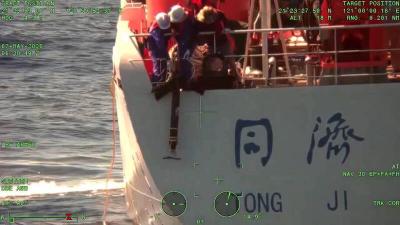
The coast guard today said that it had disrupted "illegal" operations by a Chinese research ship in waters close to the nation and driven it away, part of what Taipei sees a provocative pattern of China's stepped up maritime activities. The coast guard said that it on Thursday last week detected the Chinese ship Tongji (同濟號), which was commissioned only last year, 29 nautical miles (54km) southeast of the southern tip of Taiwan, although just outside restricted waters. The ship was observed lowering ropes into the water, suspected to be the deployment of scientific instruments for "illegal" survey operations, and the coast
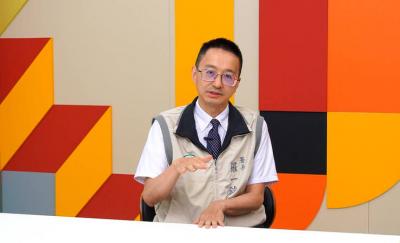
Taiwan’s two cases of hantavirus so far this year are on par with previous years’ case numbers, and the government is coordinating rat extermination work, so there should not be any outbreaks, Centers for Disease Control (CDC) Director-General Philip Lo (羅一鈞) said today in an interview with the Liberty Times (the Taipei Times’ sister newspaper). An increase in rat sightings in Taipei and New Taipei City has raised concerns about the spread of hantavirus, as rats can carry the disease. In January, a man in his 70s who lived in Taipei’s Daan District (大安) tested positive posthumously for hantavirus, Taiwan’s


 RSS
RSS