


Democratic Progressive Party (DPP) Youth Development director Chang Chi-chang (張基長) and DPP member Chou Yu-hsiu (周榆修) held a press conference yesterday accusing the government of using police to tail students involved in the Sunflower movement in an attempt to scare them into not participating in protests.
Chang said the National Taiwan University of Arts (NTUA) had allowed police, armed with batons, to enter the campus at 1:40pm.
The police followed students who participated in the recent protests and recorded them with handheld video recorders.
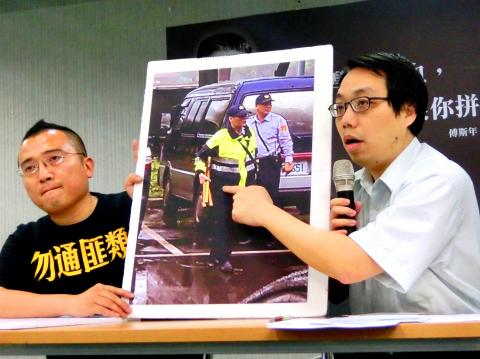
Photo: Lee Hsin-fang, Taipei Times
On Monday, NTUA students in the university’s Department of Sculpture began work on a sunflower sculpture, which they delivered to the Legislative Yuan on foot from the campus, which is in Banciao District (板橋), New Taipei City.
The students altered their schedule to leave the campus due to the police presence, Chang said, adding that despite the police helping the students by clearing their passage, their presence might have been to keep the students under tabs.
The police drove cars onto the campus grounds to the department’s doorsteps and were carrying batons, Chang said.
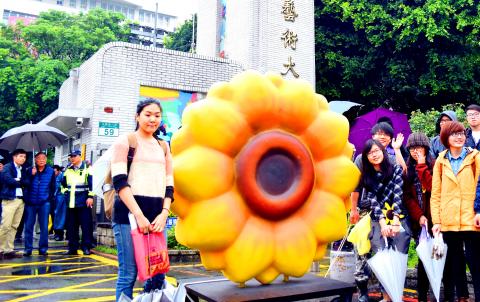
Photo: Chen Wei-tsung, Taipei Times
Chang said that the Ministry of Education might have put pressure on the university to allow the police onto the campus, adding that there was no reason the police had to enter the campus over a simple, peaceful event such as delivering a sculpture to the Legislative Yuan.
“Did [Department of Sculpture] dean Hsieh Chuan-cheng (謝顓丞) know about the police activity, did the police notify him? If he knew and agreed, then he should not be the dean,” Chou said.
In response to the accusations, the New Taipei City police Banciao Precinct said it received a tip that biker gangs might attack the students so it sent officers to keep the students safe.
The police said they drove onto the campus due to a lack of parking outside the front gates, adding that all of its actions were within the campus had been sanctioned by the university.
Despite not seeing any sign of trouble after arriving at the campus, the police made video recordings of the campus surrounds as a part of “standard procedure,” adding that they followed the students to help expedite their journey by controlling traffic lights for them.
Meanwhile, students from Taipei Municipal Jianguo High School told the Chinese-language Apple Daily that military officers at the school had asked students on Thursday for a list of people who had participated in the Sunflower movement.
“It is worrying because we are afraid that the schools or the government might be coming after us now that the movement has ended,” students said.
Jianguo High School student affairs director Tsai Che-ming (蔡哲銘) said that while the school remained neutral on participation in the movement, the schools’ dean might be asked questions about its students at an upcoming city council meeting, which prompted the request for the list of students.
There have been photos of our students in the media, and we need to know if they were part of the movement or we risk not being able to respond to questions at the council meeting, Tsai said.
Additional reporting by Wu Jen-chieh, Chen Wei-tsung and Ho Yu-hua

UPGRADE: The Kang Ding-class frigate is replacing its Chaparall missiles with Tien Chien II and Hua Yang VLS, which would provide it with long-range, 360° air defense Taiwan plans to produce 1,200 to 1,376 Hai Chien II missiles (海劍二, Sea Sword II) — also known as TC-2N — to serve as the standard air defense system of the navy’s surface combatant fleet, a source said yesterday. Last week, the Hai Chien II, the naval version of the Tien Kung II missile (天劍二, Sky Sword II), completed a live-fire test in waters off the National Chungshan Institute of Science and Technology’s Jiupeng facility (九鵬) in Pingtung County’s Manjhou Township (滿州). The MIM72 Chaparral and other dated air defense missiles that currently arm Taiwanese ships have inadequate range to combat Chinese

REASONS FOR TRAVEL: An assistant professor said that proposed amendments to penalize drivers if they used drugs overseas would not deter people from traveling People who operate a motor vehicle under the influence of marijuana would have their driver’s license revoked, even if they used the substance while overseas, the Ministry of Transportation and Communications said yesterday, citing proposed amendments to the Road Traffic Management and Penalty Act (道路交通管理處罰條例). The amendments would also authorize the government to revoke the licenses of people determined to have used Category 1 or Category 2 narcotics, even if they were not operating a vehicle while under the influence of drugs, as well as ban them from taking the license test for three years, the ministry said. People aged 18 or

HEAVY WEATHER: Typhoon Jangmi is due to crash straight into the Ryukyus as airlines look to shift flights to larger aircraft or cancel flights to Okinawa entirely Taiwan’s international air carriers announced flight adjustments over the weekend as Typhoon Jangmi is forecast to hit the Ryukyu Islands today and tomorrow. The Central Weather Administration (CWA) upgraded Jangmi from a tropical storm to a typhoon at 8am yesterday, with the eye located 580km south of Naha city. It was moving north at 19kph. Today, China Airlines’ CI-120, CI-121, CI-122 and CI-123 flights between Taoyuan and Naha, Okinawa, have been canceled as well as CI-132 and CI-133 between Kaohsiung and Naha. EVA Air’s BR-112, BR-113, BR-186 and BR-185 flights between Taoyuan and Naha are also canceled. Low-cost carrier Tigerair Taiwan canceled IT-230,
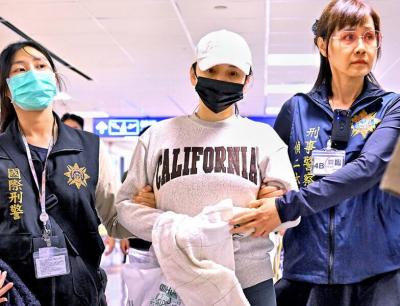
Johanne Liou (劉喬安), a Taiwanese woman who shot to unwanted fame during the Sunflower movement protests in 2014, returned to Taiwan last night after being deported from the US. She is to stand trial in Taiwan for charges involving embezzlement, fraud and drug crimes. The Criminal Investigation Bureau (CIB) said it took her into custody at Taiwan Taoyuan International Airport and would first question her before transferring her to the New Taipei District Prosecutors’ Office. She was arrested upon disembarking a flight from San Francisco that landed shortly before 7pm. Liou absconded to the US in 2019 after jumping bail


 RSS
RSS