


Former Executive Yuan spokesperson Hu Yu-wei (胡幼偉) has recently come under fire for posting a message on Facebook saying that students who participated in the Sunflower movement could face job-hunting difficulties due to their “perceived anti-establishment tendencies.”
Hu posted the comment on Monday, in which he said several high-level managers at private corporations had told him they planned to include questions such as “Did you participate in the student movement?” and “Do you support the student protesters’ anti-establishment behavior?” into their list of routine job interview questions.
“They believe participants in the movement are likelier to resign as they please or launch a campaign against the company when they encounter setbacks at work,” Hu said.
“They said their companies could not afford to have infighting at work amid a gloomy economy,” Hu wrote, adding that the negative impression attached to the movement had become a challenge that each student protester had to face once they graduated.
A netizen claiming to be an entrepreneur agreed with Hu’s opinions, saying that he would never consider hiring people who had joined the movement because their behavior indicated poor judgement, an inability to foresee the consequences of their actions, a tendency to be incited and lack of team spirit.
Others disagreed, however, saying that the student protesters had demonstrated impressive critical thinking, which would make them sought-after candidates in the job market.
Taipei Chamber of Commerce director-general Wang Ying-chieh (王應傑) said that if student leaders Lin Fei-fan (林飛帆) and Chen Wei-ting (陳為廷) ever approached him seeking employment opportunities, he would undoubtedly put them on the short list.
ELIV International Service (以立國際服務), a Taiwan-based social enterprise which was recognized as a socially responsible small and medium-sized company last year by the Chinese-language monthly magazine Manager Today, posted a help-wanted advertisement on Facebook on Monday looking exclusively for participants in the movement.
Taiwanese writer and filmmaker Giddens Ko (柯景騰), better known by his pseudonym, Jiubadao (九把刀), also took issue with Hu’s comments.
“Every creator is a skeptic who spends most of their lives criticizing the world... But they are doing so for one simple reason: to try to make this world a better, better and better place,” Ko wrote on Facebook on Tuesday.
“Let’s say I am looking for someone to help me make a movie. If the applicant seems okay with everything and does not have a problem or an opinion about anything, I would be very concerned because I do not see how we are ever going to make something mind-blowing together,” Ko wrote.
Hu’s comment also drew criticism from labor groups, with Taiwan Labor Front secretary-general Son Yu-lian (孫友聯) lambasting Hu for trying to “encourage” employers not to hire students who joined the movement.
“According to the Employment Service Act (就業服務法), employers are prohibited from discriminating against any job applicant or employee on the basis of thought. Violators are punishable by a fine ranging from NT$300,000 to NT$1.5 million [US$10,000 to US$50,000],” Son said.
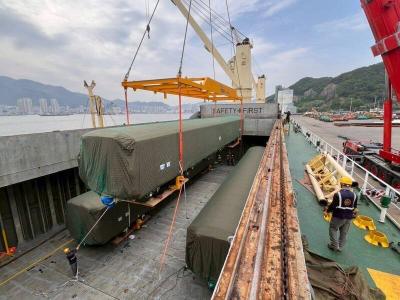
The first of 10 new high-capacity trains purchased from South Korea’s Hyundai Rotem arrived at the Port of Taipei yesterday to meet the demands of an expanding metro network, Taipei Rapid Transit Corp (TRTC) said yesterday. The train completed a three-day, 1,200km voyage from the Port of Masan in South Korea, the company said. Costing NT$590 million (US$18.79 million) each, the new six-carriage trains feature a redesigned interior based on "human-centric" transportation concepts, TRTC said. The design utilizes continuous longitudinal seating to widen the aisles and optimize passenger flow, while also upgrading passenger information displays and driving control systems for a more comfortable
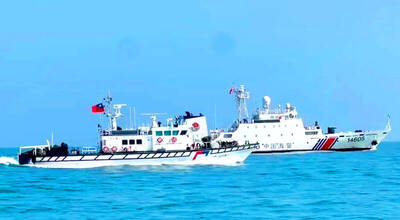
Instead of focusing solely on the threat of a full-scale military invasion, the US and its allies must prepare for a potential Chinese “quarantine” of Taiwan enforced through customs inspections, Stanford University Hoover fellow Eyck Freymann said in a Foreign Affairs article published on Wednesday. China could use various “gray zone” tactics in “reconfiguring the regional and ultimately the global economic order without a war,” said Freymann, who is also a nonresident research fellow at the US Naval War College. China might seize control of Taiwan’s links to the outside world by requiring all flights and ships entering or leaving Taiwan
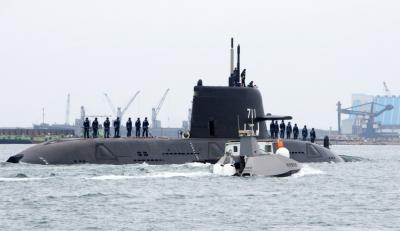
Taiwan's first indigenous defense submarine, the SS-711 Hai Kun (海鯤, or Narwhal), departed for its 13th sea trial at 7am today, marking its seventh submerged test, with delivery to the navy scheduled for July. The outing also marked its first sea deployment since President William Lai (賴清德) boarded the submarine for an inspection on March 19, drawing a crowd of military enthusiasts who gathered to show support. The submarine this morning departed port accompanied by CSBC Corp’s Endeavor Manta (奮進魔鬼魚號) uncrewed surface vessel and a navy M109 assault boat. Amid public interest in key milestones such as torpedo-launching operations and overnight submerged trials,
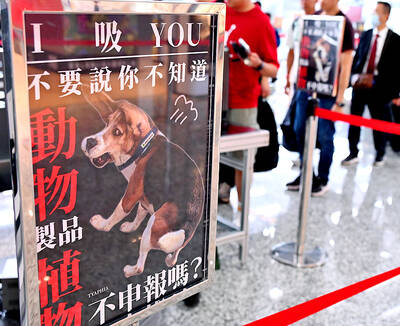
Quarantine awareness posters at Taiwan Taoyuan International Airport have gone viral for their use of wordplay. Issued by the airport branch of the Animal and Plant Health Inspection Agency, the posters feature sniffer dogs making a range of facial expressions, paired with advisory messages built around homophones. “We update the messages for holidays and campaign needs, periodically refreshing materials to attract people’s attention,” quarantine officials said. “The aim is to use the dogs’ appeal to draw focus to quarantine regulations.” A Japanese traveler visiting Taiwan has posted a photo on X of a poster showing a quarantine dog with a


 RSS
RSS