


Several anti-nuclear civic groups yesterday expressed disappointment over what they called the government’s continued disregard of public concerns over the safety of nuclear power as Japan marked the third anniversary of the worst nuclear accident in its history.
Green Citizens’ Action Alliance secretary-general Tsuei Su-hsin (崔愫欣) said the Japanese government had taken several steps to prevent the recurrence of such a catastrophe, including introducing a regulation that prohibits nuclear power plants from being built on top of active fault lines and separating the regulatory body from the administrative body in charge of promoting nuclear power in its Nuclear Regulation Authority.
“The first [Jinshan] and the second [Guosheng] nuclear power plants in New Taipei City are located only 7km and 5km respectively from the active Shanchiao fault (山腳斷層), yet our government has done nothing about that,” Tsuei said.
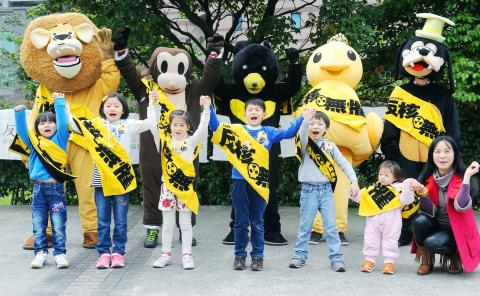
Photo: Chu Pei-hsiung, Taipei Times
Alliance deputy secretary-general Hung Shen-han (洪申翰) said the only aspect the government had tried to improve over the past three years was its skill at promoting nuclear power.
That was evidenced by the government’s efforts to purchase keywords from several search engines in August last year based on the names of prominent anti-nuclear activists to link to a pro-nuclear Web site run by the Ministry of Economic Affairs’ Bureau of Energy, and its screening at movie theaters nationwide a commercial trumpeting its plan for a gradual move toward a nuclear-free homeland, Hung said.
Anti-nuclear Alliance of Fathers executive director Kobe Chih (池國平) said that although the Atomic Energy Council and Taiwan Power Co had sought to improve the seismic capacity of the nation’s four nuclear power plants and increase the height of their tsunami-protective walls by 6m, those endeavors would only “cure the symptoms, not the disease.”
“There is no way we can forecast the severity of compounded disasters,” Chih said.
“If a nuclear accident were to occur at the first or the second nuclear power plant in winter, the strong northeast winds could blow radioactive dust more than 50km from the plants, and people living outside the current 30km evacuation zone could also be forced to leave their homes,” he said.
Chih said a high-ranking official working for the New Taipei City Government told him personally last year that he had had difficulty drawing up a workable plan to evacuate 6 million people within the evacuation zones of the two plants.
“The government is perfectly aware of the possibility of a nuclear disaster occurring in Taiwan, but it has chosen to bury its head in the sand rather than acknowledging and dealing head-on with its inability to evacuate people in the event of a nuclear disaster,” Chih said.
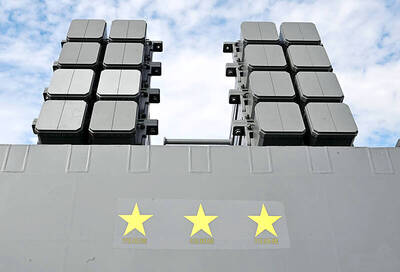
UPGRADE: The Kang Ding-class frigate is replacing its Chaparall missiles with Tien Chien II and Hua Yang VLS, which would provide it with long-range, 360° air defense Taiwan plans to produce 1,200 to 1,376 Hai Chien II missiles (海劍二, Sea Sword II) — also known as TC-2N — to serve as the standard air defense system of the navy’s surface combatant fleet, a source said yesterday. Last week, the Hai Chien II, the naval version of the Tien Kung II missile (天劍二, Sky Sword II), completed a live-fire test in waters off the National Chungshan Institute of Science and Technology’s Jiupeng facility (九鵬) in Pingtung County’s Manjhou Township (滿州). The MIM72 Chaparral and other dated air defense missiles that currently arm Taiwanese ships have inadequate range to combat Chinese

REASONS FOR TRAVEL: An assistant professor said that proposed amendments to penalize drivers if they used drugs overseas would not deter people from traveling People who operate a motor vehicle under the influence of marijuana would have their driver’s license revoked, even if they used the substance while overseas, the Ministry of Transportation and Communications said yesterday, citing proposed amendments to the Road Traffic Management and Penalty Act (道路交通管理處罰條例). The amendments would also authorize the government to revoke the licenses of people determined to have used Category 1 or Category 2 narcotics, even if they were not operating a vehicle while under the influence of drugs, as well as ban them from taking the license test for three years, the ministry said. People aged 18 or

HEAVY WEATHER: Typhoon Jangmi is due to crash straight into the Ryukyus as airlines look to shift flights to larger aircraft or cancel flights to Okinawa entirely Taiwan’s international air carriers announced flight adjustments over the weekend as Typhoon Jangmi is forecast to hit the Ryukyu Islands today and tomorrow. The Central Weather Administration (CWA) upgraded Jangmi from a tropical storm to a typhoon at 8am yesterday, with the eye located 580km south of Naha city. It was moving north at 19kph. Today, China Airlines’ CI-120, CI-121, CI-122 and CI-123 flights between Taoyuan and Naha, Okinawa, have been canceled as well as CI-132 and CI-133 between Kaohsiung and Naha. EVA Air’s BR-112, BR-113, BR-186 and BR-185 flights between Taoyuan and Naha are also canceled. Low-cost carrier Tigerair Taiwan canceled IT-230,
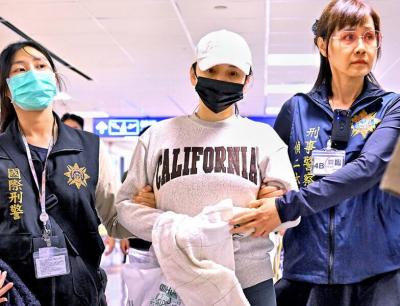
Johanne Liou (劉喬安), a Taiwanese woman who shot to unwanted fame during the Sunflower movement protests in 2014, returned to Taiwan last night after being deported from the US. She is to stand trial in Taiwan for charges involving embezzlement, fraud and drug crimes. The Criminal Investigation Bureau (CIB) said it took her into custody at Taiwan Taoyuan International Airport and would first question her before transferring her to the New Taipei District Prosecutors’ Office. She was arrested upon disembarking a flight from San Francisco that landed shortly before 7pm. Liou absconded to the US in 2019 after jumping bail


 RSS
RSS