


The Taiwan Environmental Protection Union (TEPU) and academics yesterday urged the public to sign a petition aimed at stopping Taiwan Power Co (Taipower) from installing fuel rods in the Fourth Nuclear Power Plant in New Taipei City’s Gongliao District (貢寮).
Members of the group, along with Academia Sinica’s Institute of Sociology chairman Michael Hsiao (蕭新煌), National Chengchi University sociology professor Ku Chung-hwa (顧忠華), and award-winning screenwriter and author Neil Peng (馮光遠), said they “refuse to allow the government to install fuel rods [into the new plant] without first obtaining public approval.”
TEPU founding chairperson and anti-nuclear activist Shih Hsin-min (施信民) said the group had initiated the petition for a national referendum, which would ask the public: “Do you agree that Taipower should insert fuel rods into the Fourth Nuclear Power Plant in New Taipei City for test runs?” to counter a referendum proposed by the Chinese Nationalist Party (KMT) last year.
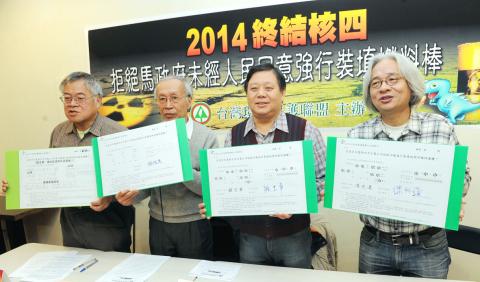
Photo: Wang Min-wei, Taipei Times
The petition has gathered more than 50,000 signatures, but it needs at least 100,000 to pass the first threshold and more than 1 million to pass the second stage for the referendum to be held, he said.
Once fuel rods are inserted into the reactor, the plant bears the risk of a radioactive leak, Shih said.
“Taiwanese should have the right to make the final decision on whether the plant is allowed to operate,” Shih said.
Peng suggested drawing up a list of pro-nuclear groups and public figures — including government officials and legislators — and make sure that these people are “banned from leaving Taiwan” if a nuclear accident ever occurs.
Kao Cheng-yan (高成炎), a National Taiwan University professor and TEPU’s anti-nuclear team convener, said recent problems with the new household registration system had affected many people, but it would be a greater disaster if fuel rods were installed in the new nuclear plant, as it might lead to a nuclear meltdown.
There is “no chance of turning back” once the fuel rods are inserted, they said.
Furthermore, decommissioning the nuclear plant will also entail a huge sum of money to properly handle the radioactive plant, they said.

NATIONAL SECURITY: Authorities are working to confirm the identities of the military personnel involved and investigating possible illegal conduct and regulatory violations Authorities are probing possible national security implications after Kinmen police and immigration officers on Sunday found a Chinese woman allegedly posing as a tourist while engaging in prostitution involving more than 10 military personnel. The woman, surnamed Chen (陳), has since been deported, authorities said, adding that investigators are still working to confirm the identities of those implicated, as the records only listed code names and aliases. The case stemmed from a report received by the Kinmen District Prosecutors’ Office on Friday last week from the Jinhu Precinct of the Kinmen County Police Bureau. On Sunday, police, along with the National Immigration

GLOBALGIVING: ‘ Caving to external pressure is not acceptable for an organization that has cultivated justice reform and human rights for 30 years,’ one NGO said A slew of non-government organizations (NGOs) have withdrawn from the GlobalGiving fundraising platform after it announced it would use “Chinese Taipei” instead of “Taiwan” from next month. The Taiwan Good Rice Association wrote on Facebook on Friday that it was informed on April 28 via a teleconference call of the change, which was made because the platform wanted to operate in China. Taiwan Good Rice is to terminate all cooperative relationships with GlobalGiving in response to the platform’s “unilateral and non-negotiable” decision to remove references to Taiwan, the NGO said. “Taiwan is in the official name of Taiwan Good Rice Association and the

HEAVY WEATHER: Typhoon Jangmi is due to crash straight into the Ryukyus as airlines look to shift flights to larger aircraft or cancel flights to Okinawa entirely Taiwan’s international air carriers announced flight adjustments over the weekend as Typhoon Jangmi is forecast to hit the Ryukyu Islands today and tomorrow. The Central Weather Administration (CWA) upgraded Jangmi from a tropical storm to a typhoon at 8am yesterday, with the eye located 580km south of Naha city. It was moving north at 19kph. Today, China Airlines’ CI-120, CI-121, CI-122 and CI-123 flights between Taoyuan and Naha, Okinawa, have been canceled as well as CI-132 and CI-133 between Kaohsiung and Naha. EVA Air’s BR-112, BR-113, BR-186 and BR-185 flights between Taoyuan and Naha are also canceled. Low-cost carrier Tigerair Taiwan canceled IT-230,

Chinese Nationalist Party (KMT) Chairwoman Cheng Li-wun (鄭麗文) yesterday briefed her party’s Central Standing Committee regarding her scheduled visit to the US between Monday next week and June 16, saying that her purpose would be to persuade the US that the Republic of China (ROC) Constitution was a “one China” constitution that would foster stable and peaceful cross-strait relations. The ROC Constitution is the most important defense for all Taiwanese citizens, as it upholds our democracy and has contributed to our robust economy, which aligns with international and US interests, she said. “We would not be troublemakers and drag the US under,”


 RSS
RSS