


The Democratic Progressive Party (DPP) yesterday released the party’s “blue paper” on defense policy, urging the government to speed up the development of submarines and increase its military spending to 3 percent of the country’s GDP in light of China’s growing military strength.
“I propose a concept of ‘two-stage indigenous production of submarines,’ namely, conserving the integrity of the navy’s current submarine forces on one hand, while activating a long-term development cycle of ship design and R&D [research and development], critical equipment acquisition, testing and operation, and upgrading,” DPP chairman Su Tseng-chang (蘇貞昌) said at a press conference held to unveil the paper, titled China’s Military Threats Against Taiwan in 2025.
“We must maintain a long-term commitment to indigenous submarine R&D, increase the ratio of indigenous production, accumulate the quality of our shipbuilding workforces and technology, and strengthen the combat capabilities of naval denial,” he said.
Su said the government should also tackle insufficient defense budget allocations as soon as possible, so it can attract more talent to contribute R&D potential in Taiwan’s science and technology.
On the issue of China’s cyberthreat, Taiwan must strengthen its current national information security mechanism, endorse the legislations concerning critical infrastructure protection, support the information security industry and cultivate cybersecurity talent, Su said.
The status of the Information and Electronic Warfare Command in the organization chart of the Ministry of National Defense should be bolstered, he added.
As for Taiwan’s air capabilities, Su said that it must transform toward developing diversified platforms. Apart from continuing to support the upgrade of the current IDF and F-16 fleets and urgently seeking to procure advanced fighters from overseas, the indigenous production of advanced long-range unmanned combat air vehicles (UCAV) should be the priority, he said.
“The resource competition between defense expenditure and economic development must be changed conceptually and practically into a mutually reciprocal relationship. No economy, no defense: the economy and defense must be mutually reinforcing,” Su added.
York Chen (陳文政), convener of the DPP’s defense policy advisory committee, said that if Taiwan initiated a plan in 2016 to build eight indigenous submarines within 25 years, the first self-built submarine could be completed by 2022.
Eight submarines would cost NT$400 billion (US$13.2 billion), or NT$16 billion per year on average, he said.
He predicted that the project would require higher investment in the first few years, at NT$23 billion per year.
With military spending accounting for just 2.22 percent of GDP in 2012, an additional NT$23 billion would raise the share to 2.38 percent of GDP, which would remain far behind the 3 percent target, he said.
In response, military spokesman David Lo (羅紹和) yesterday said the navy recognizes that a submarine force has a significant role and position in joint sea defense warfare capabilities. The navy continues to seek to procure submarines from the US, while developing its own submarines, he said.
Chinese Nationalist Party (KMT) Legislator Lin Yu-fang (林郁方) yesterday questioned the DPP’s commitment to build locally developed submarines.
Lin said the previous DPP administration in March 2005 was opposed to a proposal, which he advocated as early as 2002, that six of the eight diesel-powered submarines that Taiwan had planned to acquire from the US be built in Taiwan using technology transfer.
The then-DPP led by Su instructed its caucus to pass a legislative resolution against indigenous submarine development due to concerns over limited budget, Lin said.
The nation’s first locally-built submarine could have been launched in 2011 had the previous DPP administration not been opposed to the project in 2005, Lin said, adding that the DPP and Su owe the public an apology.
Additional reporting by Shih Hsiu-chuan and CNA

NATIONAL SECURITY: Authorities are working to confirm the identities of the military personnel involved and investigating possible illegal conduct and regulatory violations Authorities are probing possible national security implications after Kinmen police and immigration officers on Sunday found a Chinese woman allegedly posing as a tourist while engaging in prostitution involving more than 10 military personnel. The woman, surnamed Chen (陳), has since been deported, authorities said, adding that investigators are still working to confirm the identities of those implicated, as the records only listed code names and aliases. The case stemmed from a report received by the Kinmen District Prosecutors’ Office on Friday last week from the Jinhu Precinct of the Kinmen County Police Bureau. On Sunday, police, along with the National Immigration

GLOBALGIVING: ‘ Caving to external pressure is not acceptable for an organization that has cultivated justice reform and human rights for 30 years,’ one NGO said A slew of non-government organizations (NGOs) have withdrawn from the GlobalGiving fundraising platform after it announced it would use “Chinese Taipei” instead of “Taiwan” from next month. The Taiwan Good Rice Association wrote on Facebook on Friday that it was informed on April 28 via a teleconference call of the change, which was made because the platform wanted to operate in China. Taiwan Good Rice is to terminate all cooperative relationships with GlobalGiving in response to the platform’s “unilateral and non-negotiable” decision to remove references to Taiwan, the NGO said. “Taiwan is in the official name of Taiwan Good Rice Association and the

HEAVY WEATHER: Typhoon Jangmi is due to crash straight into the Ryukyus as airlines look to shift flights to larger aircraft or cancel flights to Okinawa entirely Taiwan’s international air carriers announced flight adjustments over the weekend as Typhoon Jangmi is forecast to hit the Ryukyu Islands today and tomorrow. The Central Weather Administration (CWA) upgraded Jangmi from a tropical storm to a typhoon at 8am yesterday, with the eye located 580km south of Naha city. It was moving north at 19kph. Today, China Airlines’ CI-120, CI-121, CI-122 and CI-123 flights between Taoyuan and Naha, Okinawa, have been canceled as well as CI-132 and CI-133 between Kaohsiung and Naha. EVA Air’s BR-112, BR-113, BR-186 and BR-185 flights between Taoyuan and Naha are also canceled. Low-cost carrier Tigerair Taiwan canceled IT-230,
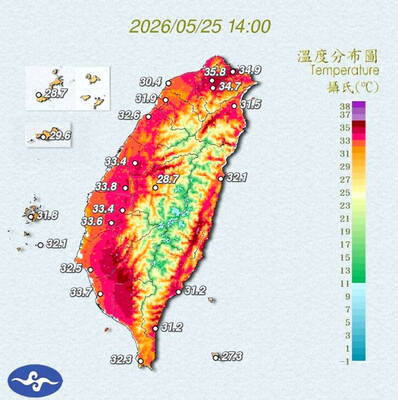
STAY COOL: The HPA recommended that people stay hydrated, use air-conditioning or fans while indoors, wear loose-fitting clothes and walk in the shade while outdoors Employers must implement measures such as installing cooling equipment, and providing drinking water and rest breaks for outdoor workers starting from Monday next week, the Taipei Department of Labor said on Sunday. Employers who fail to comply could face fines of NT$30,000 to NT$300,000 under the Occupational Safety and Health Act (職業安全衛生法), the department said. Businesses in Taipei employing fewer than 100 workers, as well as registered self-employed workers with labor insurance coverage, could receive on-site assessments and guidance from occupational safety consultants to help them apply for central government subsidies to implement or improve heat-protection measures, it said. Under the Ministry of


 RSS
RSS