


Two Taiwanese economists have challenged the views of former World Bank chief economist and senior vice president Justin Lin (林毅夫) that Taiwan’s economy lags behind South Korea because it has not integrated with China.
Lin said in Beijing on Friday that Taiwan’s economic development started to slide in the mid-1990s because “politics interfered with economics.”
The nation’s economy could not integrate with China, but South Korea has used the opportunity of China’s opening to catch up with Taiwan, Lin said.
However, Liu Meng-chun (劉孟俊), director of the Chung-Hua Institution for Economic Research’s Center for Economic Forecasting and Gordon Sun (孫明德), director of the Macroeconomic Forecasting Center at the Taiwan Institute for Economic Research, said the country’s lagging behind is caused by internal and external factors.
Liu said that Lin’s remarks were made from the cross-strait viewpoint and were fragmentary.
Liu said that the biggest reason is that Taiwan’s progress in participating in regional economic integration has been slower than South Korea’s. This is not just in the case of the Trans-Pacific Partnership, a proposed free-trade agreement (FTA), he said, adding that South Korea signed a free-trade agreement with the EU a long time ago.
He said that if Taiwan wants to sign FTAs with other countries, the unspoken rule is that Taiwan has to sign agreements with China first before other countries will agree to do so with Taiwan, citing the examples of Singapore and New Zealand.
In addition to the political factor in Taiwan’s participation in regional economic integration, Taiwan’s industry is not diversified enough and relies too much on the information and communications sector, Liu said.
The machine tool sector, although good, is not large-scale, while the service industry is not strong enough, Liu said.
Another reason is that Taiwan’s trade and economic reforms, as well as liberalization, have not been fast enough since its participation in the WTO in 2002.
The integration of inter-governmental agencies is also insufficient, while the lack of government efficiency and the lack of direction in leading the country by the top leadership are also reasons, he said.
Sun said that Lin has a deep understanding of China, but described his analysis of Taiwan’s economy as partial and fragmentary.
He said there are many reasons Taiwan’s economy lags behind South Korea’s.
Sun said that South Korea obtained a bailout from the IMF in the wake of the 1998 financial crisis and began merging financial institutions, while its electronics and auto industries also began to integrate.
The bigger economic scale, especially the megabanks created through the integration of financial institutions, has also helped accelerate its economic development, Sun said.
Lin, a Yilan County native, is wanted by Taiwan’s government for defecting to China in 1979, when he was an army captain serving on Kinmen. He swam from Kinmen to China’s Fujian Province.
He received a master’s degree in Marxist political economics from Peking University in 1982 and a doctorate in economics from the University of Chicago in 1986.
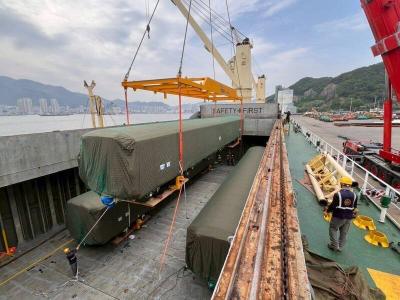
The first of 10 new high-capacity trains purchased from South Korea’s Hyundai Rotem arrived at the Port of Taipei yesterday to meet the demands of an expanding metro network, Taipei Rapid Transit Corp (TRTC) said yesterday. The train completed a three-day, 1,200km voyage from the Port of Masan in South Korea, the company said. Costing NT$590 million (US$18.79 million) each, the new six-carriage trains feature a redesigned interior based on "human-centric" transportation concepts, TRTC said. The design utilizes continuous longitudinal seating to widen the aisles and optimize passenger flow, while also upgrading passenger information displays and driving control systems for a more comfortable
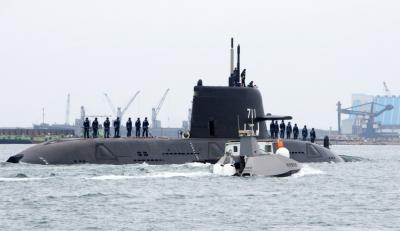
Taiwan's first indigenous defense submarine, the SS-711 Hai Kun (海鯤, or Narwhal), departed for its 13th sea trial at 7am today, marking its seventh submerged test, with delivery to the navy scheduled for July. The outing also marked its first sea deployment since President William Lai (賴清德) boarded the submarine for an inspection on March 19, drawing a crowd of military enthusiasts who gathered to show support. The submarine this morning departed port accompanied by CSBC Corp’s Endeavor Manta (奮進魔鬼魚號) uncrewed surface vessel and a navy M109 assault boat. Amid public interest in key milestones such as torpedo-launching operations and overnight submerged trials,
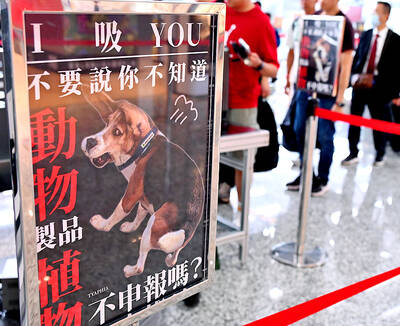
Quarantine awareness posters at Taiwan Taoyuan International Airport have gone viral for their use of wordplay. Issued by the airport branch of the Animal and Plant Health Inspection Agency, the posters feature sniffer dogs making a range of facial expressions, paired with advisory messages built around homophones. “We update the messages for holidays and campaign needs, periodically refreshing materials to attract people’s attention,” quarantine officials said. “The aim is to use the dogs’ appeal to draw focus to quarantine regulations.” A Japanese traveler visiting Taiwan has posted a photo on X of a poster showing a quarantine dog with a
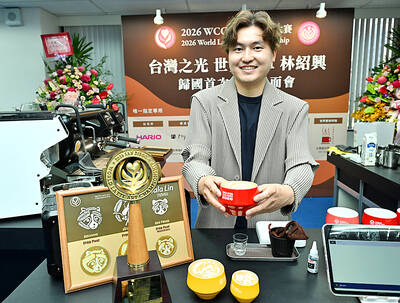
Taiwan’s coffee community has launched a “one-person-one-e-mail” campaign, calling for people to send a protest-e-mail to the World Coffee Championships (WCC) urging it to redesignate Taiwanese competitors as from “Taiwan,” rather than “Chinese Taipei.” The call followed sudden action last week after the WCC changed all references to Taiwanese competitors from “Taiwan” to “Chinese Taipei,” including recent World Latte Art champion Bala (林紹興), who won the World Latte Art Championship in San Diego earlier this month. When Bala received the trophy, he was referred to as representing Taiwan, as well as in the announcement on the WCC’s Web site, until it


 RSS
RSS