


Preservation activists yesterday called on the Ministry of Culture to intervene to save two 82-year-old warehouses in the Port of Keelung, which have witnessed much of Taiwan’s migration history, but are threatened by development projects.
In the past week, preservationists, including residents, artists, writers and historians, have been protesting against a project drafted by the Keelung City Government to tear down the two warehouses on the port’s west pier. They are the only two remaining buildings of a group of eight warehouses built in 1932 that once stood in the area.
“It was really shocking when I heard Keelung city officials saying that a warehouse is a warehouse, not a historic building — this shows that our history education is a total failure,” Chang Tien-wan (張典婉), a writer and historian, told a press conference held at the Legislative Yuan yesterday.
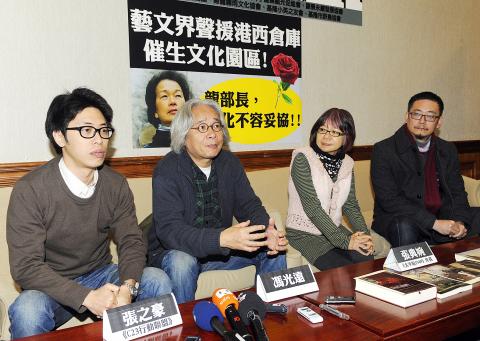
Photo: Chen Chih-chu, Taipei Times
Chang said that during the Japanese colonial period, many Japanese entered Taiwan through the warehouses — which also served as terminal buildings for ferry lines — and they also left through the buildings when they were reptriated after World War II.
“Between 1945 and 1949, at the port’s peak, more than 50 ferry boats docked at Keelung every day from Guangzhou, Xiamen, Wenzhou, Shanghai and other Chinese cities,” she said. “So this is also where many Chinese — including civilians and Chinese Nationalist Party [KMT] troops — first set foot on Taiwanese soil when they fled [here from China].”
Therefore, Chang said, buildings with such historic significance should not be torn down, as they are not mere warehouses.
Neil Peng (馮光遠), a writer, compared the two warehouses to Ellis Island in New York City.
“The West 2 and West 3 warehouses are like Ellis Island in New York — they are the entrance to the nation, where many immigrants arrived through the two buildings,” he said. “In 1954, Ellis Island was turned into an immigration museum and descendants of European immigrants can check their ancestry at the museum. That is what we should turn the two warehouses into.”
Peng said that history is important to a country and he is often saddened to see buildings with historical significance torn down to make way for modern towers.
“We have enough high-rise apartment complexes and commercial towers, but we need more historical buildings to be preserved,” Peng said, urging Minister of Culture Lung Ying-tai (龍應台), who is also an author and has written about the preservation of historical buildings, to intervene.
Wang Chieh (王傑), a preservation activist who grew up in Keelung, said he was amazed to see pictures of Keelung during the 1930s and 1940s.
“According to the documents I’ve found, it took the Japanese 45 years to plan and build the city. It was once a city full of European buildings, museums and a canal with beautiful bridges over it,” Wang said. “Sadly, none of what appeared in the pictures still existed when I was born.”
“Keelung as I know it is a devastated city, it is a city that people around the nation make fun of. We should do something about it. We should do something for ourselves and the generations to come,” he added.
The city government originally planned to flatten both West 2 and West 3 warehouses on Monday, but the demolition was halted due to strong opposition.
Lung visited the buildings earlier in the week and said that the two buildings have the potential to be designated as historical buildings, but instead of organizing a meeting to evaluate their historical value, the ministry decided to allocate NT$2.5 million (US$82,600) to the Keelung City Government to conduct research on the warehouses.


Kenting National Park service technician Yang Jien-fon (楊政峰) won a silver award in World Grand Prix Photography Awards Spring Season for his photograph of two male rat snakes intertwined in combat. Yang’s colleagues at Kenting National Park said he is a master of nature photography who has been held back by his job in civil service. The awards accept entries in all four seasons across six categories: architectural and urban photography, black-and-white and fine art photography, commercial and fashion photography, documentary and people photography, nature and experimental photography, and mobile photography. Awards are ranked according to scores and divided into platinum, gold and

More than half of the bamboo vipers captured in Tainan in the past few years were found in the city’s Sinhua District (新化), while other districts had smaller catches or none at all. Every year, Tainan captures about 6,000 snakes which have made their way into people’s homes. Of the six major venomous snakes in Taiwan, the cobra, the many-banded krait, the brown-spotted pit viper and the bamboo viper are the most frequently captured. The high concentration of bamboo vipers captured in Sinhua District is puzzling. Tainan Agriculture Bureau Forestry and Nature Conservation Division head Chu Chien-ming (朱健明) earlier this week said that the
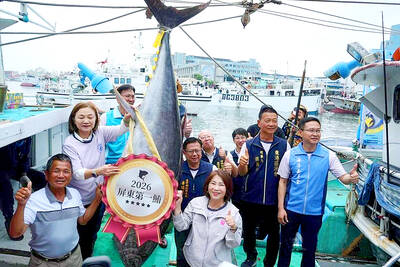
The first bluefin tuna of the season, brought to shore in Pingtung County and weighing 190kg, was yesterday auctioned for NT$10,600 (US$333.5) per kilogram, setting a record high for the local market. The auction was held at the fish market in Donggang Fishing Harbor, where the Siaoliouciou Island-registered fishing vessel Fu Yu Ching No. 2 delivered the “Pingtung First Tuna” it had caught for bidding. Bidding was intense, and the tuna was ultimately jointly purchased by a local restaurant and a local company for NT$10,600 per kilogram — NT$300 ,more than last year — for a total of NT$2.014 million. The 67-year-old skipper
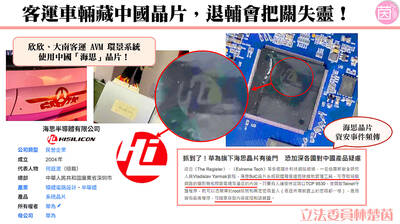
BREACH OF CONTRACT: The bus operators would seek compensation and have demanded that the manufacturer replace the chips with ones that meet regulations Two bus operators found to be using buses with China-made chips are to demand that the original manufacturers replace the systems and provide compensation for breach of contract, the Veterans Affairs Council said yesterday. Democratic Progressive Party Legislator Michelle Lin (林楚茵) yesterday said that Da Nan Bus Co and Shin-Shin Bus Co Ltd have fielded a total of 82 buses that are using Chinese chips. The bus models were made by Tron-E, while the systems provider was CYE Electronics, Lin said. Lin alleged that the buses were using chips manufactured by Huawei subsidiary HiSilicon Co, which presents a national security risk if the


 RSS
RSS