

The International Federation of Journalists (IFJ) and the Democratic Progressive Party (DPP) yesterday condemned China for its refusal to issue visas to two Taiwanese journalists who had planned to cover Mainland Affairs Council (MAC) Minister Wang Yu-chi’s (王郁琦) visit to China.
The reporters from the Chinese-language Apple Daily and Radio Free Asia were among the 89 local journalists who had applied for visas to cover Wang’s four-day trip and the unprecedented meeting between the council and the Taiwan Affairs Office that begins today in Nanjing.
The federation said the pair were banned from entering China without any explanation from Beijing.
“The IFJ joins its affiliate the Association of Taiwan Journalists [ATJ] in condemning China’s refusal to issue visas to two Taiwanese journalists set to travel to China this week,” the federation said in a press release.
IFJ Asia-Pacific director Jacqui Park said the Chinese government’s refusal to issue the visas was indicative of an ongoing trend.
“The Chinese government is clearly using their ability to retract or refuse visas to journalists as an instrument of censorship,” Park said.
“Recently we have witnessed high-profile cases in which foreign journalists such as the New York Times’ Austin Ramzy and the South China Morning Post’s Paul Mooney were forced to leave the country after having visa renewals declined. This is the first case we have come across where Taiwanese journalists have been targeted,” she said.
Mooney was denied a new press card and visa after he left the South China Morning Post and went to work for Reuters last year.
The Association of Taiwan Journalists demanded that Wang lodge a protest to China and urged the council to take action to defend the freedom of the press.
The council on Sunday night said that it deeply regretted the unfortunate development and called on the Chinese to respect the freedom of the press.
The DPP demanded that Wang protest the denial of visas and make sure all the reporters who signed up for his trip could cover his visit.
“If some Taiwanese reporters are not allowed to visit China, what is the point of Taiwan engaging in negotiations with China about an agreement that will allow news institutions from both sides to set up offices in each other’s territories?” DPP spokesperson Lin Chun-hsien (林俊憲) told a press conference.
The council’s expression of “deep regret” was weak against Beijing’s blatant suppression of the freedom of the press, as well as a violation of international covenants, Lin said.
The visa denials highlighted the significance of the signing of a cross-strait agreement on press freedom protection, DPP Department of China Affairs director Honigmann Hong (洪財隆) said.
The council said yesterday that Wang would “discuss issues related to equal exchanges of news information” when he meets with Taiwan Affairs Office Director Zhang Zhijun (張志軍) during his trip.
“Press freedom is a universal value. We have repeatedly said that the most important thing regarding news exchange between the two sides is the free and equal flow of information,” the council said in a statement.
In related news, the Chinese-language United Daily News yesterday reported that Beijing has demanded that a memorandum be signed by Wang and Zhang after they meet to serve as “a foundation of future meetings,” citing an unnamed Chinese official.
Council spokeswoman Wu Mei-hung (吳美紅) denied the report, reiterating that Wang “would not sign any document during his visit.”
A TAO spokesperson in Beijing said the office had no comment on the newspaper report.
Additional reporting by staff writer and AFP

The National Police Agency’s Third Special Police Corps yesterday said that from May to July, it intercepted five smuggling operations from China, seizing more than 70,000 counterfeit Beyblades with an estimated infringement value of NT$34.45 million (US$1.08 million). It added that any bootleg unit that reached the local market could present hidden health hazards to players. Beyblades, a line of spinning toy tops used in competitive gaming and developed in Japan by toy company Takara Tomy, have become popular in Taiwan, making them a target for fraudsters. The Third Special Police Corps, dedicated to safeguarding maritime borders and trade lines,
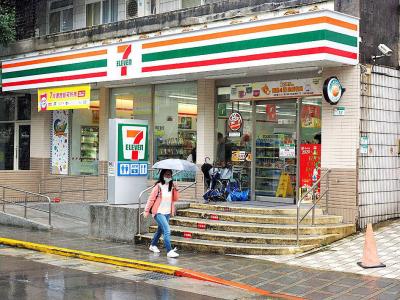
Five customers who made purchases at 7-Eleven stores across Taiwan won the top NT$10 million (US$313,716) special prize in the July-August uniform invoice lottery, including one who spent just NT$27 on photocopying, the convenience store chain said today. The five special prize winners made their purchases at stores in Taoyuan, Taipei, Taichung and Kaohsiung, 7-Eleven operator President Chain Store Corp said. The five winning purchases included NT$29 spent on snacks at a store in Taoyuan's Zhongli District (中壢), NT$27 on photocopying at a store in Taipei's Zhongzheng District (中正), NT$139 on City Cafe coffee and daily necessities at a store in Taipei's
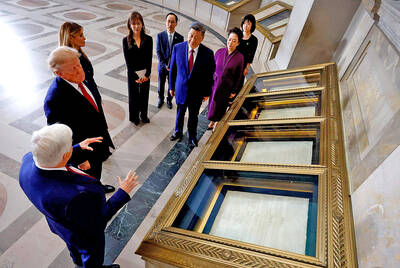
Chinese President Xi Jinping (習近平) reportedly cut short his visit to the National Archives in Washington after the Chinese delegation objected to plans to view the Treaty of San Francisco, sources in Washington’s media circles said. Xi and his wife, Peng Liyuan (彭麗媛), concluded their three-day state visit to the US on Friday after having tea with US President Donald Trump and first lady Melania Trump at the White House and visiting the archives. Chinese democracy advocates and members of pro-China groups gathered outside the venue during Xi’s visit, with the two groups exchanging competing slogans while police kept them separated. The US

TRICKY ISSUE: Taiwan’s defense of the ROC in WWII could conflict with the government’s narrative on Taiwanese history and identity, an academic said Chinese President Xi Jinping (習近平) had no standing to discuss US-China relations in World War II (WWII), as the People’s Republic of China did not exist at that time, Mainland Affairs Council (MAC) Deputy Minister Shen Yu-chung (沈有忠) said yesterday. Taipei would ensure that Washington has a clear understanding that it was the Republic of China (ROC), not the People’s Republic of China (PRC), that was a steadfast ally of the US in WWII, Shen said. Shen was referring to a White House fact sheet released on Friday about Xi’s meeting with US President Donald Trump in Washington. It said that “the two


 RSS
RSS