


Chinese Communist Party authorities have restored an 80-year-old house once used by Chiang Kai-shek (蔣介石), as changing relations with Taiwan transform an archenemy into a recognized figure.
Political differences were plastered over as Nanjing — once China’s capital under the Chinese Nationalist Party (KMT) — spent US$4.9 million to renovate the three-story house at the base of a hill.
It was one of several houses used by Chiang and his wife Soong Mayling (宋美齡) before they fled to Taiwan in 1949 at the end of the Chinese civil war.
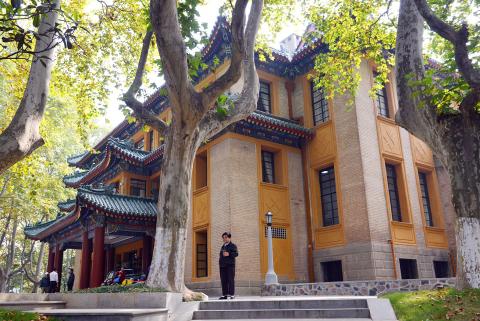
Photo: AFP
Chiang led Taiwan as president until his death 26 years later, still proclaiming himself the rightful ruler of the whole of China.
For decades, the building was kept as a state guesthouse and closed to the public, but the doors were thrown open after a year-long renovation was completed in October.
“This renovation has a very important use for cross-strait cultural exchanges, so we considered that,” said Liao Jinhan, deputy head of the Chinese government agency that administers the surrounding scenic area. “Our feeling is that the house is a very important cultural heritage landmark.”
The chance discovery of an original architectural plan in a closet in the house allowed workers to faithfully restore the building, down to the basement coal room.
“We completely followed the blueprint from that time. You can see from photos of the time, it is exactly the same,” property manager Zhou Zhongxing said.
“The renovation is significant for cross-strait cultural contacts as it shows the mainland’s focus on preserving historical heritage related to the Kuomintang [KMT],” Shanghai Institute for International Studies research fellow Tong Liqun (童立群) said.
“To take relations one step further would mean exchanges in the field of politics, and that is where the two sides are having trouble,” she said.
The historical sensitivity is such that officials commonly refer to the house as the “Mayling Palace” after Chiang’s last wife, despite its status as the former residence of a Chinese head of state.
Soong Mayling was one of the three Soong sisters, who between them married two top Chinese leaders and a wealthy businessman who served as Chinese finance minister.
Few images of Chiang can be seen inside the property, although the study holds a portrait of Sun Yat-sen (孫中山), founding father of the Republic of China — who is revered by both Communists and Nationalists, and whose tomb is on the hill and visible from the house.
An exhibit on the couple’s lives in Taiwan is called “Years on Taiwan island,” highlighting the Chinese doctrine that it is not a country, but part of Chinese territory.
The house has Chinese features, such as the curved roof, but the interior is Western in style, reflecting Soong’s education in the US.
The building also gives subtle hints about the couple’s lifestyle.
Chiang had a room off the main bedroom where he slept, reflecting his military habit of rising early, while Soong Mayling required a Western-style oven, which still survives, and kept ashtrays in the rooms for smoking — a habit she picked up in the US.
A small chapel shows the couple’s embrace of Christianity: Soong Mayling, who was Methodist, insisted that her husband convert to her religion.
“The manor is like its mistress: graceful and elegant, knowing both Chinese and Western style,” a sign reads.
Soong’s achievements are on display in an exhibition which praises her for building support for China in its fight against Japan in the 1930s and 1940s, and her charitable causes.
“She had class,” tour-guide Chen Chen said. “Soong Ching-ling (宋慶齡), the second one, was very pretty.”
The middle Soong sister, Ching-ling, was Sun’s wife and stayed in China after the Communist takeover. The eldest of the trio, Soong Ai-ling (宋靄齡), married financier Kung Hsiang-hsi (孔祥熙).
Since opening in October, tens of thousands have paid the 30 yuan (US$5) ticket price to see the house, but it has proved especially popular with the elderly, some of them old enough to remember Chiang’s time.
A panel in one part of the exhibition reads: “The perfect combination of traditional Chinese architectural style and modern Western construction technology puts this building in the perfect realm of architectural history in modern China.”
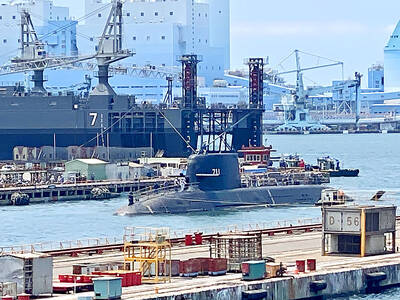
AGING: While Japan has 22 submarines, Taiwan only operates four, two of which were commissioned by the US in 1945 and 1946, and transferred to Taiwan in 1973 Taiwan would need at least 12 submarines to reach modern fleet capabilities, CSBC Corp, Taiwan chairman Chen Cheng-hung (陳政宏) said in an interview broadcast on Friday, citing a US assessment. CSBC is testing the nation’s first indigenous defense submarine, the Hai Kun (海鯤, Narwhal), which is scheduled to be delivered to the navy next month or in July. The Hai Kun has completed torpedo-firing tests and is scheduled to undergo overnight sea trials, Chen said on an SET TV military affairs program. Taiwan would require at least 12 submarines to establish a modern submarine force after assessing the nation’s operational environment and defense

A white king snake that frightened passengers and caused a stir on a Taipei MRT train on Friday evening has been claimed by its owner, who would be fined, Taipei Rapid Transit Corp (TRTC) said yesterday. A person on Threads posted that he thought he was lucky to find an empty row of seats on Friday after boarding a train on the Bannan (Blue) Line, only to spot a white snake with black stripes after sitting down. Startled, he jumped up, he wrote, describing the encounter as “terrifying.” “Taipei’s rat control plan: Release snakes on the metro,” one person wrote in reply, referring
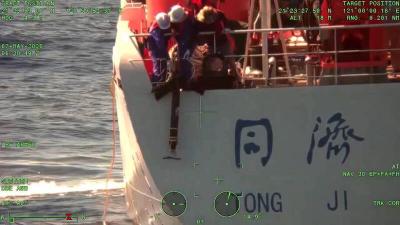
The coast guard today said that it had disrupted "illegal" operations by a Chinese research ship in waters close to the nation and driven it away, part of what Taipei sees a provocative pattern of China's stepped up maritime activities. The coast guard said that it on Thursday last week detected the Chinese ship Tongji (同濟號), which was commissioned only last year, 29 nautical miles (54km) southeast of the southern tip of Taiwan, although just outside restricted waters. The ship was observed lowering ropes into the water, suspected to be the deployment of scientific instruments for "illegal" survey operations, and the coast
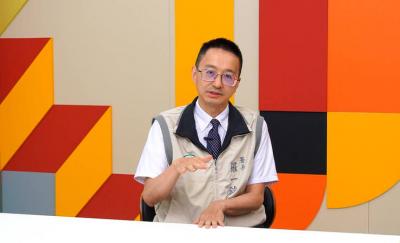
Taiwan’s two cases of hantavirus so far this year are on par with previous years’ case numbers, and the government is coordinating rat extermination work, so there should not be any outbreaks, Centers for Disease Control (CDC) Director-General Philip Lo (羅一鈞) said today in an interview with the Liberty Times (the Taipei Times’ sister newspaper). An increase in rat sightings in Taipei and New Taipei City has raised concerns about the spread of hantavirus, as rats can carry the disease. In January, a man in his 70s who lived in Taipei’s Daan District (大安) tested positive posthumously for hantavirus, Taiwan’s


 RSS
RSS