


Divisions within the Democratic Progressive Party (DPP) have come to the fore again, as the party prepares for the seven-in-one elections next year, with former vice president Annette Lu (呂秀蓮) warning that it could turn away public support.
Lu, who is hoping to represent the DPP in the race for Taipei mayor next year, said the Taipei primary has become a “proxy war” between party heavyweights and could result in a public backlash.
Lu did not name names, but DPP Chairman Su Tseng-chang (蘇貞昌) is widely believed to favor lawyer Wellington Koo (顧立雄), while former DPP chairperson Tsai Ing-wen (蔡英文) reportedly supports National Taiwan University Hospital physician Ko Wen-je (柯文哲), an independent who currently has the highest support rate among all pan-green aspirants.
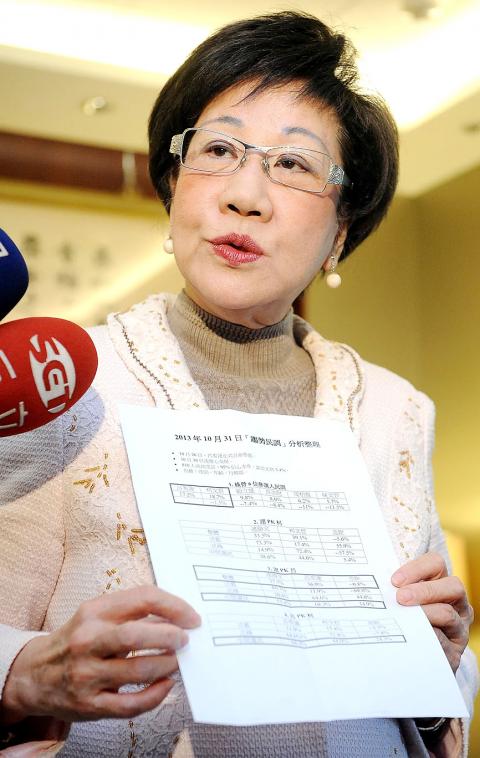
Photo: Chu Pei-hsiung, Taipei Times
The Taipei primary has become a proxy for a private competition between Su and Tsai for the DPP chairmanship election next year, Lu said.
This maneuvering for personal gain could cost the party dearly, such as the DPP losing in all constituencies in northern and central Taiwan except Yilan County next year, she said.
Lu, who has repeatedly complained of a lack of media coverage of her campaign and the media’s focus on her age, urged DPP headquarters to remain neutral in the primaries.
Meanwhile, the emergence of the New Tide, arguably the most powerful DPP faction, has caught the public’s attention and raised tensions in the party after the group secured a series of primary victories.
Three nominees — Pan Men-an (潘孟安) of Pingtung County, Wei Ming-ku (魏明谷) of Changhua County and Lee Wen-chung (李文忠) of Nantou County — are New Tide members, while Lee Ching-yung (李進勇) won the Yunlin County primary with the backing of the New Tide.
In Greater Taichung, Tsai Chi-chang (蔡其昌), another New Tide member, is trying to narrow the gap with Lin Chia-lung (林佳龍) before the primary on Dec. 20. In Taipei, the group appears to have thrown its support behind Koo, with many city councilors who are members of the group endorsing the lawyer.
A DPP resolution in 2006 dissolved all party factions, prohibiting them from establishing offices, recruiting members and fundraising. However, the factions did not really disappear, as many continue to operate in the form of think tanks or foundations led by a senior party member.
The New Tide’s string of primary wins and heavy campaigning to assist them by Greater Tainan Mayor William Lai (賴清德) and Greater Kaohsiung Mayor Chen Chu (陳菊), both New Tide members, could escalate tensions within the party, former DPP legislator Julian Kuo (郭正亮) said yesterday.
Incumbent mayors and commissioners are advised to stay neutral in the primaries to prevent factional tensions, Kuo said.
Former premier Yu Shyi-kun’s victory in the New Taipei City primary, which drew protests of unfairness from New Taipei City (新北市) Chapter director Lo Chih-cheng (羅致政), who is close to Tsai Ing-wen, has also been described as a trade-off between Yu and Su in exchange for support of Su’s re-election campaign for the chairperson’s post next year. Yu and Su have denied the rumor.

FUKUOKA SITUATION: Japanese media reported that the pathogen is expected to be identified by the summer, while the CDC downplayed the idea that it was hMPV A “mysterious cold-like illness” reported in Japan’s Fukuoka Prefecture does not seem to be a new disease, but Japanese authorities have been asked about the situation, the Centers for Disease Control (CDC) said yesterday. The Fukuoka Prefectural Medical Association on Wednesday told a news conference that a “mystery cold” that has become a hot topic on social media is “highly likely to be caused by some kind of viral infection,” Japan’s KBC News reported. “Many people are experiencing symptoms starting with a sore throat, followed by a runny nose, phlegm and a severe cough,” KBC News reported, citing association officials. Health authorities are

Nvidia Corp CEO Jensen Huang (黃仁勳) arrived in Taiwan yesterday ahead of upcoming AI and technology events, saying he plans to meet with clients and Taiwan Semiconductor Manufacturing Co Chairman C.C. Wei (魏哲家) during his visit. After landing at Taipei Songshan Airport, Huang posed for photos with fans and handed out Yakult drinks to reporters and supporters waiting at the scene, saying he has “a lot to do” during the trip. Asked about reports that Nvidia’s planned headquarters site in Taipei’s Beitou Shilin Technology Park could break ground on May 27, Huang said that if the company holds an event, he would

The Ministry of Finance this afternoon announced the winning numbers for the March-April uniform invoice lottery. The winning number for the NT$10 million (US$318,060) special prize is 19531471, and the winning number for the NT$2 million grand prize is 85941329. Three numbers were drawn for the NT$200,000 first prize: 07225810, 20231230 and 83518781. Those with receipts matching the last seven digits of any of the first-prize numbers will win the NT$40,000 second prize, while those matching the last six digits will win the NT$10,000 third prize. Those whose receipts match the last five digits of the first-prize numbers can claim the NT$4,000 fourth prize,
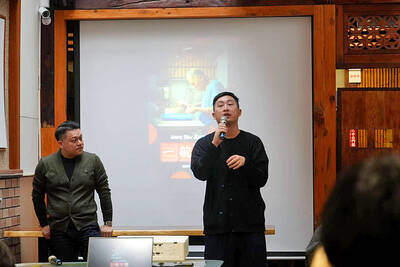
Taiwan Travelogue (臺灣漫遊錄), which earlier this week became the first Taiwanese novel to win the International Booker Prize, is to be adapted into a television series through a Taiwan-Japan coproduction, producer Chang Chen-yu (張辰漁) said yesterday. Chang, a producer at World Softest Production Film Co, wrote on Facebook that the company had been searching for projects with international appeal that retain a strong Taiwanese identity after colleagues and Japanese partners strongly recommended the novel. After reading the book, Chang said he immediately decided to pursue the screen rights. “A great story has the power to transcend time and borders, and connect countless people,”


 RSS
RSS