


The review of a proposed casino act was placed on hold yesterday as lawmakers opposed to the legislation demanded more time to study all the relevant information.
Legislators from the transportation, economic and judiciary committees were yesterday scheduled to review the act governing the management of casino resorts (觀光賭場管理條例) bill proposed by the Executive Yuan.
They were also to consider two similar drafts proposed by Independent Legislator Chen Hsuen-sheng (陳雪生) and Chinese Nationalist Party (KMT) Legislator Alex Tsai (蔡正元).
They were also supposed to review an amendment to the International Airport Park Development Act (國際機場園區發展條例) proposed by several legislators including KMT Legislator Chen Ken-te (陳根德), which would allow casinos to be built within the boundaries of the Taoyuan Aerotropolis project.
According to the proposed amendment, casinos would be located in the airport’s free trade zone, and people entering them must hold passports and may be exempt from paying customs tax.
At the meeting yesterday, lawmakers opposing the bill were angered by the non-appearance of Minister of Transportation and Communications Yeh Kuang-shih (葉匡時). They said they would not review the acts until Yeh came to the committee.
After Yeh arrived, Democratic Progressive Party (DPP) legislators demanded more time to study the proposed bills and asked Yeh to clarify the position of the Executive Yuan on casino resorts.
Yeh had said earlier that the revenue generated by a casino resort in Taiwan Taoyuan International Airport could help fund the construction of a state-of-the-art airport in Matsu, which many legislators interpreted to mean that the Cabinet was considering the building of casinos on Taiwan proper rather than the nation’s outlying islands.
However, Executive Yuan secretary-general Chen Wei-jen (陳威仁) was reported to have said that the government is only allowing casinos to be built on the outlying islands, as stated in the Offshore Islands Development Act (離島建設條例).
DPP Legislator Yeh Yi-jin (葉宜津) said Chen Ken-te’s proposed amendment was problematic because it would “give other free-trade zones around the nation a legal basis to build casinos.”
DPP Legislators Kuan Bi-ling (管碧玲) and Tien Chiu-chin (田秋堇) asked how lawmakers were supposed to review these bills when they had yet to see the minutes of a public hearing on them, which was held on Wednesday.
DPP Legislator Chen Jie-ju (陳節如) said that when Vice Premier Mao Chi-kuo (毛治國) was the Minister of Transportation and Communications, he had said that casinos must be strictly regulated by a specific government agency, which must also have the right to enforce laws comparable to that of the police.
“However, I have seen none of these items mentioned in the draft act,” she said.
In response, Yeh said the proposed act was drafted following the passage of the Offshore Islands Development Act.
Outlying islands that get receive a positive result on a referendum are able to build casinos, he said.

NATIONAL SECURITY: Authorities are working to confirm the identities of the military personnel involved and investigating possible illegal conduct and regulatory violations Authorities are probing possible national security implications after Kinmen police and immigration officers on Sunday found a Chinese woman allegedly posing as a tourist while engaging in prostitution involving more than 10 military personnel. The woman, surnamed Chen (陳), has since been deported, authorities said, adding that investigators are still working to confirm the identities of those implicated, as the records only listed code names and aliases. The case stemmed from a report received by the Kinmen District Prosecutors’ Office on Friday last week from the Jinhu Precinct of the Kinmen County Police Bureau. On Sunday, police, along with the National Immigration

GLOBALGIVING: ‘ Caving to external pressure is not acceptable for an organization that has cultivated justice reform and human rights for 30 years,’ one NGO said A slew of non-government organizations (NGOs) have withdrawn from the GlobalGiving fundraising platform after it announced it would use “Chinese Taipei” instead of “Taiwan” from next month. The Taiwan Good Rice Association wrote on Facebook on Friday that it was informed on April 28 via a teleconference call of the change, which was made because the platform wanted to operate in China. Taiwan Good Rice is to terminate all cooperative relationships with GlobalGiving in response to the platform’s “unilateral and non-negotiable” decision to remove references to Taiwan, the NGO said. “Taiwan is in the official name of Taiwan Good Rice Association and the

HEAVY WEATHER: Typhoon Jangmi is due to crash straight into the Ryukyus as airlines look to shift flights to larger aircraft or cancel flights to Okinawa entirely Taiwan’s international air carriers announced flight adjustments over the weekend as Typhoon Jangmi is forecast to hit the Ryukyu Islands today and tomorrow. The Central Weather Administration (CWA) upgraded Jangmi from a tropical storm to a typhoon at 8am yesterday, with the eye located 580km south of Naha city. It was moving north at 19kph. Today, China Airlines’ CI-120, CI-121, CI-122 and CI-123 flights between Taoyuan and Naha, Okinawa, have been canceled as well as CI-132 and CI-133 between Kaohsiung and Naha. EVA Air’s BR-112, BR-113, BR-186 and BR-185 flights between Taoyuan and Naha are also canceled. Low-cost carrier Tigerair Taiwan canceled IT-230,
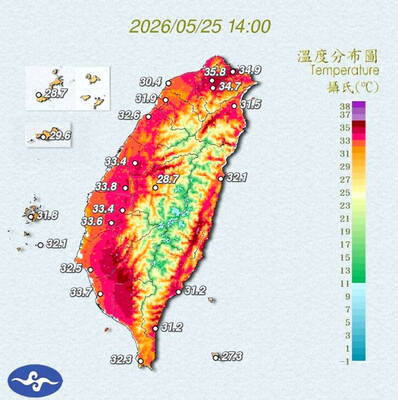
STAY COOL: The HPA recommended that people stay hydrated, use air-conditioning or fans while indoors, wear loose-fitting clothes and walk in the shade while outdoors Employers must implement measures such as installing cooling equipment, and providing drinking water and rest breaks for outdoor workers starting from Monday next week, the Taipei Department of Labor said on Sunday. Employers who fail to comply could face fines of NT$30,000 to NT$300,000 under the Occupational Safety and Health Act (職業安全衛生法), the department said. Businesses in Taipei employing fewer than 100 workers, as well as registered self-employed workers with labor insurance coverage, could receive on-site assessments and guidance from occupational safety consultants to help them apply for central government subsidies to implement or improve heat-protection measures, it said. Under the Ministry of


 RSS
RSS