


When it comes to how political leaders in a democratic society are assessed, in addition to whether they follow the rule of law, the public’s perception of them is also an important indicator, a long-term US observer of Taiwan said recently in Taipei.
Charles Irish, emeritus professor of law at the University of Wisconsin Law School in Madison, Wisconsin, and senior director of the East Asian Legal Studies Center at the university, made the remarks in an interview with the Taipei Times on Tuesday.
Given that the basis of the US legal system differs from that of Taiwan, Irish was hesitant to say whether President Ma Ying-jeou (馬英九) had failed to abide by the law and Constitution in what have been perceived as his recent attempts to oust Legislative Speaker Wang Jin-pyng (王金平).
Irish offered his comments according to the public’s perception, saying that “the public certainly has a sense” that Ma has overstepped his power.
Irish drew a parallel between the situation Ma is facing and that experienced by former Thai prime minister Thaksin Shinawatra when the tax-free sale of his telecommunication company Shin Corp to Singapore’s Temasek Holdings in 2006 incited an outcry from the public which is said to have led to his downfall.
Although most Thais agreed that “the sale was legal under Thai law,” the people thought that “he [Thaksin] was wrong,” Irish said.
Ma might insist that he has followed the law, but public perception is that what he did was wrong and that he abused his power, Irish said.
“You go out onto the streets and you talk to taxi drivers. The average people don’t know about the rules, but they have a sense. That probably is a good indicator of whether what [Ma] did was right or wrong,” Irish said.
“The public feels that what he did is wrong and that is very important in a democratic society. It’s not necessarily whether it [what Ma did] is technically legal, it’s the public perception of what is right or wrong,” he added.
Over the course of his career, Irish has traveled to about 80 countries and done extensive advisory work on tax reform and trade policy in Africa, Asia, Europe and the Caribbean.
He first visited Taiwan in 1984 when the country was still under martial law and had just suffered the impact of the US’ shift in recognition to China a few years before, and was grappling with diplomatic recognition worldwide.
Irish said he was struck by “the spirit of the people” of Taiwan; a spirit of “independence” and “resilience” that he said made Taiwan different.
There is a tendency for countries that are having a hard time to blame foreigners, but Taiwanese use their intelligence and work hard to survive, he said.
Over the past 25 years, Irish has worked with people in the government, mainly in the Ministry of Finance and the Ministry of Economic Affairs.
The people he knows in the government “are really interested in trying to find better ways to do things,” he said.
The US’ democratic system has been sustained for nearly 250 years, but it still has shortcomings as shown by the recent conflict between US President Barack Obama’s administration and the Republican-controlled US House of Representatives over budget and debt issues, Irish said.
There are always bumps in the road to democracy, Irish said.
Taiwan also has problems in its young but “fully functional democracy,” but “I don’t think it has as much of a problem in [Taiwan] as some other places in the world,” Irish said, adding that he holds a positive view on its development.
Irish said Ma’s reputation in the international community is “much better” than his national image because the cross-strait relationship has been “quiet” and “smooth” as a result of his rapprochement policy, which is welcomed by the international community.
The signing of the Economic Cooperation Framework Agreement (ECFA) in 2010 and the subsequent cross-strait trade service trade agreement could enable Taiwan to become a platform for access to the Chinese market, Irish said.
However, Irish is concerned about the nation’s economic reliance on China, saying it is “scary” that Taiwan has so much of its economic activities based in one place, and “that place can easily turn hostile towards Taiwan.”
“The government has to be very, very careful about the globalization going toward China, because China is going to do what is in China’s self-interest, and that self-interest does not include Taiwan,” Irish said.
In its fighting against marginalization as most countries might kowtow to China’s pressure to refrain from signing trade pacts with Taiwan and to exclude Taiwan in regional trade blocs, the nation needs more than cordial relations with China, he said.
Taiwan should unilaterally liberalize its economy to attract foreign investments and to establish its readiness for multilateral trade negotiations since the world could break the impasse has stalled that the Doha Round since 2001, Irish said.
If negotiations on the Trans Pacific Partnership agreement are finalized by the end of this year, it could provide impetus to reactivate the Doha Round, he said.

FUKUOKA SITUATION: Japanese media reported that the pathogen is expected to be identified by the summer, while the CDC downplayed the idea that it was hMPV A “mysterious cold-like illness” reported in Japan’s Fukuoka Prefecture does not seem to be a new disease, but Japanese authorities have been asked about the situation, the Centers for Disease Control (CDC) said yesterday. The Fukuoka Prefectural Medical Association on Wednesday told a news conference that a “mystery cold” that has become a hot topic on social media is “highly likely to be caused by some kind of viral infection,” Japan’s KBC News reported. “Many people are experiencing symptoms starting with a sore throat, followed by a runny nose, phlegm and a severe cough,” KBC News reported, citing association officials. Health authorities are

Nvidia Corp CEO Jensen Huang (黃仁勳) arrived in Taiwan yesterday ahead of upcoming AI and technology events, saying he plans to meet with clients and Taiwan Semiconductor Manufacturing Co Chairman C.C. Wei (魏哲家) during his visit. After landing at Taipei Songshan Airport, Huang posed for photos with fans and handed out Yakult drinks to reporters and supporters waiting at the scene, saying he has “a lot to do” during the trip. Asked about reports that Nvidia’s planned headquarters site in Taipei’s Beitou Shilin Technology Park could break ground on May 27, Huang said that if the company holds an event, he would

The Ministry of Finance this afternoon announced the winning numbers for the March-April uniform invoice lottery. The winning number for the NT$10 million (US$318,060) special prize is 19531471, and the winning number for the NT$2 million grand prize is 85941329. Three numbers were drawn for the NT$200,000 first prize: 07225810, 20231230 and 83518781. Those with receipts matching the last seven digits of any of the first-prize numbers will win the NT$40,000 second prize, while those matching the last six digits will win the NT$10,000 third prize. Those whose receipts match the last five digits of the first-prize numbers can claim the NT$4,000 fourth prize,
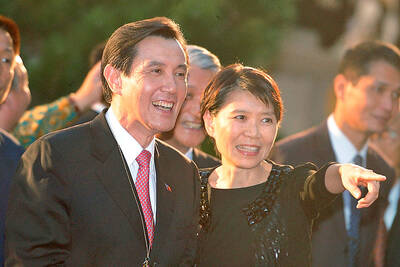
Former president Ma Ying-jeou (馬英九) yesterday expressed “shock and regret” over a statement issued by his wife without his consent, and rejected her assertion that his eldest sister, Ma Yi-nan (馬以南), would manage his medical care or act as his spokesperson amid an ongoing embezzlement probe into his foundation. Ma Ying-jeou in a statement said he was shocked by a statement by his wife, Chou Mei-ching (周美青), regarding his affairs. Ma Yi-nan “must not” be in charge of his healthcare and other personal affairs, nor can she be allowed to represent the Ma family, the former president said. He said he was also


 RSS
RSS