


The Tourism Bureau has been accused of becoming a political tool and thug of the Chinese government after it asked local governments to remove posters and boards put up by the Falun Gong movement at tourist attractions to prevent them from tarnishing the nation’s image.
According to a source familiar with the matter, the bureau recently issued an official document to local governments saying that “a member of the public has complained about the billboards the Falun Gong installed at several sightseeing hotspots, worrying that they might negatively affect foreign tourists’ perceptions of the country.”
The document instructed local officials to step up inspection efforts and ensure the removal of “inappropriate” material.
The bureau’s move has drawn fierce criticism from Democratic Progressive Party (DPP) lawmakers and borough wardens, with some critics saying that while President Ma Ying-jeou’s (馬英九) administration has long been known for its pro-China stance, it was preposterous to see the bureau acting as a hired thug for the Chinese government.
DPP Legislator Tien Chiu-chin (田秋堇) said the public’s right to advertise is part of their constitutionally protected freedom of speech and that the bureau’s actions show that Taiwan is inferior to Macau in terms of protection of basic human rights, because Macau allows Falun Gong practitioners to set up stalls in public places to promote their beliefs.
“In what way have the Falun Gong’s advertisements impeded tourism development in this country? How could the government take down its billboards and keep them out of the sight of Chinese tourists just because the Chinese government is not a fan of the group?” Tien said.
The bureau should identify the “member of the public” who complained and say if the person is a Republic of China (ROC) citizen, she said.
DPP Legislator Chen Ting-fei (陳亭妃) said the Ma administration should know that for Chinese tourists, who have grown up under an isolated, autocratic regime, the Falun Gong posters are not a hindrance to Taiwan’s tourism, but a sign of the nation’s democratic achievements and cultural diversity.
“The only one minding the Falun Gong is the Chinese government, which is why it has sought every possible means to pressure the Ma administration into removing the group’s ads. If we cooperate, it would be no different from pandering to the Chinese government and murdering the nation’s democracy,” Chen said.
Chen Jen-jung (陳仁榮), warden of Greater Taichung’s Guoguang Borough (國光), said the bureau’s policy raises questions about whether the Ma government is acting in response to political pressure from China or making some kind of political gesture.
“There are countless organizations putting up illegal billboards across the country, yet the bureau is aiming its guns only at the Falun Gong,” he said.
The bureau on Tuesday said the complainant was an ROC citizen surnamed Tu (杜), who filed the complaint via e-mail on Sept.1.
Tu wrote that rampant illegal advertising was destroying the nation’s landscape and he singled out the Falun Gong, the bureau said, adding that Tu wanted the bureau to take down all illegal ads and billboards, not just the ones posted by the Falun Gong.
“The document we issued only reflects the man’s personal opinion and does not represent the bureau’s position,” it said.
Tourism Bureau Deputy Director-General Chang Hsi-tsung (張錫聰) said the agency would pay more attention to the wording of its documents to avoid unnecessary misunderstandings.

The first of 10 new high-capacity trains purchased from South Korea’s Hyundai Rotem arrived at the Port of Taipei yesterday to meet the demands of an expanding metro network, Taipei Rapid Transit Corp (TRTC) said yesterday. The train completed a three-day, 1,200km voyage from the Port of Masan in South Korea, the company said. Costing NT$590 million (US$18.79 million) each, the new six-carriage trains feature a redesigned interior based on "human-centric" transportation concepts, TRTC said. The design utilizes continuous longitudinal seating to widen the aisles and optimize passenger flow, while also upgrading passenger information displays and driving control systems for a more comfortable

Instead of focusing solely on the threat of a full-scale military invasion, the US and its allies must prepare for a potential Chinese “quarantine” of Taiwan enforced through customs inspections, Stanford University Hoover fellow Eyck Freymann said in a Foreign Affairs article published on Wednesday. China could use various “gray zone” tactics in “reconfiguring the regional and ultimately the global economic order without a war,” said Freymann, who is also a nonresident research fellow at the US Naval War College. China might seize control of Taiwan’s links to the outside world by requiring all flights and ships entering or leaving Taiwan
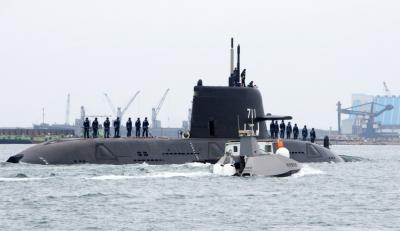
Taiwan's first indigenous defense submarine, the SS-711 Hai Kun (海鯤, or Narwhal), departed for its 13th sea trial at 7am today, marking its seventh submerged test, with delivery to the navy scheduled for July. The outing also marked its first sea deployment since President William Lai (賴清德) boarded the submarine for an inspection on March 19, drawing a crowd of military enthusiasts who gathered to show support. The submarine this morning departed port accompanied by CSBC Corp’s Endeavor Manta (奮進魔鬼魚號) uncrewed surface vessel and a navy M109 assault boat. Amid public interest in key milestones such as torpedo-launching operations and overnight submerged trials,
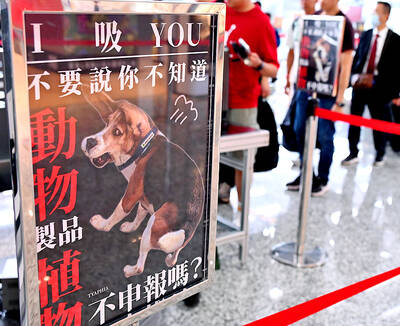
Quarantine awareness posters at Taiwan Taoyuan International Airport have gone viral for their use of wordplay. Issued by the airport branch of the Animal and Plant Health Inspection Agency, the posters feature sniffer dogs making a range of facial expressions, paired with advisory messages built around homophones. “We update the messages for holidays and campaign needs, periodically refreshing materials to attract people’s attention,” quarantine officials said. “The aim is to use the dogs’ appeal to draw focus to quarantine regulations.” A Japanese traveler visiting Taiwan has posted a photo on X of a poster showing a quarantine dog with a


 RSS
RSS