


A new analysis concludes that although difficult, it may be possible for Taiwan to join the Trans-Pacific Partnership (TPP) free-trade agreement.
“The various obstacles are indeed daunting,” Brookings Institution senior fellow Richard Bush said in the 13-page analysis.
“If Las Vegas or Macau bookmakers took bets on the chances of TPP success for Taiwan, they would surely be very long,” Bush said.
However, he has devised a six-step approach that — if followed in order — could greatly improve the prospects.
First, said Bush, the 12 countries that are party to the current TPP negotiations must complete an agreement or there will be no TPP option for Taiwan. Second, Taiwanese must reach a broad political consensus on why TPP membership is vital to the nation’s long-term economic competitiveness.
“There is no economic reason why Taiwan should not be included in the various emerging regional blocs tying Northeast and Southeast Asia together or tying Asian countries to markets in the Western Hemisphere,” Bush said. “The reason is entirely political: China’s desire to keep Taiwan’s international profile as low as it can.”
As a third step, Taiwan can and should restore its credibility with key trading partners, Bush said.
“Taipei must still eliminate a significant threshold obstacle to its becoming a part of TPP. That is, its poor track record over recent years in negotiating trade agreements,” Bush said.
Economic officials, he said, are seriously constrained by domestic political forces, he said.
Step four, is for Taiwan to develop a negotiating position and strategy for TPP, Bush said.
“This will perhaps be the most complex trade negotiation that Taiwan has ever undertaken, for reasons of both substance and process,” he said.
Concerning substance, the removal of non-tariff barriers will be difficult enough, given the likely resistance of domestic groups that benefit from such barriers, he said.
The fifth step is the variable most outside Taiwan’s control: China’s leaders must opt for fundamental economic reform.
“Taiwan must hope for a ‘sweet spot’ in Beijing’s calculus concerning economic reform,” Bush said. “The optimal situation for Taiwan is when China’s reformist leaders sincerely want to carry out fundamental change, but face stiff resistance from domestic interests, to the point that they cannot move forward on their own, even though they want to. In that case, external incentives can stimulate reform.”
As a sixth and final step, Bush says that Taiwan must leverage China’s accommodation.
If Chinese leaders make a political decision to block TPP membership for Taiwan, then entry is “highly unlikely” Bush said.
The US might be willing to judge Taiwan’s TPP negotiating position on its economic merits, but other member countries would be more likely to “succumb to Beijing’s political pressure,” he said. “That Beijing would mount political opposition by exerting pressure on the smaller members of TPP is a reality that cannot be wished away — it is an obstacle that must be circumvented.”
Just as China has shifted on TPP in general, it is also adjusting its view of Taiwan’s membership, Bush said. Now, at least in conversations with Taiwanese academics, Chinese counterparts are holding out the WTO model as a possible way for Taiwan to join TPP.
“That is, the PRC [People’s Republic of China] and Taiwan join simultaneously, as they did for WTO,” he said.
Taiwan should also make the case that if Beijing blocks entry to TPP it will be far less likely to achieve its political objective of unification.
“Taiwan’s path to membership is not easy, but a path does exist,” Bush said.
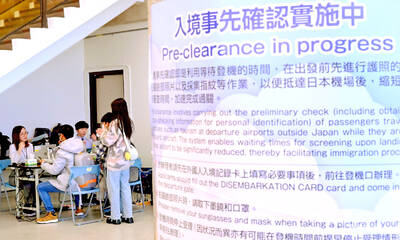
A preclearance service to facilitate entry for people traveling to select airports in Japan would be available from Thursday next week to Feb. 25 at Taiwan Taoyuan International Airport, Taoyuan International Airport Corp (TIAC) said on Tuesday. The service was first made available to Taiwanese travelers throughout the winter vacation of 2024 and during the Lunar New Year holiday. In addition to flights to the Japanese cities of Hakodate, Asahikawa, Akita, Sendai, Niigata, Okayama, Takamatsu, Kumamoto and Kagoshima, the service would be available to travelers to Kobe and Oita. The service can be accessed by passengers of 15 flight routes operated by

Chinese spouse and influencer Guan Guan’s (關關) residency permit has been revoked for repeatedly posting pro-China videos that threaten national security, the National Immigration Agency confirmed today. Guan Guan has said many controversial statements in her videos posted to Douyin (抖音), including “the red flag will soon be painted all over Taiwan” and “Taiwan is an inseparable part of China,” and expressing hope for expedited reunification. The agency last year received multiple reports alleging that Guan Guan had advocated for armed reunification. After verifying the reports, the agency last month issued a notice requiring her to appear and explain her actions. Guan

GIVE AND TAKE: Blood demand continues to rise each year, while fewer young donors are available due to the nation’s falling birthrate, a doctor said Blood donors can redeem points earned from donations to obtain limited edition Formosan black bear travel mugs, the Kaohsiung Blood Center said yesterday, as it announced a goal of stocking 20,000 units of blood prior to the Lunar New Year. The last month of the lunar year is National Blood Donation Month, when local centers seek to stockpile blood for use during the Lunar New Year holiday. The blood demand in southern Taiwan — including Tainan and Kaohsiung, as well as Chiayi, Pingtung, Penghu and Taitung counties — is about 2,000 units per day, the center said. The donation campaign aims to boost
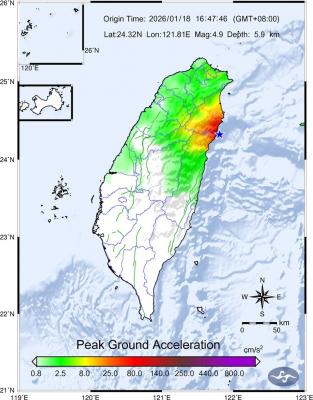
The Central Weather Administration (CWA) said a magnitude 4.9 earthquake that struck off the coast of eastern Taiwan yesterday was an independent event and part of a stress-adjustment process. The earthquake occurred at 4:47pm, with its epicenter at sea about 45.4km south of Yilan County Hall at a depth of 5.9km, the CWA said. The quake's intensity, which gauges the actual effects of a temblor, was highest in several townships in Yilan and neighboring Hualien County, where it measured 4 on Taiwan's seven-tier intensity scale, the CWA said. Lin Po-yu (林柏佑), a division chief at the CWA's Seismological Center, told a news conference


 RSS
RSS