


Media and show business personalities yesterday joined other protesters in front of the Supreme Prosecutors’ Office Special Investigation Division (SID) to demand the resignation of Prosecutor-General Huang Shih-ming (黃世銘), who had allegedly approved the use of illegal wiretaps.
Huang reportedly met with President Ma Ying-jeou (馬英九) on Aug. 31 and Sept. 1 to discuss the alleged improper lobbying by Chinese Nationalist Party (KMT) Legislative Speaker Wang Jin-pyng (王金平) of former minister of justice Tseng Yung-fu (曾勇夫), High Prosecutors’ Office Head Prosecutor Chen Shou-huang (陳守煌) and High Prosecutors’ Office prosecutor Lin Shiow-tao (林秀濤) on behalf of Democratic Progressive Party (DPP) caucus whip Ker Chien-ming (柯建銘).
Though an investigation into Wang’s actions had been closed without charges being filed and only administrative penalties have been suggested for him, the public and the DPP had been angered at what they called the “illegal grounds” of the division’s wiretapping of the phone lines of Wang, Ker and others.
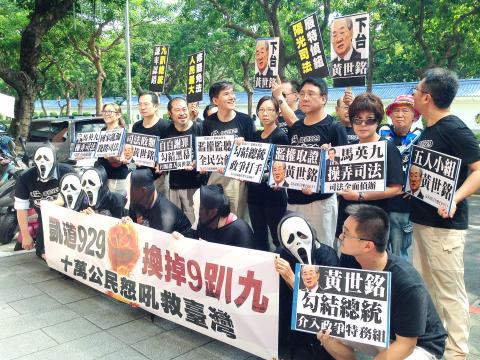
Photo: CNA
Former TVBS vice president Ge Shu-ren (葛樹人) and actress Kuo Mei-chu (郭美珠) took part in the protest, along with the 929 protest event spokesperson Ryan Wu (吳睿穎) and others dressed in black — an allusion to police covert activities — to protest Huang’s allegations against Ker.
The SID initially responded to the protest by pulling down the metal doors that block off the hallway to its office, but after Kuo took off her shoes and started using them to hammer the door — an act that encouraged other protestors to try to manually raise the doors — the SID completely shut the door, while police officers formed a wall and started to push the protesters back.
Ge then calmed tensions by urging the protesters not to become irate over the matter and led the crowd in chanting slogans.
Ge said that he was against using personal influence for lobbying, but the crux of the issue lay not with Wang’s lobbying for Ker, but rather how the SIC handled its investigation.
The public cannot accept the division’s blatant wiretapping and infringement of rights, Ge said.
Ge also said that an anti-Ma protest scheduled for tomorrow would include a “wall” on which participants could vent their frustration.

UPGRADE: The Kang Ding-class frigate is replacing its Chaparall missiles with Tien Chien II and Hua Yang VLS, which would provide it with long-range, 360° air defense Taiwan plans to produce 1,200 to 1,376 Hai Chien II missiles (海劍二, Sea Sword II) — also known as TC-2N — to serve as the standard air defense system of the navy’s surface combatant fleet, a source said yesterday. Last week, the Hai Chien II, the naval version of the Tien Kung II missile (天劍二, Sky Sword II), completed a live-fire test in waters off the National Chungshan Institute of Science and Technology’s Jiupeng facility (九鵬) in Pingtung County’s Manjhou Township (滿州). The MIM72 Chaparral and other dated air defense missiles that currently arm Taiwanese ships have inadequate range to combat Chinese

REASONS FOR TRAVEL: An assistant professor said that proposed amendments to penalize drivers if they used drugs overseas would not deter people from traveling People who operate a motor vehicle under the influence of marijuana would have their driver’s license revoked, even if they used the substance while overseas, the Ministry of Transportation and Communications said yesterday, citing proposed amendments to the Road Traffic Management and Penalty Act (道路交通管理處罰條例). The amendments would also authorize the government to revoke the licenses of people determined to have used Category 1 or Category 2 narcotics, even if they were not operating a vehicle while under the influence of drugs, as well as ban them from taking the license test for three years, the ministry said. People aged 18 or

HEAVY WEATHER: Typhoon Jangmi is due to crash straight into the Ryukyus as airlines look to shift flights to larger aircraft or cancel flights to Okinawa entirely Taiwan’s international air carriers announced flight adjustments over the weekend as Typhoon Jangmi is forecast to hit the Ryukyu Islands today and tomorrow. The Central Weather Administration (CWA) upgraded Jangmi from a tropical storm to a typhoon at 8am yesterday, with the eye located 580km south of Naha city. It was moving north at 19kph. Today, China Airlines’ CI-120, CI-121, CI-122 and CI-123 flights between Taoyuan and Naha, Okinawa, have been canceled as well as CI-132 and CI-133 between Kaohsiung and Naha. EVA Air’s BR-112, BR-113, BR-186 and BR-185 flights between Taoyuan and Naha are also canceled. Low-cost carrier Tigerair Taiwan canceled IT-230,
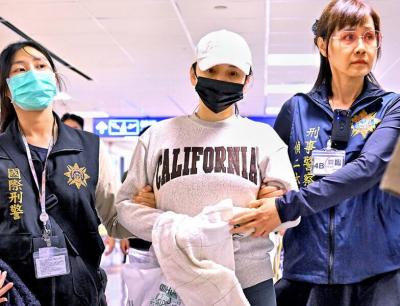
Johanne Liou (劉喬安), a Taiwanese woman who shot to unwanted fame during the Sunflower movement protests in 2014, returned to Taiwan last night after being deported from the US. She is to stand trial in Taiwan for charges involving embezzlement, fraud and drug crimes. The Criminal Investigation Bureau (CIB) said it took her into custody at Taiwan Taoyuan International Airport and would first question her before transferring her to the New Taipei District Prosecutors’ Office. She was arrested upon disembarking a flight from San Francisco that landed shortly before 7pm. Liou absconded to the US in 2019 after jumping bail


 RSS
RSS