


Following the death of a resident of Dapu Borough (大埔), whose house was demolished by the Miaoli County authorities two months ago, protesters staged surprise protests outside the Executive Yuan and the presidential residence late on Wednesday, leading to minor clashes with police.
Despite their efforts to stop forcible demolitions through administrative and legal means, as well as street demonstrations, the home of Chang Sen-wen (張森文) — along with those of three other families — were torn down in July.
Chang was found dead in an irrigation channel a little more than 200m away from the site of his former home on Wednesday.
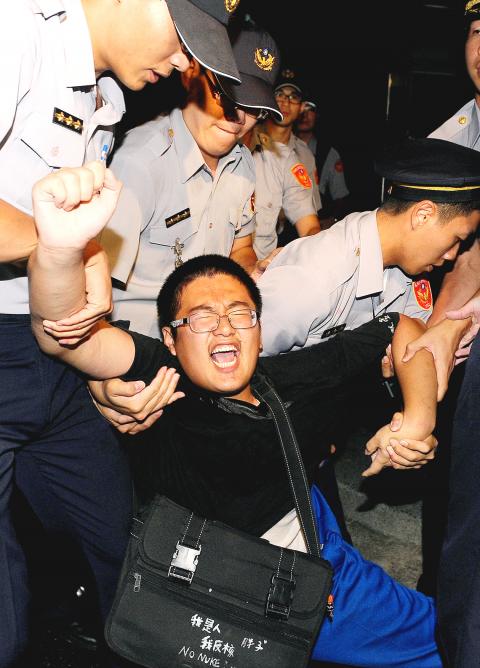
Photo: Chu Pei-hsiung, Taipei Times
While the cause of his death has not yet been determined, Chang’s family and supporters are blaming the government officials who insisted on tearing down his house.
“[Premier] Jiang Yi-huah [江宜樺] come out! Take up your responsibility!” dozens of protesters shouted outside the Executive Yuan at about 9:30pm on Wednesday.
Police officers rushed to the scene, quickly outnumbering the protesters, and clashes both physical and verbal erupted as some protesters tried to climb over the fence into the Executive Yuan’s compound.
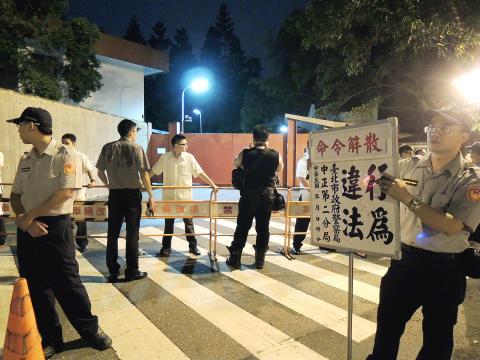
Photo: Hsieh Wen-hua, Taipei Times
Another group of protesters turned up outside the presidential residence after midnight, blaming President Ma Ying-jeou (馬英九) for Chang’s death. They pushed and shoved the security guards and military guards outside the residence, and threw red paint and ghost money before leaving.
Meanwhile, National Tsing Hua University student and Youth Alliance for Miaoli spokesman Chen Wei-ting (陳為廷) said he had been the one to throw a shoe at Miaoli County Commissioner Liu Cheng-hung (劉政鴻) on Wednesday night when Liu tried to pay his respects to the Chang family over Chang Sen-wen’s death.
“I bought the pair of shoes a year ago before taking part in a march from Miaoli to Taipei with workers who were illegally laid off by the Hualong Group. Exactly a year later, one of the shoes broke after being stepped on by police officers who were escorting Liu to the Changs’ residence,” Chen said in a posting on Facebook.
“I think the shoe was sacrificed in a righteous way,” Chen wrote.
Asked by reporters if he was worried that Liu might take legal action against him, Chen said he was already facing several lawsuits for the protests he took part in.
“One more lawsuit makes no difference,” he said.
Earlier in the day, former Democratic Progressive Party (DPP) chairperson Tsai Ing-wen (蔡英文) visited the Chang family to pay her condolences.
“The government must take the lion’s share of the responsibility [for Chang Sen-wen’s death],” Tsai said.
She also promised to add her name to a proposed amendment to the Land Expropriation Act (土地徵收條例) that the Taiwan Rural Front plans to submit to the legislature.
The public should not become detached from such issues, or try to cloud them, Tsai said, adding that everyone should push for the amendments.
A crowd also gathered at Liberty Square in Taipei last night to remember Chang.
Additional reporting by Jake Chung
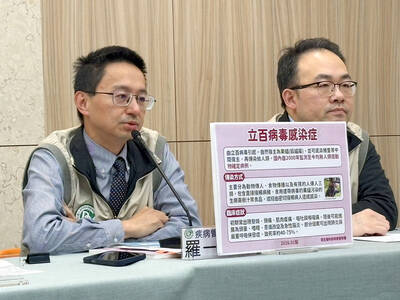
Nipah virus infection is to be officially listed as a category 5 notifiable infectious disease in Taiwan in March, while clinical treatment guidelines are being formulated, the Centers for Disease Control (CDC) said yesterday. With Nipah infections being reported in other countries and considering its relatively high fatality rate, the centers on Jan. 16 announced that it would be listed as a notifiable infectious disease to bolster the nation’s systematic early warning system and increase public awareness, the CDC said. Bangladesh reported four fatal cases last year in separate districts, with three linked to raw date palm sap consumption, CDC Epidemic Intelligence

Two Taiwanese prosecutors were questioned by Chinese security personnel at their hotel during a trip to China’s Henan Province this month, the Mainland Affairs Council (MAC) said yesterday. The officers had personal information on the prosecutors, including “when they were assigned to their posts, their work locations and job titles,” MAC Deputy Minister and spokesman Liang Wen-chieh (梁文傑) said. On top of asking about their agencies and positions, the officers also questioned the prosecutors about the Cross-Strait Joint Crime-Fighting and Judicial Mutual Assistance Agreement, a pact that serves as the framework for Taiwan-China cooperation on combating crime and providing judicial assistance, Liang
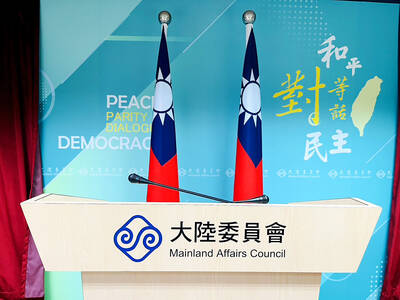
Reports of Taiwanese going missing, being detained or interrogated, or having their personal liberties restricted in China increased about fourfold annually last year, the Mainland Affairs Council (MAC) said yesterday. Last year, 221 Taiwanese who traveled to China were reported missing, were detained and interrogated, or otherwise had their personal freedom restricted, up from 55 the previous year, the council said. Reopening group tours to China would be risky, as it would leave travelers with no way to seek help through official channels after Beijing shut down dialogue between the associations tasked with handling cross-strait tourism, the MAC said. Taipei’s Taiwan Strait Tourism
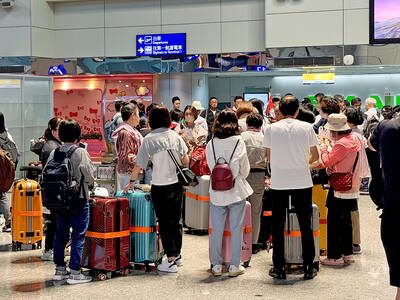
SHIFT: Taiwan is evolving from a transit stop into a tourist destination, with more international travelers willing to spend on tours, dining and cultural activities Taiwan rose three places in the World Tourism Barometer to 36th globally in 2024, with international tourism revenue of US$10.028 billion, the Tourism Administration said on Monday. The UN Tourism Organization publication said that its focus has switched from whether a country has returned to pre-COVID-19 levels of tourism to the amount spent by a tourist during an overseas trip. The nation last year welcomed 8.57 million international tourists, about 9 percent more than in 2024, with most tourists coming from Japan, South Korea, and Hong Kong and Macau, all of which accounted for at least 1 million tourists each. During the first


 RSS
RSS