


A sports research team at National Taiwan Normal University (NTNU) has developed a device designed to help joggers avoid injuries by detecting and transmitting signs of fatigue from the body to mobile communication devices.
The research results, which were unveiled yesterday, come at a time when jogging is becoming increasingly popular around the nation.
However, many have sustained injuries because they often run only on weekends and tend to overdo it.
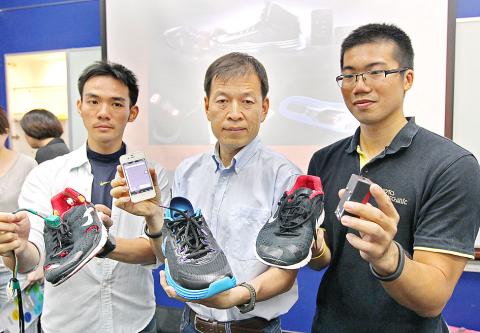
Photo: CNA
The university team, led by Department of Athletic Performance professor Hsiang Tzyy-yuang (相子元), found that the physical activity level of low-impact running can be estimated from the acceleration of the wrists, while the acceleration of ankles can be used to gauge the physical activity level of high-
impact running.
The fatigue produced by excessive exercise causes the runner’s posture to change, which is the main cause of sports injuries, he said.
Hsiang said the device combines the use of an accelerometer and a gyroscope with Bluetooth technology. The accelerometer is used to determine the impact of body movements and changes in speed, whereas the gyroscope is used to determine the types of movements made by the user by detecting the speed of foot rotation.
Hsiang said the device can be placed inside users’ running shoes to detect how much exercise they have done. The device will send a warning message to users’ mobile phone if it detects signs of fatigue to remind users to adjust their posture or to stop running.
The result of the research has been published in the locomotion and balance research journal Gait and Posture and was accepted by the Journal of Sports Sciences for publication next year.
The technology will also be used by the sportswear manufacturer Nike to produce “smart” running shoes, the researchers said.
Aside from casual runners, Hsiang said athletes can use the device to gather training data.
Athletes can look at the data and see if they are making any progress, he said.
“The digital device would show the athletes what they have gained from the training, which would enable them to determine what they should work on next,” he said.
In addition to joggers, users engaged in other sports can also place the device on other body parts to prevent injuries, he added.
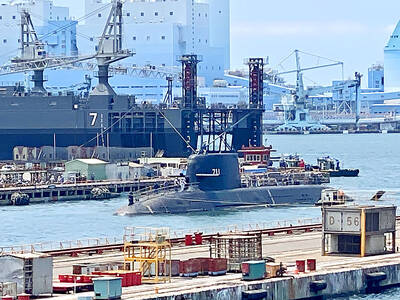
AGING: While Japan has 22 submarines, Taiwan only operates four, two of which were commissioned by the US in 1945 and 1946, and transferred to Taiwan in 1973 Taiwan would need at least 12 submarines to reach modern fleet capabilities, CSBC Corp, Taiwan chairman Chen Cheng-hung (陳政宏) said in an interview broadcast on Friday, citing a US assessment. CSBC is testing the nation’s first indigenous defense submarine, the Hai Kun (海鯤, Narwhal), which is scheduled to be delivered to the navy next month or in July. The Hai Kun has completed torpedo-firing tests and is scheduled to undergo overnight sea trials, Chen said on an SET TV military affairs program. Taiwan would require at least 12 submarines to establish a modern submarine force after assessing the nation’s operational environment and defense

Yangmingshan National Park authorities yesterday urged visitors to respect public spaces and obey the law after a couple was caught on a camera livestream having sex at the park’s Qingtiangang (擎天崗) earlier in the day. The Shilin Police Precinct in Taipei said it has identified a suspect and his vehicle registration number, and would summon him for questioning. The case would be handled in accordance with public indecency charges, it added. The couple entered the park at about 11pm on Thursday and began fooling around by 1am yesterday, the police said, adding that the two were unaware of the park’s all-day live
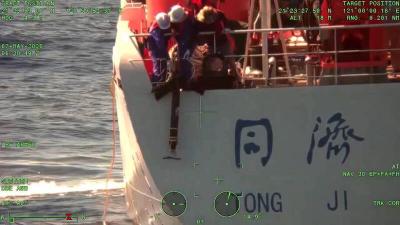
The coast guard today said that it had disrupted "illegal" operations by a Chinese research ship in waters close to the nation and driven it away, part of what Taipei sees a provocative pattern of China's stepped up maritime activities. The coast guard said that it on Thursday last week detected the Chinese ship Tongji (同濟號), which was commissioned only last year, 29 nautical miles (54km) southeast of the southern tip of Taiwan, although just outside restricted waters. The ship was observed lowering ropes into the water, suspected to be the deployment of scientific instruments for "illegal" survey operations, and the coast

A former soldier and an active-duty army officer were yesterday indicted for allegedly selling classified military training materials to a Chinese intelligence operative for a total of NT$79,440. The Taipei District Prosecutors’ Office indicted Chen Tai-yin (陳泰尹) and Lee Chun-ta (李俊達) for contravening the National Security Act (國家安全法) and the Anti-Corruption Act (貪污治罪條例). Chen left the military in September 2013 after serving alongside then-staff sergeant Lee, now an army lieutenant, at the 21st Artillery Command of the army’s Sixth Corps from 2011 to 2013, according to the indictment. Chen met a Chinese intelligence operative identified as “Wang” (王) through a friend in November


 RSS
RSS