


The authorities have again urged people to exercise extreme caution and wear protective clothing when hiking or walking in the wilderness, after yet another fatal hornet attack, the third this year.
The body of the latest victim, surnamed Liu (劉), was found on Monday in the hills of Hansi Village (寒溪村) in Yilan County’s Datong Township (大同).
Liu, a Chunghwa Telecom employee, heard that a colleague surnamed Huang (黃) had found large numbers of hornets buzzing around his property in the Yilan village.
Sixty-four-year-old Liu, who lived in New Taipei City (新北市), volunteered to remove the hornet nests. After successfully taking down and wrapping up one nest on Saturday last week, Liu went up again, alone, on Sunday to remove another nest, but he did not return that day.
Huang called the search and rescue team at the local fire department, and they recovered his body on Monday.
Liu was found wearing makeshift gear comprised of boots, a rubber raincoat, hat and head net, and with a towel wrapped around his neck. He had used tape to seal the gaps.
However, a rescue team member said there were holes and breaks in his clothing, and they found four hornets in the towel around his neck.
“His face was stung by hornets. The insects attacked him and entered through the holes and gaps in his clothing. He was not wearing the kind of protective gear worn by professionals. It seems he underestimated what the hornets could do,” search and rescue team captain Chen Po-ching (陳保慶) said.
Chen said they encountered large hornet swarms flying around the area, and three nests were found.
He said that the species in question is very aggressive and carries a highly toxic venom. A person can die from just two stings.
“The victim’s makeshift gear had lots of gaps, it was not thick enough, and wearing a towel around the neck could not protect him,” Chen said.
“People must not go removing hornet nests unless they are well-prepared and have the right type of professional protective gear,” he added.
The peak season for attacks is from August to November, when hornets are preparing for winter and will defend their nests against trespassers.
The hornets in this case were the Vespa ducalis species, known as “black-tailed tiger-head bees” (黑尾虎頭蜂), with bright orange-brown stripes and black at the anterior end.
This was the third reported fatality this year: A man, 47, working on a landscaping job at a school in Yilan County’s Jiaosi Township (礁溪) was killed by hornets on Aug. 7. A woman, 67, died from hornet stings at Taitung County’s Chihshang Township (池上) on Sept. 4.

Actor Darren Wang (王大陸) was sentenced to six months in prison, commutable to a fine, by the New Taipei District Court today for contravening the Personal Data Protection Act (個人資料保護法) in a case linked to an alleged draft-dodging scheme. Wang allegedly paid NT$3.6 million (US$114,380) to an illegal group to help him evade mandatory military service through falsified medical documents, prosecutors said. He transferred the funds to Chen Chih-ming (陳志明), the alleged mastermind of a draft-evasion ring, although he lost contact with him as he was already in detention on fraud charges, they said. Chen is accused of helping a

SECURITY: Starlink owner Elon Musk has taken pro-Beijing positions, and allowing pro-China companies to control Taiwan’s critical infrastructure is risky, a legislator said Starlink was reluctant to offer services in Taiwan because of the nation’s extremely high penetration rates in 4G and 5G services, the Ministry of Digital Affairs said yesterday. The ministry made the comments at a meeting of the legislature’s Transportation Committee, which reviewed amendments to Article 36 of the Telecommunications Management Act (電信管理法). Article 36 bans foreigners from holding more than 49 percent of shares in public telecommunications networks, while shares foreigners directly and indirectly hold are also capped at 60 percent of the total, unless specified otherwise by law. The amendments, sponsored by Chinese Nationalist Party (KMT) Legislator Ko

The eastern extension of the Taipei MRT Red Line could begin operations as early as late June, the Taipei Department of Rapid Transit Systems said yesterday. Taipei Rapid Transit Corp said it is considering offering one month of free rides on the new section to mark its opening. Construction progress on the 1.4km extension, which is to run from the current terminal Xiangshan Station to a new eastern terminal, Guangci/Fengtian Temple Station, was 90.6 percent complete by the end of last month, the department said in a report to the Taipei City Council's Transportation Committee. While construction began in October 2016 with an
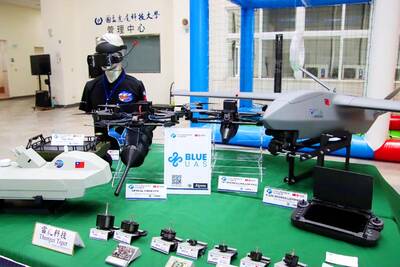
NON-RED SUPPLY: Boosting the nation’s drone industry is becoming increasingly urgent as China’s UAV dominance could become an issue in a crisis, an analyst said Taiwan’s drone exports to Europe grew 41.7-fold from 2024 to last year, with demand from Ukraine’s fight against Russian aggression the most likely driver of growth, a study showed. The Institute for Democracy, Society and Emerging Technology (DSET) in a statement on Wednesday said it found that many of Taiwan’s uncrewed aerial vehicle (UAV) sales were from Poland and the Czech Republic. These countries likely transferred the drones to Ukraine to aid it in its fight against the Russian invasion that started in 2022, it said. Despite the gains, Taiwan is not the dominant drone exporter to these markets, ranking second and fourth


 RSS
RSS