


With the two-month-old panda cub nicknamed Yuan Zai (圓仔) having become the new media darling and drawing lots of public attention, a netizen has accused the Taipei Zoo of creating an “M-shaped” society — a term describing deep inequality — among its creatures and leaving the nation’s Formosan black bears in the cold.
The netizen, who identified herself as Peng Shu-chen (彭淑禎), recently took to Facebook to vent her frustration over what she said was the zoo’s different treatment of pandas and the Formosan black bears, both of which are endangered species.
“While the zoo’s four Formosan black bears have to crowd together in a 165 ping [544.5m2] ‘slum,’ Yuan Zai’s parents, Tuan Tuan (團團) and Yuan Yuan (圓圓), are given the privilege of living in a 438 ping air-conditioned ‘lavish mansion,’” Peng wrote.
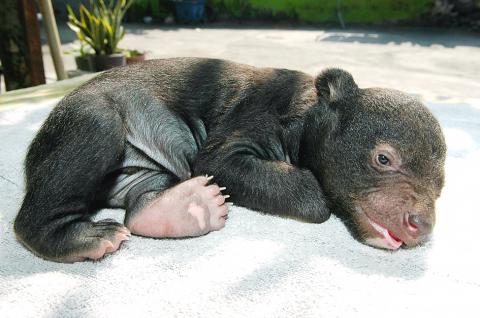
Photo: CNA, courtesy of the Taiwan Black Bear Conservation Association
Formosan black bears are much rarer than giant pandas, Peng wrote, adding that while there are about 1,590 wild giant pandas in the world, there are only about 200 wild Formosan black bears.
Yuan Zai, which was born on July 6, is the first giant panda born in Taiwan.
The parents were donated to the zoo by China in late 2008.
Shrugging off the criticism, zoo spokesman Chao Ming-chieh (趙明杰) said the zoo has never cut back on its efforts to facilitate the preservation of Formosan black bears.
“We have signed a declaration on the preservation and revival of endangered species with 16 animal conservation organizations, while assisting animal experts nationwide in helping the black bears mate and procreate,” he said.
Chao said the exhibition hall housing the three pandas was built using a NT$300 million (US$9.9 million) donation from the Shin Kong Group, adding that the hall might run out of space because the zoo plans to add more giant pandas after the cub grows up.
“It is natural that most of the public attention is being directed at Yuan Zai, since it is the first panda born in this country. Nevertheless, the zoo is endeavoring to introduce more species endemic to Taiwan to the public through the cub,” Chao said.
Chao was referring to a video featuring Yuan Yuan and Yuan Zai that the the zoo released on Friday last week. The video features an imaginary conversation between the pandas about Formosan black bears.
Meanwhile, catering to the public craze for information about Yuan Zai, a free mobile application chronicling the cub’s daily activities has drawn a lot of interest since it was launched on Aug. 20, said the developer, who prefers to be known as “mip.”
It has been downloaded more than 10,000 times, the developer said.
The app provides real-time updates on Yuan Zai, including the latest pictures and articles about the cub and some basic information on pandas, the developer said.
The app has not been approved by Taipei Zoo, but the zoo said it would not take any legal action against the developer at the moment, as the app is not for profit.
It did say, however, that it was considering applying for a trademark for the name “Yuan Zai.”
Additional reporting by CNA

FUKUOKA SITUATION: Japanese media reported that the pathogen is expected to be identified by the summer, while the CDC downplayed the idea that it was hMPV A “mysterious cold-like illness” reported in Japan’s Fukuoka Prefecture does not seem to be a new disease, but Japanese authorities have been asked about the situation, the Centers for Disease Control (CDC) said yesterday. The Fukuoka Prefectural Medical Association on Wednesday told a news conference that a “mystery cold” that has become a hot topic on social media is “highly likely to be caused by some kind of viral infection,” Japan’s KBC News reported. “Many people are experiencing symptoms starting with a sore throat, followed by a runny nose, phlegm and a severe cough,” KBC News reported, citing association officials. Health authorities are

Nvidia Corp CEO Jensen Huang (黃仁勳) arrived in Taiwan yesterday ahead of upcoming AI and technology events, saying he plans to meet with clients and Taiwan Semiconductor Manufacturing Co Chairman C.C. Wei (魏哲家) during his visit. After landing at Taipei Songshan Airport, Huang posed for photos with fans and handed out Yakult drinks to reporters and supporters waiting at the scene, saying he has “a lot to do” during the trip. Asked about reports that Nvidia’s planned headquarters site in Taipei’s Beitou Shilin Technology Park could break ground on May 27, Huang said that if the company holds an event, he would

The Ministry of Finance this afternoon announced the winning numbers for the March-April uniform invoice lottery. The winning number for the NT$10 million (US$318,060) special prize is 19531471, and the winning number for the NT$2 million grand prize is 85941329. Three numbers were drawn for the NT$200,000 first prize: 07225810, 20231230 and 83518781. Those with receipts matching the last seven digits of any of the first-prize numbers will win the NT$40,000 second prize, while those matching the last six digits will win the NT$10,000 third prize. Those whose receipts match the last five digits of the first-prize numbers can claim the NT$4,000 fourth prize,

Taiwan Travelogue (臺灣漫遊錄), which earlier this week became the first Taiwanese novel to win the International Booker Prize, is to be adapted into a television series through a Taiwan-Japan coproduction, producer Chang Chen-yu (張辰漁) said yesterday. Chang, a producer at World Softest Production Film Co, wrote on Facebook that the company had been searching for projects with international appeal that retain a strong Taiwanese identity after colleagues and Japanese partners strongly recommended the novel. After reading the book, Chang said he immediately decided to pursue the screen rights. “A great story has the power to transcend time and borders, and connect countless people,”


 RSS
RSS