


More than 100 civic groups yesterday announced that they are planning to recruit more than 100,000 people as “vote brokers” to stop construction of the Fourth Nuclear Power Plant if the issue is put to a vote in a Chinese Nationalist Party (KMT)-proposed referendum.
Making a joint announcement in front of the Presidential Office in Taipei, group representatives urged the Cabinet to abort construction of the facility in New Taipei City’s (新北市) Gongliao Dictrict (貢寮).
“We will not give up until use of nuclear power [in Taiwan] is abolished,” Citizen of the Earth, Taiwan (CET) executive director Lee Ken-cheng (李根政) said.
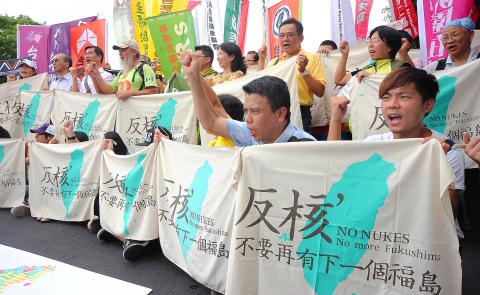
Photo: Liu Hsin-de, Taipei Times
The groups are set to initiate an anti-nuclear civic network project that will include anti-nuclear shops and anti-nuclear vote brokers, he said.
Shop owners can participate by hanging anti-nuclear flags in their stores, setting up a display of anti-nuclear brochures, or holding public events, Lee said.
Through these measures, customers will have better access to relevant nuclear energy information and have more exposure to the issue, he added.
The anti-nuclear vote brokers would devote their efforts to drumming up referendum votes against the plant and would also pressure the government to bring a halt to the project before the plebiscite, as well as urging lawmakers to retract their support of the proposed referendum, Lee said.
“We hope we can solicit more than 10 million votes against completing the plant through 100,000 vote brokers,” he said.
The KMT-proposed referendum would ask the public whether it agrees that construction on the Fourth Nuclear Power Plant should be stopped and that it should not be allowed to operate. Critics insist the project should be scrapped without the poll, which they say is dishonest because the threshold of voter turnout stipulated by law to achieve a “yes” vote, and for the referendum to be valid, is unreasonably high.
“The public can no longer accept how the government is trying to use the referendum to draw attention away from the broader issues of nuclear safety or investigating the responsibility of governmental officials for the poor quality construction of the power plant,” Green Citizens’ Action Alliance secretary-general Tsuei Su-hsin (崔愫欣) said.
Tsuei said they also urge lawmakers to form a special investigative task force to reveal the truth about five important aspects of the nation’s nuclear power plants: the safety of the three operational nuclear power plants; the real costs of nuclear energy; who is responsible for the Gongliao plant’s budget and quality; how to deal with nuclear waste; and the risks and consequences of a nuclear disaster in Taiwan.
The real cost of generating electricity through atomic energy has long been underestimated, leaving out many costs such as disposal of nuclear waste, which is already a problem with effects that will last for millions of years, she said.
“The Fourth Nuclear Power Plant has already cost three times what the average plant does. Doesn’t President Ma Ying-jeou (馬英九) or any official from the Ministry of Economic Affairs, the National Audit Office or other agencies related to the approval of the budget need to be held responsible for this?” theater and film director Ko Yi-chen (柯一正) asked.
“People have the right to live without fear and to have stability … and opinion polls have shown that up to 70 percent of the public are against the Gongliao plant,” he said, adding that “Ma should do at least one thing right in his reign: abort the project.”
The groups said that any shop owner or individual who wants to participate in their anti-nuclear initiative can register at the National Nuclear Abolition Action Platform’s Web site:
www.nonukeyesvote.org.tw.
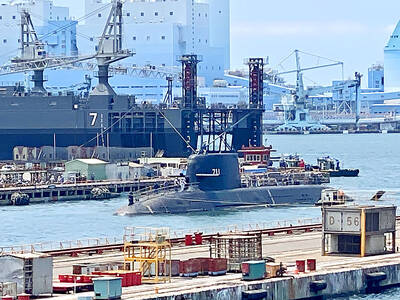
AGING: While Japan has 22 submarines, Taiwan only operates four, two of which were commissioned by the US in 1945 and 1946, and transferred to Taiwan in 1973 Taiwan would need at least 12 submarines to reach modern fleet capabilities, CSBC Corp, Taiwan chairman Chen Cheng-hung (陳政宏) said in an interview broadcast on Friday, citing a US assessment. CSBC is testing the nation’s first indigenous defense submarine, the Hai Kun (海鯤, Narwhal), which is scheduled to be delivered to the navy next month or in July. The Hai Kun has completed torpedo-firing tests and is scheduled to undergo overnight sea trials, Chen said on an SET TV military affairs program. Taiwan would require at least 12 submarines to establish a modern submarine force after assessing the nation’s operational environment and defense
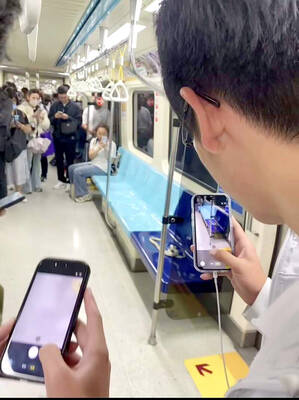
A white king snake that frightened passengers and caused a stir on a Taipei MRT train on Friday evening has been claimed by its owner, who would be fined, Taipei Rapid Transit Corp (TRTC) said yesterday. A person on Threads posted that he thought he was lucky to find an empty row of seats on Friday after boarding a train on the Bannan (Blue) Line, only to spot a white snake with black stripes after sitting down. Startled, he jumped up, he wrote, describing the encounter as “terrifying.” “Taipei’s rat control plan: Release snakes on the metro,” one person wrote in reply, referring
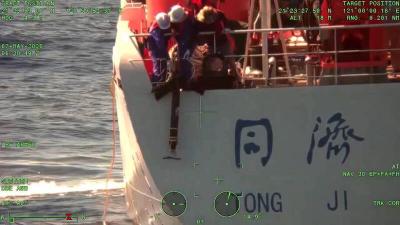
The coast guard today said that it had disrupted "illegal" operations by a Chinese research ship in waters close to the nation and driven it away, part of what Taipei sees a provocative pattern of China's stepped up maritime activities. The coast guard said that it on Thursday last week detected the Chinese ship Tongji (同濟號), which was commissioned only last year, 29 nautical miles (54km) southeast of the southern tip of Taiwan, although just outside restricted waters. The ship was observed lowering ropes into the water, suspected to be the deployment of scientific instruments for "illegal" survey operations, and the coast
Taiwan’s two cases of hantavirus so far this year are on par with previous years’ case numbers, and the government is coordinating rat extermination work, so there should not be any outbreaks, Centers for Disease Control (CDC) Director-General Philip Lo (羅一鈞) said today in an interview with the Liberty Times (the Taipei Times’ sister newspaper). An increase in rat sightings in Taipei and New Taipei City has raised concerns about the spread of hantavirus, as rats can carry the disease. In January, a man in his 70s who lived in Taipei’s Daan District (大安) tested positive posthumously for hantavirus, Taiwan’s


 RSS
RSS