


An amendment to the standards used in the environmental impact assessment (EIA) of a development project drew a mixed reaction at a public hearing yesterday, with environmental activists saying that the amendment has been designed to solve controversial cases.
The amendment being proposed by the Environmental Protection Administration (EPA) would allow developers to build roads, residential communities, hotels, recreational parks or factories that could cause pollution in water catchment areas near reservoirs.
Chinese Nationalist Party (KMT) Legislator Su Ching-chuan (蘇清泉), officials from the Greater Tainan Government and representatives from the gravel industry all supported the amendment, saying that the catchment areas near reservoirs are too big. It would hurt the economy if no development in this massive area is allowed, they said.
However, environmental activists strongly opposed the amendment.
Wu Li-huei (吳麗慧), a representative of the Taiwan Water Resources Protection Union (TWRPU), asked whether the amendment was meant to offer an easy way out for several controversial development cases, such as the Miramar Resort Hotel (美麗灣渡假村) project.
TWRPU director Jennifer Nien (粘麗玉) said the amendment would open the way for development projects to take place in the high mountains, on farm land, wet lands, national parks and wildlife protection zones without the scrutiny of an EIA committee.
Currently, the nation has 96 reservoirs with more than 100,000 hectares of catchment area. For years, local governments and legislators from Greater Tainan, Yunlin and Chiayi have tried to persuade the EPA to relax the regulations on the use of such land.
Because of the pressure, the EPA decided to hold a public hearing to listen to the opinions of different parties.
Should the amendment be passed, any construction project involving a development area of less than 500m2 or accumulative area of less 2,500m2 would be able to proceed without having to conduct an environmental impact assessment.
Environmental groups opposed to the amendment said it would damage the water quality in the nation’s reservoirs.
Aside from the changes to the regulations in reservoir catchment areas, the amendment would also relax urban renewal regulations for old communities.
While some supported that amendment, they said that the lack of an EIA review would generate more disputes of the rights to properties.
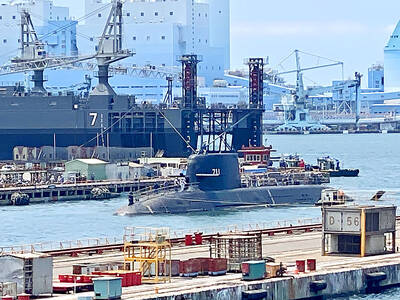
AGING: While Japan has 22 submarines, Taiwan only operates four, two of which were commissioned by the US in 1945 and 1946, and transferred to Taiwan in 1973 Taiwan would need at least 12 submarines to reach modern fleet capabilities, CSBC Corp, Taiwan chairman Chen Cheng-hung (陳政宏) said in an interview broadcast on Friday, citing a US assessment. CSBC is testing the nation’s first indigenous defense submarine, the Hai Kun (海鯤, Narwhal), which is scheduled to be delivered to the navy next month or in July. The Hai Kun has completed torpedo-firing tests and is scheduled to undergo overnight sea trials, Chen said on an SET TV military affairs program. Taiwan would require at least 12 submarines to establish a modern submarine force after assessing the nation’s operational environment and defense

A white king snake that frightened passengers and caused a stir on a Taipei MRT train on Friday evening has been claimed by its owner, who would be fined, Taipei Rapid Transit Corp (TRTC) said yesterday. A person on Threads posted that he thought he was lucky to find an empty row of seats on Friday after boarding a train on the Bannan (Blue) Line, only to spot a white snake with black stripes after sitting down. Startled, he jumped up, he wrote, describing the encounter as “terrifying.” “Taipei’s rat control plan: Release snakes on the metro,” one person wrote in reply, referring
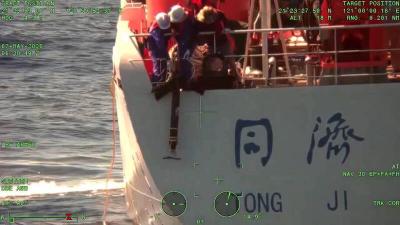
The coast guard today said that it had disrupted "illegal" operations by a Chinese research ship in waters close to the nation and driven it away, part of what Taipei sees a provocative pattern of China's stepped up maritime activities. The coast guard said that it on Thursday last week detected the Chinese ship Tongji (同濟號), which was commissioned only last year, 29 nautical miles (54km) southeast of the southern tip of Taiwan, although just outside restricted waters. The ship was observed lowering ropes into the water, suspected to be the deployment of scientific instruments for "illegal" survey operations, and the coast
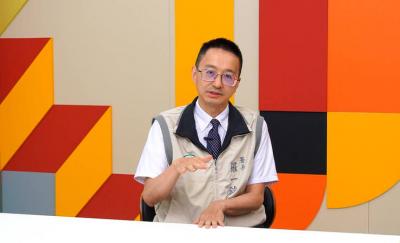
Taiwan’s two cases of hantavirus so far this year are on par with previous years’ case numbers, and the government is coordinating rat extermination work, so there should not be any outbreaks, Centers for Disease Control (CDC) Director-General Philip Lo (羅一鈞) said today in an interview with the Liberty Times (the Taipei Times’ sister newspaper). An increase in rat sightings in Taipei and New Taipei City has raised concerns about the spread of hantavirus, as rats can carry the disease. In January, a man in his 70s who lived in Taipei’s Daan District (大安) tested positive posthumously for hantavirus, Taiwan’s


 RSS
RSS