


A conservation group in Pingtung County is calling on the public to send them seashells to save homeless hermit crabs, which are facing a life-threatening situation because of people’s habit of collecting seashells that the crabs use for protection.
Houwan Preservation Association director Yang Mei-yun (楊美雲) recently initiated a “send shells to me” project on the Internet, calling on the public to send the association leftover shells from seafood restaurants.
Yang said the association would clean up the shells and distribute them on the seashore at Houwan (後灣) in Checheng Township (車城) to provide homes for hermit crabs.
Hermit crabs lack a carapace, so they scavenge empty shells and repeatedly change shells as they grow, to protect their vulnerable bodies, the association said.
However, the decline in the number of abandoned shells is threatening the existence of hermit crabs at Houwan, a recent study showed.
About 95 percent of the crabs in Houwan live in the discarded shells of giant African land snails, but these are unsuitable for the crabs because the shells are light and fragile.
The crabs also often face the risk of being stepped on, Yang said.
Many have been seen using unexpected items in place of shells, such as cans and even plastic bottle caps, she said.
Yang added that since hermit crabs are also popular pets for children, many people illegally trap them and sell them at night markets in central and northern Taiwan.
A study by Kaohsiung Medical University professor Chiu Yuh-wen (邱郁文) found that among the 400 butcher land hermit crabs, 1,500 viola hermit crabs and 60 indos land hermit crabs they recorded between May and July this year, only 1 percent of them were living in suitable shells.
July and August are the peak breeding period for hermit crabs on the Hengchun Peninsula, when many of them emerge from seaside bushes at night to lay their eggs on the foreshore, Chiu said.
Crabs living in plastic bottle caps are vulnerable to attack by ants, he said, adding that whelks, horned turban shells and egg cowry shells are considered suitable homes for the crabs.
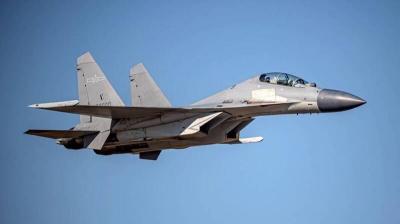
Eight Chinese naval vessels and 24 military aircraft were detected crossing the median line of the Taiwan Strait between 6am yesterday and 6am today, the Ministry of National Defense said this morning. The aircraft entered Taiwan’s northern, central, southwestern and eastern air defense identification zones, the ministry said. The armed forces responded with mission aircraft, naval vessels and shore-based missile systems to closely monitor the situation, it added. Eight naval vessels, one official ship and 36 aircraft sorties were spotted in total, the ministry said.
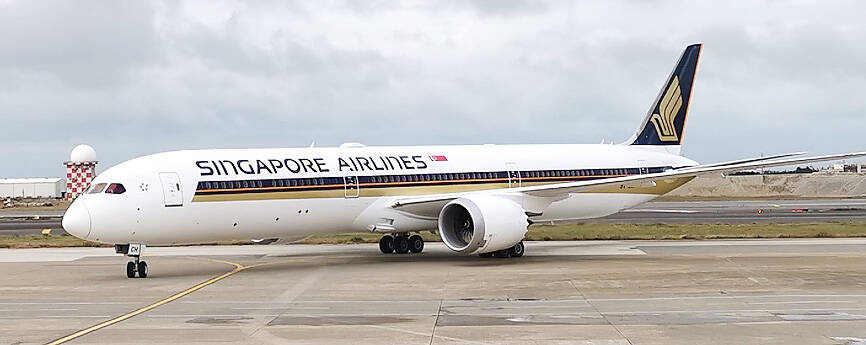
INCREASED CAPACITY: The flights on Mondays, Wednesdays, Fridays and Sundays would leave Singapore in the morning and Taipei in the afternoon Singapore Airlines is adding four supplementary flights to Taipei per week until May to meet increased tourist and business travel demand, the carrier said on Friday. The addition would raise the number of weekly flights it operates to Taipei to 18, Singapore Airlines Taiwan general manager Timothy Ouyang (歐陽漢源) said. The airline has recorded a steady rise in tourist and business travel to and from Taipei, and aims to provide more flexible travel arrangements for passengers, said Ouyang, who assumed the post in July last year. From now until Saturday next week, four additional flights would depart from Singapore on Monday, Wednesday, Friday
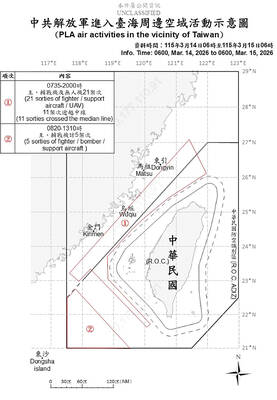
The Ministry of National Defense yesterday reported the return of large-scale Chinese air force activities after their unexplained absence for more than two weeks, which had prompted speculation regarding Beijing’s motives. China usually sends fighter jets, drones and other military aircraft around the nation on a daily basis. Interruptions to such routine are generally caused by bad weather. The Ministry of National Defense said it had detected 26 Chinese military aircraft in the Taiwan Strait over the previous 24 hours. It last reported that many aircraft on Feb. 25, when it spotted 30 aircraft, saying Beijing was carrying out another “joint combat
The Ministry of Foreign Affairs (MOFA) today said that if South Korea does not reply appropriately to its request to correct Taiwan’s name on its e-Arrival card system before March 31, it would take corresponding measures to alter how South Korea is labeled on the online Taiwan Arrival Card system. South Korea’s e-Arrival card system lists Taiwan as “China (Taiwan)” in the “point of departure” and “next destination” fields. The ministry said that it changed the nationality for South Koreans on Taiwan’s Alien Resident Certificates from “Korea” to “South Korea” on March 1, in a gesture of goodwill and based on the


 RSS
RSS