


Taiwan is being bullied by China and the US should do something about it, a US congressional committee was told on Wednesday.
“We need to help Taiwan avoid being coerced into making unfair concessions to mainland China,” said Patrick Cronin, the senior director of the Asia program at the Center for a New American Security.
Cronin, who had just returned from a visit to Taiwan, said it was being “squeezed” by China “more and more every day.”
Addressing a US House of Representatives Armed Services Committee hearing on “Rebalancing to the Asia-Pacific Region and Implications for US National Security,” Cronin said that Washington needed to accelerate an official review of the US-Japan defense guidelines.
“We need a common strategic approach to countering Chinese coercive diplomacy in the short term and countering Chinese anti-access aerial-denial capabilities in the long run,” he said.
US allies in Asia have been concerned that as China has become stronger, it has also become more assertive, said Michael Auslin, director of Japanese studies at the American Enterprise Institute.
“They’re concerned about their particular sets of territorial disputes and other issues in which they feel that there is little chance for each of them alone to resolve these on terms that would be most favorable to them,” Auslin said.
Over the past several years, there has been an increasing tendency for friends and allies in Asia to look to the US for backup and support, he said.
“In part, they do this because the administration has stated that it is rebalancing, it is re-engaging, it is back in Asia,” Auslin said.
“And yet, when we come down to the specifics that concern them and interest them, the US often takes a pass,” he said.
Auslin said that both Japan and the Philippines felt frustration at the lack of US support over territorial issues with China in the South and East China Seas.
While there was no fear of a major conflict breaking out soon, Auslin said that Asian nations feared that the environment in which they operated today — “the environment they know and understand” — was “slowly slipping away.”
“That is where the influence of the United States is most important — in stressing that we will not passively sit by while the security environment degrades for the worse and then raise the significant questions about stability, insecurity and the potential for conflict,” Auslin said.
“The administration needs to more clearly articulate the rationale behind the rebalance and its goals,” he said.
Admiral Gary Roughead, the former commander of the US Pacific fleet, said the US approach in rebalancing “must be strategic and not superficial.”
The admiral asked the committee to consider whether China was intending ultimately to become not only assertive, but aggressive.
“I think we should actually be very worried and should ask ourselves the question why is everyone who can afford it in the region buying more weapons?” Roughead said.

Actor Darren Wang (王大陸) was sentenced to six months in prison, commutable to a fine, by the New Taipei District Court today for contravening the Personal Data Protection Act (個人資料保護法) in a case linked to an alleged draft-dodging scheme. Wang allegedly paid NT$3.6 million (US$114,380) to an illegal group to help him evade mandatory military service through falsified medical documents, prosecutors said. He transferred the funds to Chen Chih-ming (陳志明), the alleged mastermind of a draft-evasion ring, although he lost contact with him as he was already in detention on fraud charges, they said. Chen is accused of helping a

SECURITY: Starlink owner Elon Musk has taken pro-Beijing positions, and allowing pro-China companies to control Taiwan’s critical infrastructure is risky, a legislator said Starlink was reluctant to offer services in Taiwan because of the nation’s extremely high penetration rates in 4G and 5G services, the Ministry of Digital Affairs said yesterday. The ministry made the comments at a meeting of the legislature’s Transportation Committee, which reviewed amendments to Article 36 of the Telecommunications Management Act (電信管理法). Article 36 bans foreigners from holding more than 49 percent of shares in public telecommunications networks, while shares foreigners directly and indirectly hold are also capped at 60 percent of the total, unless specified otherwise by law. The amendments, sponsored by Chinese Nationalist Party (KMT) Legislator Ko

The eastern extension of the Taipei MRT Red Line could begin operations as early as late June, the Taipei Department of Rapid Transit Systems said yesterday. Taipei Rapid Transit Corp said it is considering offering one month of free rides on the new section to mark its opening. Construction progress on the 1.4km extension, which is to run from the current terminal Xiangshan Station to a new eastern terminal, Guangci/Fengtian Temple Station, was 90.6 percent complete by the end of last month, the department said in a report to the Taipei City Council's Transportation Committee. While construction began in October 2016 with an
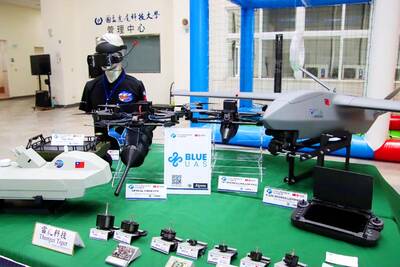
NON-RED SUPPLY: Boosting the nation’s drone industry is becoming increasingly urgent as China’s UAV dominance could become an issue in a crisis, an analyst said Taiwan’s drone exports to Europe grew 41.7-fold from 2024 to last year, with demand from Ukraine’s fight against Russian aggression the most likely driver of growth, a study showed. The Institute for Democracy, Society and Emerging Technology (DSET) in a statement on Wednesday said it found that many of Taiwan’s uncrewed aerial vehicle (UAV) sales were from Poland and the Czech Republic. These countries likely transferred the drones to Ukraine to aid it in its fight against the Russian invasion that started in 2022, it said. Despite the gains, Taiwan is not the dominant drone exporter to these markets, ranking second and fourth


 RSS
RSS