


Former Guatemalan president Alfonso Portillo, who has pleaded not guilty to embezzling state funds including US$2.5 million given by Taiwan, is due to appear in a New York court next week.
His lawyers are likely to argue that he should be released on bail, but although it could take months before his actual trial gets underway, it is unlikely that he will be released on bail.
Portillo, 61, was extradited from Guatemala to the US last week because he is alleged to have laundered embezzled money through US banks.
The Taiwanese cash is only part of a much bigger case involving tens of millions of US dollars prosecutors say he stole from the Guatemalan Treasury.
Portillo appeared for the first time before US District Judge Robert Patterson on Tuesday, and entered a not-guilty plea.
“After three years of fighting his extradition, Alfonso Portillo has finally arrived in the United States to answer for his alleged misappropriation of millions of dollars intended for the benefit of the people of Guatemala and which he laundered through US banks,” US Attorney Preet Bharara said.
Portillo served as president of Guatemala from January 2000 to January 2004.
According to a statement issued by the US Department of Justice, Portillo may have started his alleged “criminality and corruption” with the money given by Taiwan.
“First, in 2000 and 2002, Portillo embezzled approximately 2.5 million dollars US provided by the Government of Taiwan’s embassy in Guatemala,” the statement said.
“In 2000, the Taiwanese embassy issued three checks totaling 1.5 million dollars US, drawn upon a New York bank account created for the purpose of funding a Guatemalan program designed to purchase books for school libraries,” it said.
Prosecutors maintain that Portillo endorsed the checks and then deposited them in a Miami bank.
None of the money was spent on the Libraries for Peace program and prosecutors say most of it was diverted to accounts held in the name of Portillo’s daughter and his ex-wife in Paris.
When the corruption allegations first surfaced eight years ago, Taiwanese officials said that some of the money was meant to print teacher’s manuals and that several copies of the manuals had been delivered to the embassy “as proof” that the money had been properly used.
The embassy said that checks had been made out to Portillo personally at the request of the Guatemalan government.
When Guatemalan officials began their probe, Portillo fled to Mexico but was later acquitted of embezzlement charges by a court in Guatemala.
Since then he had been fighting extradition to the US.
“Portillo has been charged with converting the office of the Guatemalan presidency into his personal ATM,” Bharara said.
Aside from the Taiwanese money, Portillo is alleged to have taken about US$4 million from the Guatemalan Ministry of Defense and huge sums of government money from one of the country’s national banks.
If convicted, he could face a prison term of up to 20 years and a fine of about US$500,000.

Yangmingshan National Park authorities yesterday urged visitors to respect public spaces and obey the law after a couple was caught on a camera livestream having sex at the park’s Qingtiangang (擎天崗) earlier in the day. The Shilin Police Precinct in Taipei said it has identified a suspect and his vehicle registration number, and would summon him for questioning. The case would be handled in accordance with public indecency charges, it added. The couple entered the park at about 11pm on Thursday and began fooling around by 1am yesterday, the police said, adding that the two were unaware of the park’s all-day live
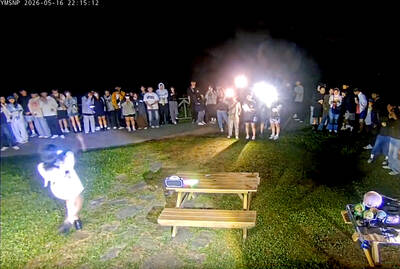
Yangmingshan National Park’s Qingtiangang (擎天崗) nature area has gone viral after a park livestream camera observed a couple in the throes of intimate congress, which was broadcast live on YouTube, drawing large late-night crowds and sparking a backlash over noise, bright lights and disruption to wildlife habitat. The area’s livestream footage appeared to show a couple engaging in sexual activity on a picnic table in the park on Friday last week, with the uncensored footage streamed publicly online. The footage quickly spread across social media, prompting a tide of visitors to travel to the site to “check in” and recreate the

A former soldier and an active-duty army officer were yesterday indicted for allegedly selling classified military training materials to a Chinese intelligence operative for a total of NT$79,440. The Taipei District Prosecutors’ Office indicted Chen Tai-yin (陳泰尹) and Lee Chun-ta (李俊達) for contravening the National Security Act (國家安全法) and the Anti-Corruption Act (貪污治罪條例). Chen left the military in September 2013 after serving alongside then-staff sergeant Lee, now an army lieutenant, at the 21st Artillery Command of the army’s Sixth Corps from 2011 to 2013, according to the indictment. Chen met a Chinese intelligence operative identified as “Wang” (王) through a friend in November

Minister of Digital Affairs Lin Yi-ching (林宜敬) yesterday cited regulatory issues and national security concerns as an expert said that Taiwan is among the few Asian regions without Starlink. Lin made the remarks on Facebook after funP Innovation Group chief executive officer Nathan Chiu (邱繼弘) on Friday said Taiwan and four other countries in Asia — China, North Korea, Afghanistan and Syria — have no access to Starlink. Starlink has become available in 166 countries worldwide, including Ukraine, Malaysia, the Philippines and Vietnam, in the six years since it became commercial, he said. While China and North Korea block Starlink, Syria is not


 RSS
RSS