


The public should avoid using hot-and-cold-water dispensers, to save electricity and improve the quality of drinking water, Democratic Progressive Party Legislator Tien Chiu-chin (田秋堇) and environmentalists said yesterday.
Holding a report by the National Science Council on the results of its National Science and Technology Program on Energy, Tien said the report showed that there are about 5.48 million water dispensers in use nationwide, consuming about 3.147 billion kilowatt hours (kWh) of electricity each year.
The number is equal to about 6.79 percent of the residential and commercial sectors’ total annual electricity consumption and is also equal to about one-third of the electricity supplied annually by a nuclear reactor, she added.
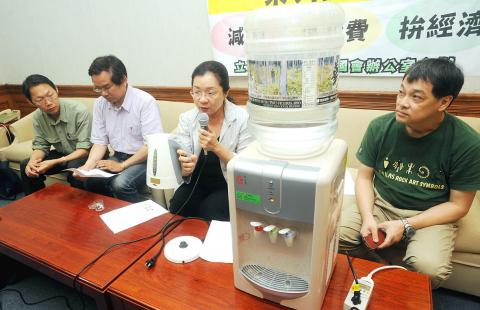
Photo: Lin Cheng-kung, Taipei Times
Green Consumers’ Foundation chairman Jay Fang (方儉) said water dispensers consume a lot of electricity because they have to continuously provide both boiling hot and cold water, and according to the foundations experiment, a water dispenser consumes about 1.6 kWh of electricity per day.
In contrast, electric kettles use a large amount of electricity only for the few minutes while they heat the water, but can keep the water warm for a long period of time without consuming electricity. This is safer and saves energy by only using about 0.09 kWh to boil a liter of water, Fang said.
“In addition, water that is repeatedly boiled in water dispensers may cause the accumulation of harmful substances, such as heavy metals,” he said.
Fang added that it is difficult to clean a water dispenser’s pipes and water container, so the water quality may be worse than the quality of water from kettles, which can be washed easily after use.
“Most Taiwanese are taught the importance of increasing income and reducing expenditure as they grow up. However, the government is stubbornly trying to only increase the supply of electricity, which will never meet the fast-growing demand if reducing power consumption is not considered,” Nuclear-Free Homeland Alliance executive director Lee Cho-han (李卓翰) said.
Green Party Taiwan member Pan Han-shen (潘翰聲) said when Germany evaluated the scenario of supplying 100 percent of its electricity needs from renewable sources by 2050, it assumed a reduction in final energy consumption of 58 percent in the household, industrial, trade, commerce and services sectors.
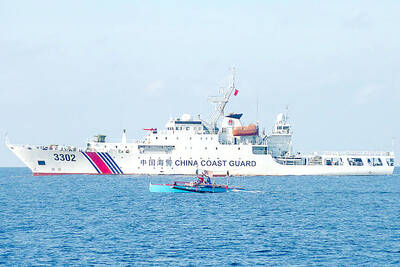
EXPANSIONIST: China deploys an average of 40 to 50 warships and coast guard vessels daily in the South China Sea, despite pledges not to militarize the region, an official said China is attempting to expand its influence across the First Island Chain and increase pressure on Japan by sending coast guard vessels into waters off of Taiwan under the pretext of maritime negotiations with Japan and the Philippines, a national security official said yesterday. China’s recent actions in the waters east of Taiwan and Japan and the Philippines’ exclusive economic zones (EEZ) are attempts to establish dominance in First Island Chain waters, said the official who declined to be named, adding that this is “expansion disguised as law enforcement.” Framing China’s actions solely as a cross-strait issue is a serious misjudgment that
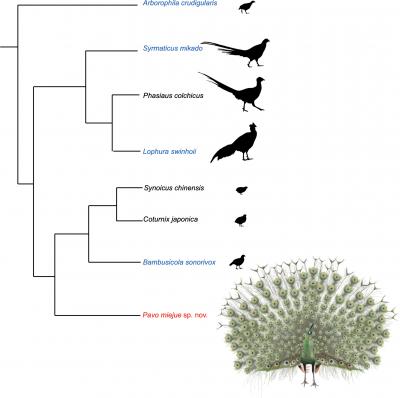
Through analyzing fossil evidence, a research team at National Taiwan University (NTU) discovered the largest endemic bird to have lived in Taiwan, naming it Pavo miejue, or extinct peafowl (滅絕孔雀). The Mikado pheasant, which is printed on the back of the NT$1,000 bank note, was previously believed to be the biggest endemic bird to Taiwan. The research team’s findings suggest that Pavo miejue lived during the Pleistocene epoch tens of thousands of years ago. It is the first endemic extinct bird species discovered and formally named in Taiwan. The study was coauthored by NTU Institute of Ecology and Evolutionary Biology professor Tsai Cheng-hsiu (蔡政修),
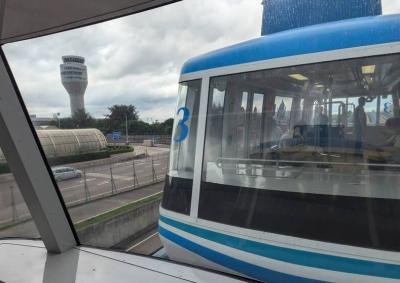
Taiwan Taoyuan International Airport is to suspend its automated Skytrain service connecting Terminal 1 and Terminal 2 starting on July 1 to facilitate connection works for the upcoming Terminal 3, the airport operator said today. Passengers and staff who need to travel between the two terminals after the suspension can instead use the Taoyuan MRT or the airport's 24-hour shuttle bus service, Taoyuan International Airport Corp said. The Taoyuan MRT Airport Line directly links the two terminals, while the shuttle buses are to operate around the clock, the company added. The Skytrain provides free transportation between the airport’s two terminals for travelers and
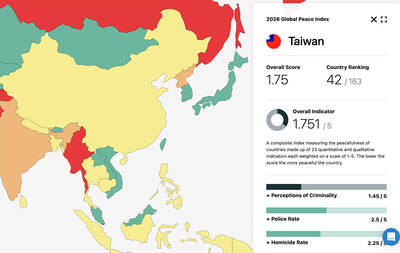
Taiwan ranked 42nd in terms of peacefulness among 163 countries, down five places from last year, according to this year’s Global Peace Index. With an overall score of 1.751, Taiwan dropped from 37th last year, the report published by the global Institute for Economics and Peace showed. The overall score measures a country’s level of peacefulness using 23 quantitative and qualitative indicators across three domains — ongoing domestic and international conflict, societal safety and security, and militarization. While Taiwan ranked 42nd worldwide, it was listed in ninth place among the 19 Asian-Pacific countries in the report, after New Zealand, Singapore, Japan, Malaysia,


 RSS
RSS