


Following an anti-nuclear power parade by thousands of protesters on Sunday and a 24-hour hunger strike by four activists in front of the legislature in Taipei overnight, demonstrations continued last night against the proposal by Chinese Nationalist Party (KMT) lawmakers to hold a national referendum to decide the fate of the Fourth Nuclear Power Plant in New Taipei City’s (新北市) Gongliao District (貢寮).
About 100 protesters, mainly middle-aged and elderly people, walked to the Legislative Yuan after Sunday’s event ended on Ketagalan Boulevard at about 8pm.
The four activists who held the hunger strike were former Taiwan Environmental Protection Union (TEPU) chairperson — and the parade’s commander-in-chief — Kao Cheng-yan (高成炎), 908 Taiwan Republic Campaign member Peter Wang (王獻極), National Taiwan University associate professor Chen Yung-chang (陳永昌) and former Environmental Protection Agency minister Chang Kuo-long (張國龍).
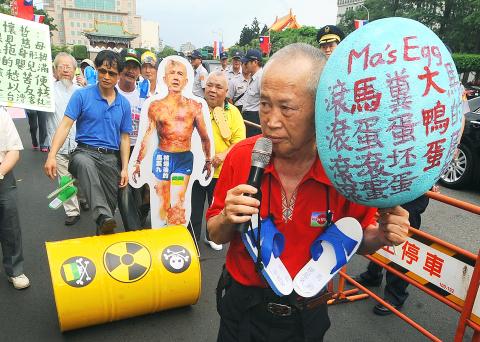
Photo: Liao Chen-hui, Taipei Times
TEPU deputy secretary-general Lee Hsiu-jung (李秀容) said they were protesting because legislators had approved the government-backed proposal to determine the fate of the plant by holding a national referendum, which is scheduled to be referred for a second reading as soon as Monday.
TEPU founding chairperson and veteran anti-nuclear activist Shih Hsin-min (施信民) said the group had held a hunger strike at the same location in 1992, when they protested plans to unfreeze the budget for the construction of the plant.
“Until this day, the victims who living near the Chernobyl nuclear disaster site still can not return to their homes. If a nuclear disaster happened in Taiwan, we would have to leave our homes forever, and the health of our generation and our children may also be affected,” said Hsinchu Environmental Protection Association chairperson Chung Shu-chi (鍾淑姬), who also participated in the 1992 protest.
“We have no [US] green card. Where can we escape to?” she said.
“Taiwan is so small that people would have no where to go if a nuclear disaster did occur, and evacuation would also be a problem. Just look at the heavy traffic congestion on national holidays,” she said.
The group said it plans to continue its protest for an indeterminate period, but at least until Sunday.

Considering that most countries issue more than five denominations of banknotes, the central bank has decided to redesign all five denominations, the bank said as it prepares for the first major overhaul of the banknotes in more than 24 years. Central bank Governor Yang Chin-lung (楊金龍) is expected to report to the Legislative Yuan today on the bank’s operations and the redesign’s progress. The bank in a report sent to the legislature ahead of today’s meeting said it had commissioned a survey on the public’s preferences. Survey results showed that NT$100 and NT$1,000 banknotes are the most commonly used, while NT$200 and NT$2,000
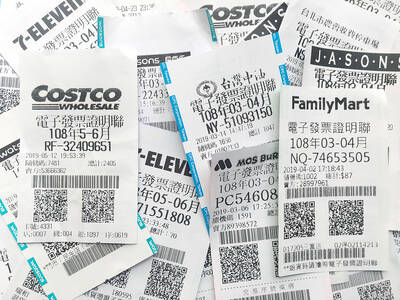
A NT$39 receipt for two bottles of tea at a FamilyMart was among the NT$10 million (US $312,969) special prize winners in the January-February uniform invoice lottery. FamilyMart said that two NT$10 million-winning receipts were issued at its stores, as well as two NT$2 million grand prizes and three NT$200,000 first prizes. The two NT$10 million receipts were issued at stores in Pingtung County and Yilan County’s Dongshan Township (冬山). One winner spent just NT$39 on two bottles of tea, while another spent NT$80 on water, tea and coffee, the company said. Meanwhile, 7-Eleven reported three NT$10 million winners — in New Taipei

The Centers for Disease Control (CDC) yesterday reported the first case of a new COVID-19 subvariant — BA.3.2 — in a 10-year-old Singaporean girl who had a fever upon arrival in Taiwan and tested positive for the disease. The girl left Taiwan on March 20 and the case did not have a direct impact on the local community, it said. The WHO added the BA.3.2 strain to its list of Variants Under Monitoring in December last year, but this was the first imported case of the COVID-19 variant in Taiwan, CDC Deputy Director-General Lin Ming-cheng (林明誠) said. The girl arrived in Taiwan on

ANNUAL EVENT: Two massive Pokemon balloons are to be set up in Daan Park, with an event zone operating from 10am to 6pm This year’s Taipei Floral Picnic is to be held at Daan Park today and tomorrow, featuring an exclusive Pokemon Go event, a themed food market, a coffee rave picnic area and stage performances, the Taipei Department of Information and Tourism said yesterday. Two massive Pokemon balloons are to be set up in the park as attractions, with an exclusive event zone operating from 10am to 6pm, it said. Participants who complete designated tasks on-site would have a chance to receive limited-edition souvenirs, it added. People could also try the newly launched game Pokemon Pokopia in the trial area, the department said. Three PokeStops are


 RSS
RSS